What to Collect for Vendor Insurance in Wedding Planning
What to Collect for Vendor Insurance in Wedding Planning
When you collect vendor insurance wedding documentation, the minimum is a Certificate of Insurance (COI) showing policy type, coverage limits, effective and expiration dates, and the insurer’s name. If the venue requires it, you also need the Additional Insured endorsement page attached. The planner typically owns this task whenever they hire or manage vendors on a client’s behalf, and the industry standard is to request COIs at booking with a firm deadline 2 to 4 weeks before the event.
That lead time matters more than most planners realize. It gives you room to catch errors, request a reissue, and still hit your final walkthrough with clean paperwork. Here’s the short version of what lands in your onboarding file for every vendor who touches setup, service, or teardown:
- Certificate of Insurance with policy type, limits, and dates
- Additional Insured endorsement page (when the venue requires it)
- Insurer name and agent contact information
- Confirmation the named insured matches the signed contract
A platform like Thespecialwedding centralizes these requests so nothing gets buried in an inbox thread three weeks before the ceremony.
Key Takeaways
Collecting vendor insurance for weddings works best as a fixed onboarding step with a 2 to 4 week deadline, a five-minute verification routine, and a single tracking system, rather than a reactive scramble before each event.
| Point | Details |
|---|---|
| Set the deadline early | Request COIs at booking and require delivery 2 to 4 weeks before the event. |
| Verify five key fields | Check named insured, coverage limits, dates, Additional Insured status, and agent contact every time. |
| Prioritize high-risk vendors | Caterers, bartenders, bands, and rental companies need the closest scrutiny. |
| Fix issues fast | Send reissue requests with exact venue wording attached to speed up agent turnaround. |
| Centralize tracking | Platforms like TheSpecialWedding.io consolidate COI uploads, status tags, and reminders in one dashboard. |
Table of Contents
- Checklist: What to Collect From Every Wedding Vendor
- When to Request COIs and Who Owns Each Step
- The 5-Minute COI Review Every Planner Should Run
- How to Store, Track, and Verify COIs Across Multiple Events
- Contract Clauses and COI Request Language That Get Results
- Fixing the Most Common COI Problems
- What Actually Matters in Vendor Insurance Collection
- How TheSpecialWedding.io Simplifies COI Collection
- Selected External Resources for COI Verification
- Sources
Checklist: What to Collect From Every Wedding Vendor
Not every vendor carries the same risk, so not every vendor needs the same scrutiny. Caterers, bartenders, bands, rental companies, and transportation providers create the most meaningful liability exposure at a wedding, and they belong at the top of your collection priority list.
For each vendor in that tier, here’s the full documentation set to request during onboarding:
- COI showing policy types — general liability at minimum, workers’ compensation if the vendor brings staff onsite, liquor liability for anyone serving alcohol, and commercial auto for transportation vendors.
- Coverage limits — a common baseline is general liability coverage of at least one million dollars per occurrence and coverage aggregated over the policy term, though venue contracts sometimes set higher minimums.
- Insurer name and policy dates that explicitly span setup, event day, and teardown, not just the ceremony window.
- Additional Insured status with the endorsements page attached, not just a checkbox claim on the COI itself.
- Named insured accuracy matching the legal business name on the signed contract, plus the certificate holder and agent contact listed correctly.
- Supplementary documents as needed: business license, W-9 if the venue requires it, and proof of bonded status for vendors handling high-value items.
Pro Tip: Build this checklist directly into your vendor onboarding template so it’s the same six items every time, regardless of vendor category. Consistency here is what makes audits fast instead of frantic.
When to Request COIs and Who Owns Each Step
Request the COI the moment a vendor signs, not the week before the wedding. Waiting invites gaps, and gaps show up during your busiest planning window when you have the least time to fix them.
Set the due date at booking and put it in writing:
- Request the COI within 48 hours of signing the vendor contract.
- Set a hard deadline 2 to 4 weeks before the event, giving room for a reissue if something’s wrong.
- Document in the contract whether the planner or the host/venue owns collection, so there’s no ambiguity mid-season.
- Build an escalation path: a reminder at the deadline, a follow-up call within 3 business days, and a final verification pass during your pre-event walkthrough.
Align these deadlines with your production schedule for vendors so insurance dates match actual setup and breakdown windows, not just the ceremony time block. A vendor arriving at 6 AM to build a dance floor needs coverage that starts before their truck does.
The 5-Minute COI Review Every Planner Should Run
You don’t need an insurance background to catch the mistakes that cause problems on wedding day. You need a routine you run the same way every time.
- Confirm the named insured matches the contract. A COI issued to a DBA that doesn’t match your signed agreement is a red flag, not a technicality.
- Verify policy types and limits against venue minimums. If the venue requires general liability coverage meeting their minimums and the COI shows less, that’s an immediate reissue request.
- Check that effective and expiration dates cover setup and teardown, not just the reception hours. This is one of the most frequent and most overlooked oversights in event insurance, since vendors often assume ceremony-day coverage is enough.
- Confirm Additional Insured status and attach the endorsements page. A checked box with no endorsement page is not proof, it’s a promise.
- Log the insurer and agent contact. When something needs fixing, you want a direct line to the person who can reissue the certificate, not a vendor relay.
Common traps include expired dates, coverage limits below the venue’s stated requirement, and missing Additional Insured wording. Every one of them is fixable in a single email to the vendor’s agent, as long as you catch it during this review instead of during setup.
How to Store, Track, and Verify COIs Across Multiple Events
A single spreadsheet works until you’re running six weddings in one season and can’t remember which vendor’s COI is still pending. At that point, your storage system needs structure, not memory.

Use a consistent naming convention for every file: vendor name, event, date, and document type (for example, “Blue Door Band, Harrison Wedding, June 14, COI”). That alone eliminates the “which version is current” problem that costs planners hours every month.
Your onboarding workflow should run in five stages:
- Request the COI at booking.
- Upload it to a single source of truth, not a scattered mix of email attachments and desktop folders.
- Verify it against your checklist within 48 hours of receipt.
- Tag its status (pending, verified, needs reissue) so anyone on your team can check progress at a glance.
- Set a renewal reminder for vendors you book repeatedly, since annual policy renewals are a common source of lapses.
Pro Tip: If you’re still juggling spreadsheets and cloud folders for this, an integrated platform with vendor onboarding and status dashboards saves real hours per event once you’re past three or four weddings a month.
Contract Clauses and COI Request Language That Get Results
The fastest way to avoid back-and-forth with a vendor’s insurance agent is to tell them exactly what you need the first time. Vague requests produce vague certificates.
Build a short insurance clause into every vendor contract requiring the vendor to maintain active coverage and provide a COI on request, with reissue obligations spelled out. Then, when you actually request the certificate, include:
- Required coverage limits stated in dollar amounts, not just policy type
- The exact Additional Insured name and mailing address the venue requires
- Effective and expiration dates covering setup through teardown
- A note that endorsements must be attached, not just referenced
Attach the venue’s sample Additional Insured wording directly to your email to the vendor’s agent. This one step alone eliminates most reissue delays, since agents work from exact language rather than a vendor’s paraphrase. Include the due date and a note that you’ll follow up in one week if nothing arrives.
Fixing the Most Common COI Problems
Most COI issues fall into four categories, and each has a quick fix that doesn’t require escalating to the venue.
- Expired or gapped dates: Request a reissue with corrected effective and expiration dates covering the full event window, including setup.
- Limits below the venue minimum: Share the venue’s exact requirement and ask the agent for a higher limit or an umbrella policy rider.
- Wrong named insured or missing endorsements: Request a reissued certificate with the endorsements page attached, not just a corrected checkbox.
- Vendor can’t comply at all: Consider a substitute vendor, add stronger indemnity language to the contract, or escalate to the venue for a final decision.
Pro Tip: For vendors installing equipment before their policy’s effective date, ask for a rider covering pre-event installation. This edge case catches more planners off guard than any other coverage gap.
What Actually Matters in Vendor Insurance Collection
Most advice on this topic treats COI collection as paperwork. It’s not. It’s risk management dressed up as an admin task, and treating it as an afterthought is where planners get burned.
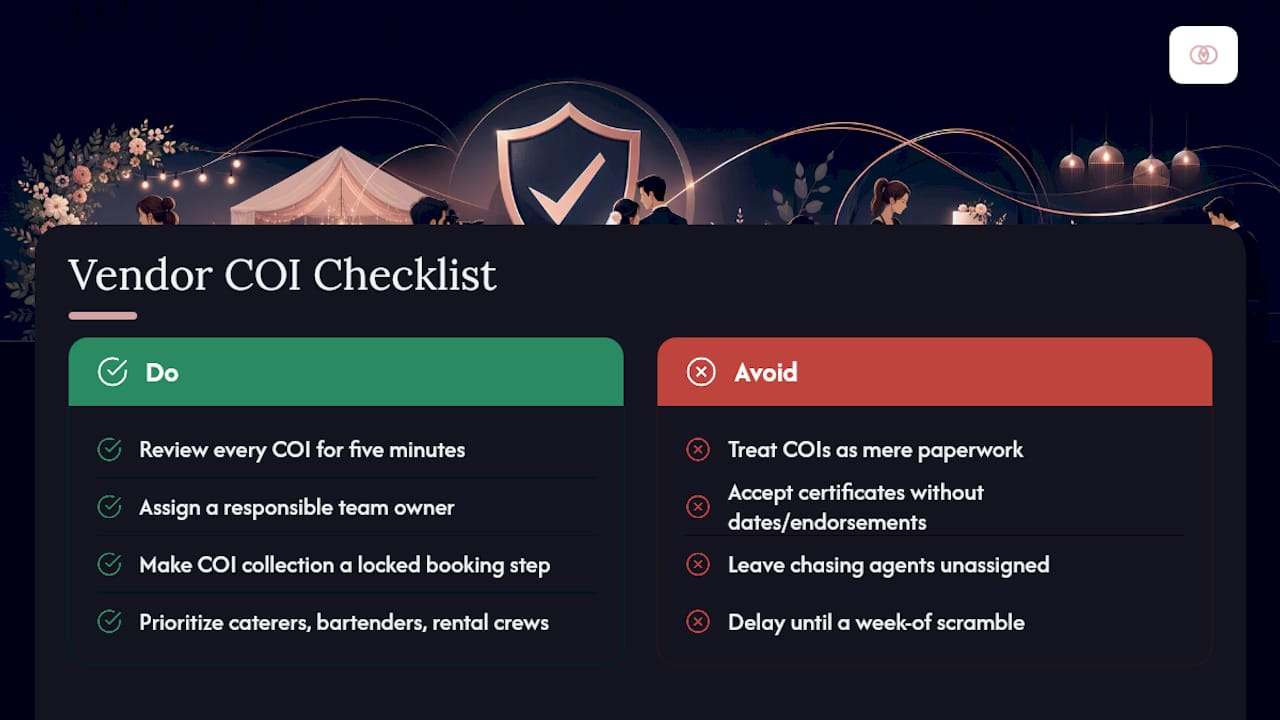
The conventional wisdom says “just ask for a certificate.” That’s incomplete. A certificate with the wrong dates or missing endorsements is functionally worthless, and plenty of planners don’t discover that until a claim is on the table. The real skill isn’t collecting COIs, it’s reviewing them with the same five-minute discipline every single time, regardless of how well you know the vendor or how many times you’ve booked them before.
Where most studios fall short is ownership clarity. When nobody on the team is explicitly responsible for chasing a slow vendor’s agent, the deadline slips quietly until it’s a week-of scramble. Prioritize building this into your booking pipeline as a locked step, not a follow-up task you get to when things slow down. The vendors who create real risk, caterers, bartenders, rental crews, deserve the tightest scrutiny. Everyone else can move faster through the process.
How TheSpecialWedding.io Simplifies COI Collection
Chasing certificates across email threads and shared drives is the exact busywork Thespecialwedding was built to eliminate. Instead of tracking vendor documents across scattered tools, you get one workspace where COI requests, uploads, and verification status live next to the rest of your vendor onboarding.
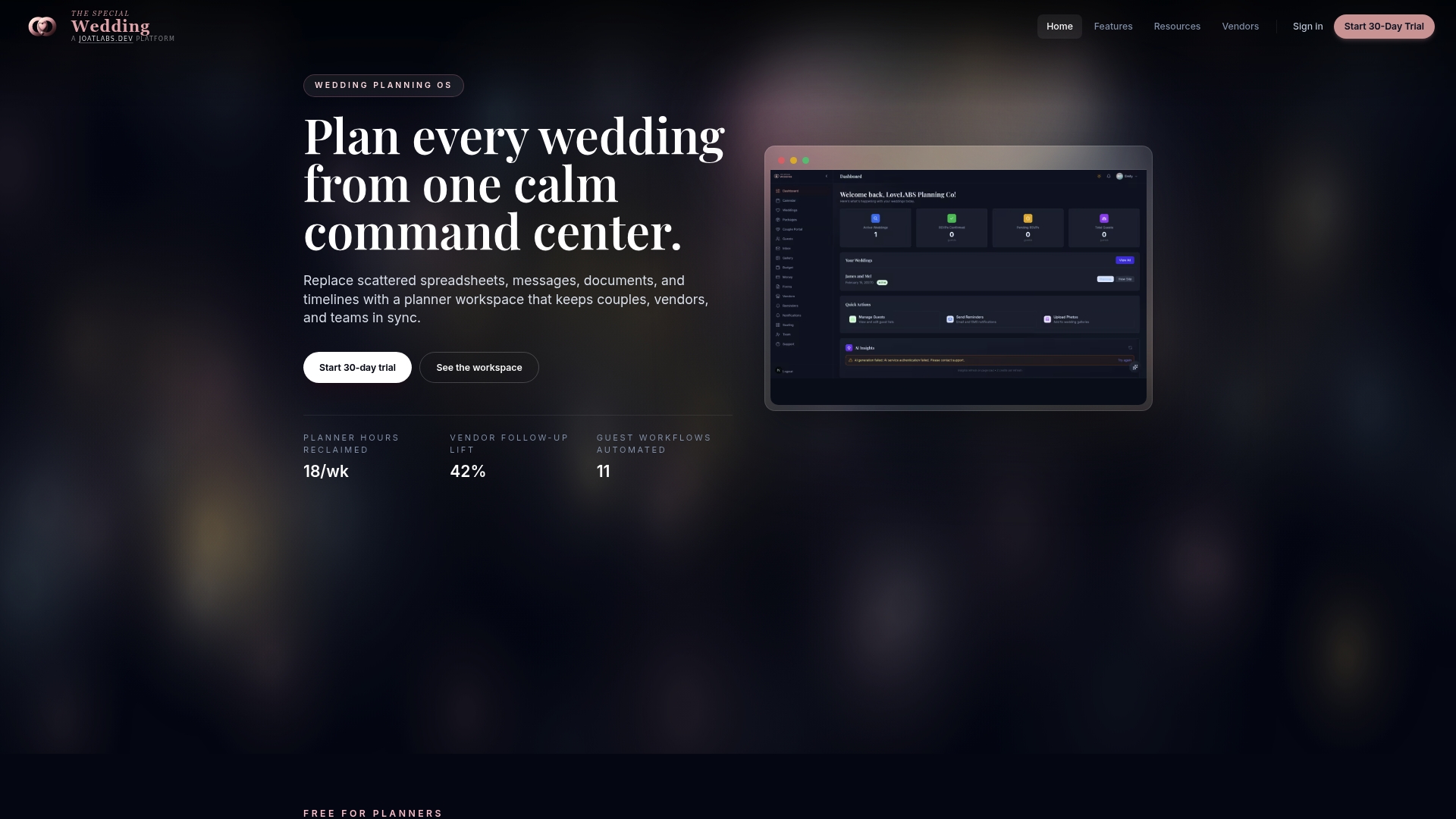
The platform lets you assign document ownership, set automatic reminders ahead of your 2 to 4 week deadline, and see a real-time dashboard of which vendors are verified and which still need a reissue. It’s built for planners running multiple weddings at once, where a manual tracking system breaks down fast. You can see how vendor listings work directly in the platform, like this event rental vendor profile showing how certificates attach to a vendor’s record.
If you’re managing more than a handful of events a season, start a free trial and set up your first vendor onboarding flow before your next booking.
Selected External Resources for COI Verification
For venue-specific wording and deeper coverage requirements, review the event planner vendor checklist for a documentation baseline, and the COI requirements breakdown for what venues typically expect and why certificates get rejected.
Sources
- Event Planner Vendor Checklist | Insurance Canopy
- Which Wedding Venue Vendors Should You Collect COIs From And Which Ones Might Get a Pass? • Nuptial
- What Is a COI? A Simple Guide for Event Planners and Vendors
- COIs for Event Planners: What Venues Require and Why
Recommended
Free wedding planner templates
Skip the blank page — these templates ship with the form fields you actually need.
Browse all 9 free templates →