Day-of Wedding Coordination Explained for Couples
Day-of Wedding Coordination Explained for Couples
Day-of wedding coordination is the professional service of managing all vendor logistics, timelines, and event-day execution in the final weeks leading up to and through your wedding. The industry term for this role is “day-of coordinator,” though many professionals now call it “month-of coordination” because the work begins 4 to 8 weeks before the event. That distinction matters. Couples who understand what this service actually covers make smarter hiring decisions and arrive at their wedding day ready to enjoy it. Pricing typically falls between $800 and $2,500 depending on location and service scope, making it one of the most cost-effective ways to protect months of planning work.
What is day-of wedding coordination explained in full?
Day-of coordination is not about planning your wedding. It is about executing the plan you already built. A wedding coordinator’s core role is to take over all logistical management so you never have to field a vendor call or chase a timeline on your wedding day.
The coordinator steps in during the final preparation phase, typically 4 to 8 weeks out. During that window, they review every vendor contract, confirm arrival times, and identify gaps before they become problems. This preparation phase is where most of the real value is built, not on the day itself.
On the wedding day, the coordinator becomes the single point of contact for every vendor, family member, and venue staff person. You answer to no one. The coordinator answers to everyone. That shift in responsibility is what many couples find most valuable about hiring this type of professional.

What are the main duties of a day-of wedding coordinator?
A day-of coordinator carries a wide range of responsibilities that span weeks, not hours. Understanding those duties helps you evaluate whether a candidate is offering real coordination or just a warm body on the day.
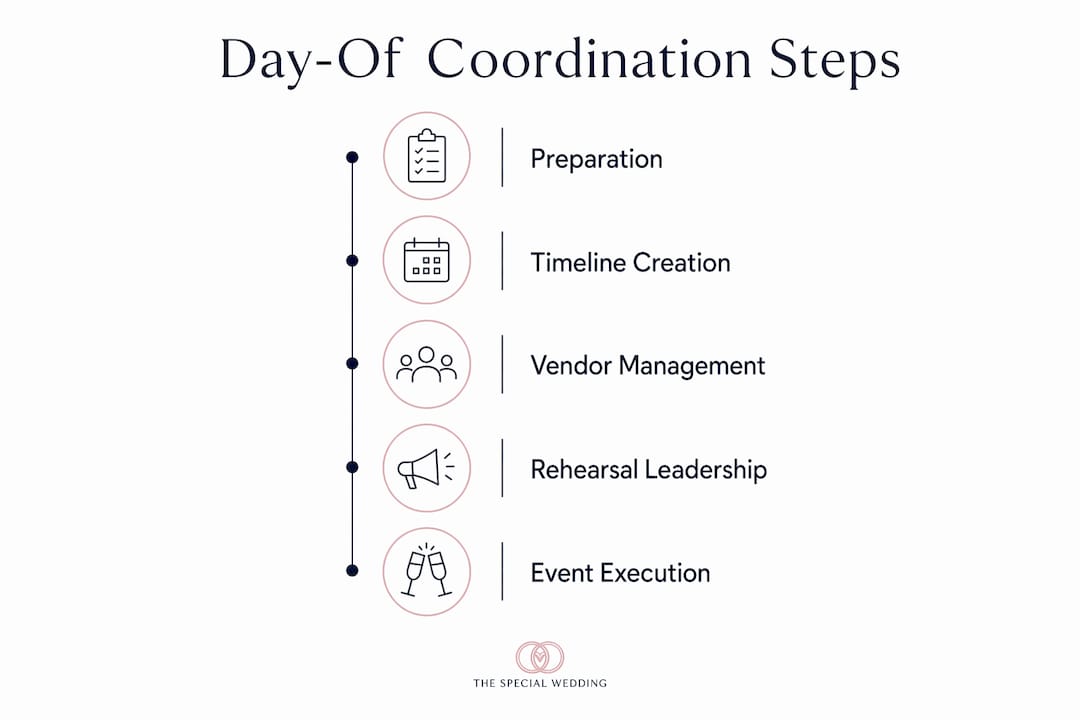
Before the wedding day:
- Reviewing all vendor contracts to catch overlooked clauses, overtime fees, and delivery conflicts
- Building the master wedding day timeline with vendor-specific arrival and activity times
- Distributing the finalized schedule to every vendor so everyone operates from the same document
- Leading the rehearsal and directing the wedding party through ceremony positions and cues
- Confirming all vendor bookings and final headcounts in the week before the event
On the wedding day:
- Directing vendor arrivals and overseeing room setup and transitions
- Managing the event schedule and adjusting timing when speeches run long or photos take extra time
- Solving problems quietly so you never know they happened
- Coordinating the final send-off and overseeing vendor breakdown
Pro Tip: Ask any coordinator candidate to show you a sample timeline they have built. A professional timeline lists every vendor by name, arrival time, and task. If a candidate cannot produce one, they are not offering true coordination.
Coordinators use a backward-and-forward timeline scheduling technique that starts from the ceremony time and builds outward in both directions. This method creates natural buffers and prevents the domino-effect delays that ruin reception flow.
How does day-of coordination compare to other wedding planning services?
The three main service tiers in the wedding industry are full-service planning, partial planning, and day-of coordination. Each serves a different couple profile and budget.
| Service type | When involvement starts | What they handle | Best for |
|---|---|---|---|
| Full-service planner | 12+ months before | Venue, vendors, design, budget, logistics | Couples with limited time or complex events |
| Partial planner | 6–9 months before | Specific tasks plus final execution | Couples who want guidance on select decisions |
| Day-of coordinator | 4–8 weeks before | Execution of existing plans only | Couples who planned themselves and want relief on the day |
The clearest distinction is timing and scope. Planners guide early decisions while coordinators manage final execution. A planner helps you choose your florist. A coordinator confirms your florist arrives at 10 a.m. with the right order.
Couples planning complex cultural ceremonies or managing difficult family dynamics often need a full planner from the start. Couples who enjoy the planning process but dread being the “stage manager” on their own wedding day are the ideal fit for coordination services.
Pro Tip: If a coordinator offers to “help with planning” during your initial call, ask exactly what that means in writing. Scope creep in this industry is common, and vague promises often lead to unmet expectations.
One misconception worth correcting: many couples assume a day-of coordinator simply shows up the morning of the wedding. That assumption leads to hiring someone underqualified. A true coordinator has already done weeks of preparation before they ever set foot at your venue.
What practical benefits do couples gain from hiring a coordinator?
The most direct benefit is stress removal. When you hand logistics to a coordinator, you stop being the person responsible for knowing where the caterer is or why the DJ has not arrived. That mental shift changes how you experience your own wedding.
Hiring a coordinator prevents costly mistakes like vendor miscommunication and overtime fees. Overtime charges from caterers, photographers, and venue staff can add hundreds of dollars to your final bill when a timeline slips. A coordinator holds the schedule tight and flags risks before they become charges.
- Your family stays in guest mode, not problem-solving mode
- Vendor disputes get resolved without your involvement
- Rental returns happen on time, avoiding damage fees
- The ceremony starts on schedule, which protects your reception timeline
- You are present in the moment instead of watching the clock
“Coordination is ideally suited for couples who enjoy planning but want to avoid being the stage manager on their own wedding day.” — Wedding Planner vs. Coordinator vs. Day-Of
The financial protection alone often justifies the cost. A single overtime fee from a venue or caterer can equal or exceed what you paid for coordination. The coordinator’s job is to make sure that never happens.
How to coordinate a wedding yourself and know when to bring in help
Self-coordinating a wedding is possible, and many couples do it well through the planning phase. The challenge arrives in the final four to six weeks, when the volume of vendor confirmations, timeline details, and logistics decisions becomes genuinely hard to manage alongside a full-time job and normal life.
Here is a practical framework for evaluating your situation:
- List every vendor you have booked. Count the number of separate arrival times, setup requirements, and confirmation calls you need to make in the final two weeks. If the list exceeds ten items, a coordinator saves you significant time and reduces error risk.
- Draft a rough wedding day timeline. Use a wedding timeline template as a starting point. If building it feels confusing or incomplete, that is a clear signal you need professional support.
- Identify your point of contact on the day. If your answer is “me” or “my mom,” reconsider. Assigning a family member to logistics pulls them out of the celebration and puts pressure on a relationship.
- Review your contracts for overtime clauses. If any vendor charges by the hour beyond a set window, you need someone watching the clock all day.
- Assess your rehearsal plan. If you have a wedding party of six or more people, managing the rehearsal without a coordinator is chaotic. Someone needs to direct traffic.
Pro Tip: Use a day-of coordination checklist to audit your own readiness. If more than a third of the items feel unclear or unassigned, bring in a professional.
The best time to hire a coordinator is no later than three months before your wedding. Waiting until the final two weeks limits what they can accomplish in the preparation phase, which is where most of their value is created.
Key takeaways
Day-of wedding coordination is the most cost-effective way for self-planning couples to protect their investment and fully enjoy their wedding day without managing logistics themselves.
| Point | Details |
|---|---|
| Coordination starts weeks early | A true coordinator begins work 4–8 weeks before the wedding, not on the day itself. |
| Execution, not planning | Coordinators manage your existing plans; they do not replace a full planner’s role. |
| Financial protection | Coordinators prevent overtime fees and vendor miscommunication that add real costs. |
| Ideal couple profile | Best fit for couples who planned themselves but want someone else running the day. |
| Hire early | Book your coordinator no later than three months before the wedding for full benefit. |
Why most couples underestimate what coordination actually is
The phrase “day-of coordinator” is genuinely misleading, and I think it has caused more hiring mistakes than any other term in the wedding industry. Couples read “day-of” and picture someone showing up at 9 a.m. with a clipboard. What they actually need is someone who has spent weeks learning their wedding inside and out.
Every time I have seen a wedding day go sideways, the root cause was almost always a preparation gap, not a day-of failure. A vendor who was never confirmed. A timeline that was never distributed. A rehearsal that never happened. None of those problems occur on the wedding day. They occur in the weeks before it, when no one was paying close enough attention.
The couples who get the most from coordination are the ones who treat it as a handoff, not a hire. They spend the final weeks briefing their coordinator thoroughly, sharing every contract, every vendor contact, and every preference. The coordinator then owns the execution completely. That handoff requires trust, and trust requires choosing someone whose process you have actually reviewed, not just whose personality you liked in a consultation call.
My honest advice: ask every coordinator candidate to walk you through what they do in weeks five, four, three, two, and one before your wedding. If they cannot answer that question in specific terms, they are not offering real coordination. The day itself is the easy part. The preparation is the work.
— JOATLABS
Find the right coordinator for your wedding day
Planning your own wedding takes real effort, and the final stretch deserves professional support.

Thespecialwedding’s vendor directory connects you directly with qualified day-of coordinators, event specialists, and wedding professionals who have been vetted for quality and reliability. You can browse by service type, read profiles, and reach out to discuss your specific needs. Whether your wedding is six months away or six weeks away, finding the right coordinator through a trusted platform removes the guesswork from one of the most important hiring decisions you will make.
FAQ
What does a day-of wedding coordinator actually do?
A day-of coordinator manages vendor arrivals, enforces the wedding timeline, leads the rehearsal, and solves problems on the event day. Their preparation work begins 4 to 8 weeks before the wedding with contract reviews and timeline building.
How much does day-of wedding coordination cost?
Day-of coordination typically costs between $800 and $2,500 depending on location, service scope, and the coordinator’s experience level.
What is the difference between a wedding planner and a day-of coordinator?
A wedding planner guides decisions from the start of the planning process, while a coordinator focuses on executing the plans you have already made. Planners are involved for 12 or more months; coordinators step in during the final 4 to 8 weeks.
Can I coordinate my own wedding without hiring anyone?
Self-coordination works well through the planning phase, but the final weeks involve a high volume of vendor confirmations, timeline management, and logistics that are difficult to handle alone. Most couples benefit from professional coordination support starting no later than three months before the wedding.
When should I hire a day-of wedding coordinator?
Book your coordinator at least three months before your wedding. Starting earlier gives them time to review contracts thoroughly and build a complete timeline before the final confirmation window opens.
Recommended
Free wedding planner templates
Skip the blank page — these templates ship with the form fields you actually need.
Browse all 9 free templates →