Event Planner Costs: A Practical Guide for Pros
Event Planner Costs: A Practical Guide for Pros
Most professional wedding and event planners underestimate their true operating costs by 20–30% because they track vendor spend carefully but leave their own overhead unallocated. The fix is straightforward: calculate your hourly overhead rate first, then attach it to every event you quote. Before you run that number, gather three things: your total annual fixed costs, your productive billable hours for the year, and your monthly software subscription spend. Everything else in this guide builds on those three inputs.
Key Takeaways
The most reliable way to protect margins as a professional planner is to calculate a defensible hourly overhead rate, attach it to every event, and run your business from a single platform that captures hours and billing automatically.
| Point | Details |
|---|---|
| Calculate hourly overhead first | Divide annual fixed costs by productive billable hours; a sample calculation yields $60/hr on $36,000 fixed costs and 1,200 billable hours. |
| Run a per-event worksheet | Multiply hourly overhead by event staff hours, add variable costs and a 10–15% contingency, then confirm contribution margin before quoting. |
| Budget software as fixed cost | Software subscriptions generally carry monthly fees in the low to mid hundreds, depending on chosen tools; evaluate each tool by hours saved times your hourly rate to confirm payback. |
| Benchmark by business scale | Solo planners, small studios, and agencies carry different fixed cost bases and break-even event volumes; model yours against the three profile scenarios. |
| Thespecialwedding consolidates the stack | The platform replaces fragmented tools with one workspace for intake, vendor CRM, timelines, budgets, and reporting, reducing admin overhead directly. |
Table of Contents
- What counts as operating costs for event planners?
- How to calculate your hourly overhead rate
- How to turn hourly overhead into a per-event cost
- How much should you budget for software subscriptions?
- Benchmark scenarios for solo planners, studios, and agencies
- Is a software subscription worth it? A decision checklist
- Monthly P&L and per-event worksheet fields
- What actually moves the needle on planner profitability
- Thespecialwedding replaces your scattered tools and captures overhead accurately
- Sources
What counts as operating costs for event planners?
Understanding your full cost picture means separating fixed costs from variable costs, then hunting down the hidden ones that quietly erode margins.
Fixed costs stay constant regardless of how many events you run:
- Office rent or co-working membership
- Base salaries and owner’s draw
- Business insurance (general liability, professional liability, workers’ comp)
- Software subscriptions (planning platforms, CRM, accounting tools)
- Equipment and technology (laptops, printers, phones)
- Marketing and advertising spend
- Professional development and licensing fees
Variable costs scale with each event:
- Per-event staffing and day-of coordinators
- Catering coordination fees and vendor deposits
- Travel, mileage, and accommodation for destination events
- Printing, signage, and event-specific supplies
- Subcontractor fees for design or AV support
The costs planners most often miss are the ones that don’t show up on a single invoice. According to hidden cost research, common margin-killers include rounding and time-capture loss, overtime, payment processing fees, travel overages, and the drag of manual billing. A survey found that a notable share of event companies use multiple project-management tools simultaneously, each carrying its own subscription fee and data-entry burden.
Quick audit checklist: Pull your last 12 months of bank and credit card statements. Flag every recurring charge. Then add a “hidden cost” column for time lost to manual processes, unbilled overages, and tool-switching. That column is usually the most revealing.
How to calculate your hourly overhead rate
The hours-based allocation method produces the most accurate hourly overhead rate for service businesses. Divide your total annual fixed costs by your productive, billable hours for the year. The result is the dollar amount of overhead you must recover on every hour you bill.
Step-by-step:
- Add up all annual fixed costs (rent, salaries, insurance, software, marketing).
- Count your productive, billable hours for the year (see the Pro Tip below).
- Divide: Annual Fixed Costs ÷ Productive Billable Hours = Hourly Overhead Rate.
| Input | Sample Value |
|---|---|
| Annual fixed costs | $36,000 |
| Productive billable hours/year | 1,200 |
| Hourly overhead rate | $60/hr |
This $60 figure is not your profit. It is the floor you must clear before you make a dollar on any event.
Pro Tip: Track your actual time for 30–90 days before setting your billable-hour baseline. Exclude marketing, admin, professional development, and unbilled client calls. Planners who overestimate billable hours systematically underprice their services and shrink margins without knowing why. A time management guide for planners can help you build a defensible baseline.
How to turn hourly overhead into a per-event cost
The formula is direct: Per-Event Overhead = Hourly Overhead Rate × Estimated Total Staff Hours for the Event.
Add variable costs on top to reach your total per-event cost, then subtract from the client fee to see your contribution margin.
- Estimate total staff hours for the event (planning, coordination, day-of).
- Multiply by your hourly overhead rate.
- Add all variable costs (venue deposits, catering coordination, travel, subcontractors).
- Add a contingency buffer, typically 10–15% of variable costs.
- Subtract the sum from your client fee to confirm positive contribution margin.
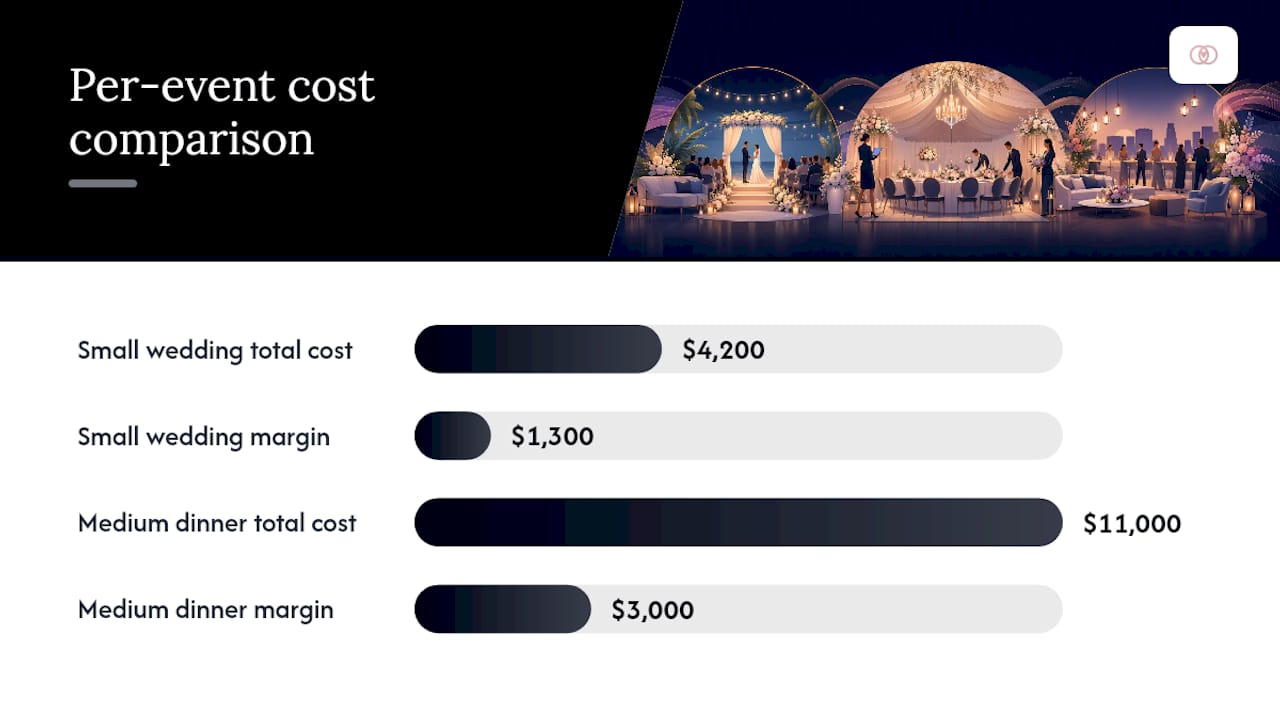
Example A: Small wedding, 50 guests Staff hours: 40 hrs × $60/hr overhead = $2,400 overhead allocation. Variable costs: $1,800. Total cost basis: $4,200. If the client fee is $5,500, contribution margin is $1,300.
Example B: Medium corporate dinner, 250 guests Staff hours: 80 hrs × $60/hr overhead = $4,800 overhead allocation. Variable costs: $6,200. Total cost basis: $11,000. At a $14,000 client fee, contribution margin is $3,000.
The EVM Institute’s break-even framework reinforces this structure: separating fixed from variable costs and tracking contribution margin per event is what tells you how many events you need to run to cover your fixed base. Venue, catering, and AV are pass-through variable costs and should never be folded into your overhead rate. Mixing them inflates your apparent overhead and distorts your pricing. For design-heavy events, pricing event design projects correctly means including explicit out-of-scope fees for on-site changes and conceptual work, which are easy to underquote when you’re working from a flat estimate.
How much should you budget for software subscriptions?
Treat software as a fixed cost and evaluate it the same way you’d evaluate a staff hire: what does it save, and does the saving exceed the cost?
Software subscriptions for planners commonly run $100–$400 per month depending on features and capacity. Mid-tier event management platforms, per Capterra pricing data, tend to cluster in the $195–$495/month band, with per-event and usage-based models available for lower-volume operators.
| Feature | Cost it reduces | How to estimate payback |
|---|---|---|
| Time tracking | Billable-hour leakage | Hours recaptured × hourly rate |
| Billing automation | Manual invoicing labor | Hours saved/month × hourly rate |
| Vendor CRM | Follow-up and rescheduling time | Calls avoided × hourly rate |
| Client portals | Email back-and-forth | Hrs saved/event × events/year |
| Reporting dashboards | Month-end reconciliation time | Hours saved × hourly rate |
The 25% of event companies running four or more project-management tools simultaneously are paying subscription fees on each one and absorbing the hidden cost of switching between them. Consolidating to one platform reclaims admin hours and closes the billing gaps that cause payroll leakage.
Thespecialwedding replaces that fragmented stack with a single workspace covering intake, vendor onboarding, timelines, guest management, budget tracking, and reporting. For planners managing multiple weddings simultaneously, that consolidation directly reduces the overhead hours in your rate calculation.
Pro Tip: Per-event pricing models can be cheaper at very low event volumes. Once you exceed roughly 10–12 events per year, a subscription plan almost always delivers better per-event economics. Run the math at your current volume before committing to either model.
Benchmark scenarios for solo planners, studios, and agencies
Overhead as a percentage of revenue tends to drop as you scale, but only if variable costs are managed tightly. Here are three illustrative profiles based on typical U.S. planner cost structures.
Per-event overhead in dollars should be calculated for each event using the hourly overhead rate method described above, reflecting the actual staff hours and rate per event, not a preset range.
Break-even event volume depends on your average contribution margin per event. A solo planner with $36,000 in fixed costs and a $1,200 average contribution margin per event needs 30 events to break even. A small studio with $120,000 in fixed costs and a $2,500 average margin needs 48 events. Running service tier analysis alongside these numbers helps you see which package types carry the healthiest margins.
Seasonality compresses this math. If 70% of your events run May through October, your fixed costs accumulate year-round while revenue concentrates in six months. Build that into your hourly overhead rate by using annual fixed costs, not just peak-season costs, in the denominator.
Is a software subscription worth it? A decision checklist
A vendor earns its place in your budget if it measurably reduces admin hours or prevents recurring hidden costs. Use this checklist before signing anything.
Decision criteria:
- Does it handle your current event volume with room to grow?
- Does it integrate with your accounting software (QuickBooks, Xero)?
- What is the onboarding cost in time and money?
- Does it produce reports you can use for P&L and tax prep?
- Is client data encrypted and backed up?
- Is pricing per seat, per event, or flat monthly?
Questions to ask in a demo:
- How does data migration work, and what format do you accept?
- What user permission levels are available for team members vs. clients?
- What is your support SLA for critical issues during an event?
- Are there add-on fees for additional storage, integrations, or users?
Red flags to watch for:
- Annual-only contracts with no monthly exit option
- Per-event fees that spike at higher volumes
- No API or CSV export (your data is locked in)
- Vague onboarding timelines (“we’ll get you set up soon”)
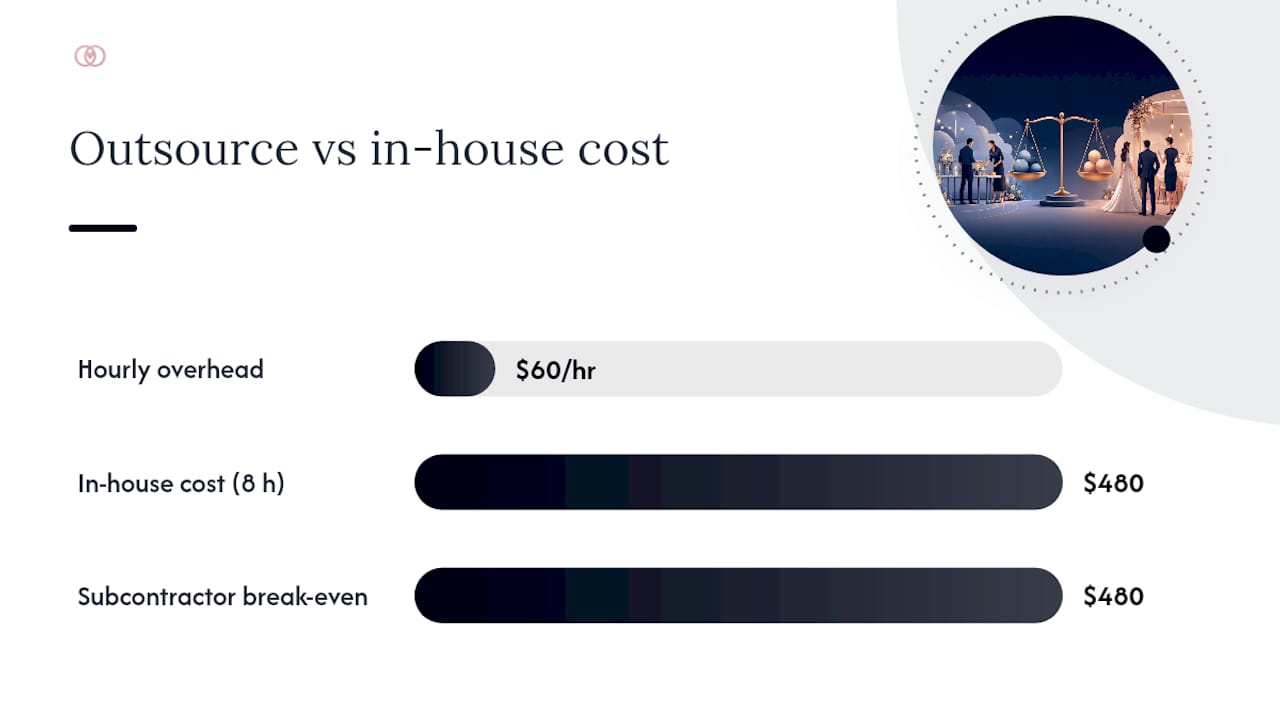
On the outsource-vs-in-house question: outsourcing a capability (catering coordination, decor sourcing) makes financial sense when the subcontractor’s fee is lower than your hourly overhead rate times the hours you’d spend doing it yourself. If your overhead rate is $60/hr and a task takes 8 hours, any subcontractor fee under $480 is a net positive. Above that, keeping it in-house is cheaper, assuming you have the capacity.
Monthly P&L and per-event worksheet fields
Tracking the right fields monthly keeps your overhead rate accurate and your margins visible. Maintaining two separate budgets is the standard approach: one for agency operating costs, one for each event. Conflating them is the most common financial mistake planners make.
Monthly P&L fields to track:
| Field | Notes |
|---|---|
| Total revenue | All client fees collected this month |
| Fixed costs | Rent, salaries, insurance, software, marketing |
| Variable costs | Per-event staffing, travel, subcontractors |
| Software subscriptions | Line-itemed separately from other fixed costs |
| Payroll taxes | Federal + state employer share |
| Business insurance | Pro-rated monthly from annual premium |
| Net operating income | Revenue minus all costs above |
Per-event cost worksheet:
Copy those fields into a spreadsheet or import them into your accounting system. Run this worksheet for every event before you quote, not after.
What actually moves the needle on planner profitability
The planners who improve margins fastest share three habits: they capture hours obsessively, they run their business from a single source of truth, and they write tighter scopes of work.
Hours capture is where most improvement starts. Planners who track time for 90 days consistently find their billable hours are 15–25% lower than estimated, which means their overhead rate was too low and every event was underpriced. Fixing the rate fixes the pricing.
Single-source-of-truth software matters because fragmented tools create billing gaps. When intake, vendor communication, timelines, and invoicing live in separate apps, tasks fall through the cracks and unbilled hours accumulate. Consolidating onto one platform, as Thespecialwedding supports, closes those gaps without adding headcount.
Tighter scopes of work reduce the on-site change problem. Out-of-scope requests during an event are almost never billed because planners don’t have a mechanism to capture and invoice them in the moment. Building an explicit out-of-scope fee structure into every contract, as outlined in value-based pricing guidance, recovers revenue that currently disappears.
Thespecialwedding replaces your scattered tools and captures overhead accurately
Running your business from a spreadsheet means your overhead rate is always slightly wrong, your vendor follow-ups are always slightly late, and your P&L is always slightly behind. Thespecialwedding fixes all three at once.
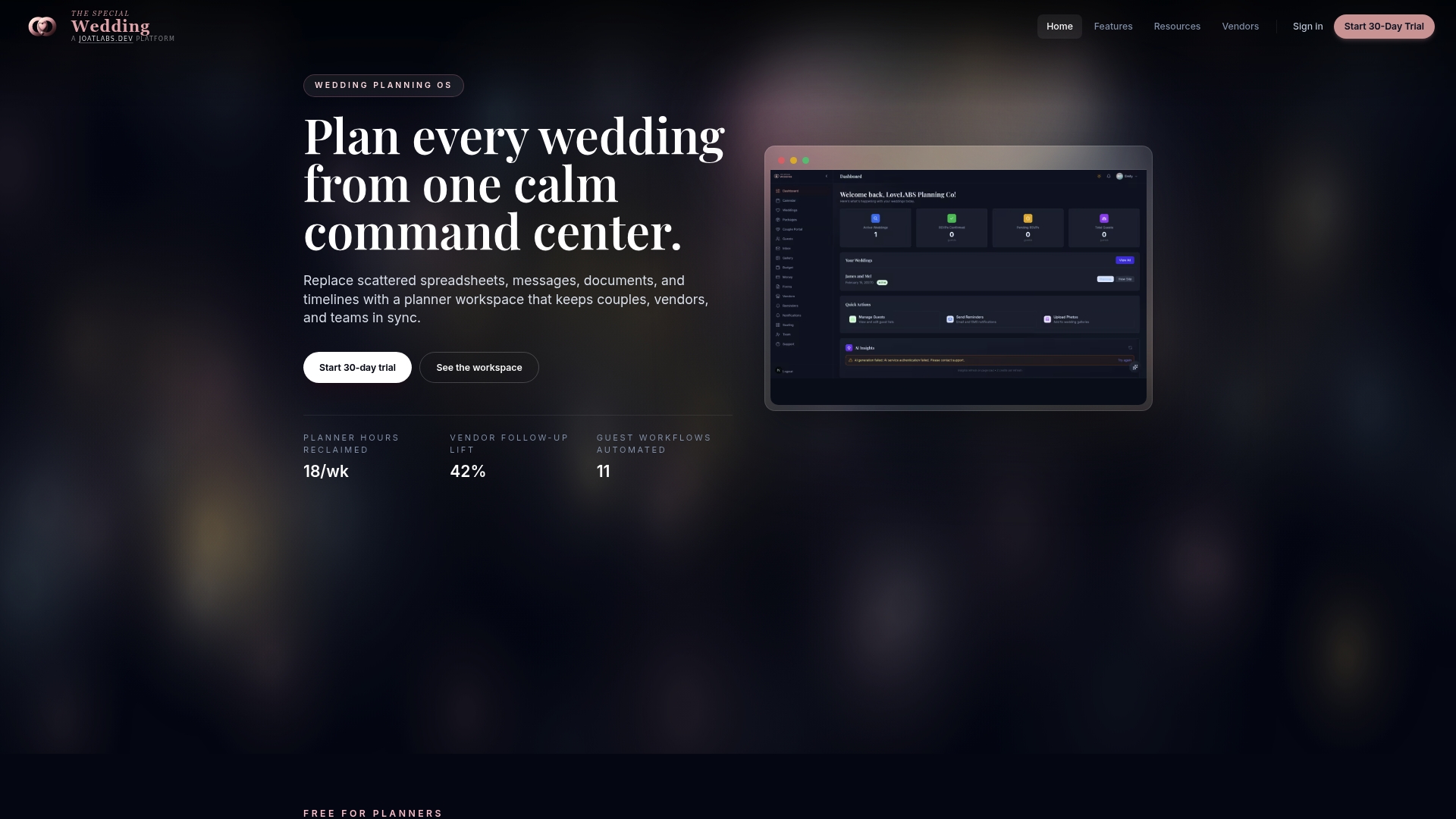
The platform consolidates client intake, vendor onboarding, timelines, guest management, budget tracking, and reporting into one workspace. That means your overhead hours drop, your billing gaps close, and your per-event worksheet reflects reality instead of estimates. Whether you’re a solo planner running 15 weddings a year or a studio managing 40+, the platform scales with your event volume and team size. Start a 30-day free trial at Thespecialwedding and bring your P&L and one sample event worksheet to your onboarding call so the setup maps directly to your numbers.
Sources
- PricingLink
- Calculating the Break-even Point for Event Companies • Event Management (EVM) Institute
- 15 Hidden Costs in Event Companies
- Wedding Planner: Detailed Startup Budget (2026) – BusinessDojo
- Event Management Software Pricing: Models, Add-Ons, and How to Evaluate
- Event Planning Budget Example | Stackrows
- How to price an event design project without underquoting concept work, vendor coordination, and on-site changes • Roadbase Blog
Recommended
Free wedding planner templates
Skip the blank page — these templates ship with the form fields you actually need.
Browse all 9 free templates →