Guest Communication in Weddings: A Planner's Guide
Guest Communication in Weddings: A Planner’s Guide
Guest communication in weddings is defined as the proactive, structured exchange of information between hosts and guests that shapes the entire event experience. The role of guest communication in weddings goes far beyond sending invitations. It sets expectations, reduces anxiety, and creates the conditions for genuine connection. Couples and planners who treat communication as hospitality, not logistics, consistently produce events where guests feel cared for rather than processed. This guide covers the strategies, timing, content, and interactive elements that make guest communication work from the first save-the-date through the final thank-you note.
How does guest communication enhance engagement and satisfaction at weddings?
Clear guest communication directly increases satisfaction. Proactive communication raises guest satisfaction scores by 23%, and the mechanism is straightforward. When guests know what to expect, they stop worrying and start enjoying.
Weddings are long events. Guests typically spend four hours at a reception. That is a long time to feel uncertain about where to sit, when dinner starts, or whether they know anyone at their table. Well-timed information removes that uncertainty before it becomes anxiety. The result is a guest who is relaxed, present, and far more likely to engage with other people in the room.

Interactive elements amplify this effect. Couples who allocate 12–18% of budgets to interactive entertainment see an 81% increase in positive guest feedback and 47% less phone use during events. Less phone use is a meaningful signal. It means guests are engaged with the room, not retreating into their screens.
The social psychology here is simple. People mingle more freely when they feel oriented. A guest who received clear pre-event information about the venue layout, the cocktail hour location, and the reception schedule arrives confident. A guest who received nothing arrives scanning for cues and often defaults to staying close to the people they already know.
- Pre-event communication reduces arrival anxiety and shortens the time guests need to “settle in.”
- Day-of updates (shuttle times, ceremony start, dinner service) keep guests synchronized with the event flow.
- Interactive prompts (advice cards, photo activities) give guests a natural reason to talk to strangers.
Pro Tip: Schedule interactive engagement during the cocktail hour, not the reception. Guests are still in social mode, drinks are flowing, and the lower-stakes environment makes participation feel natural rather than obligatory.
What are effective communication strategies and timing for weddings?
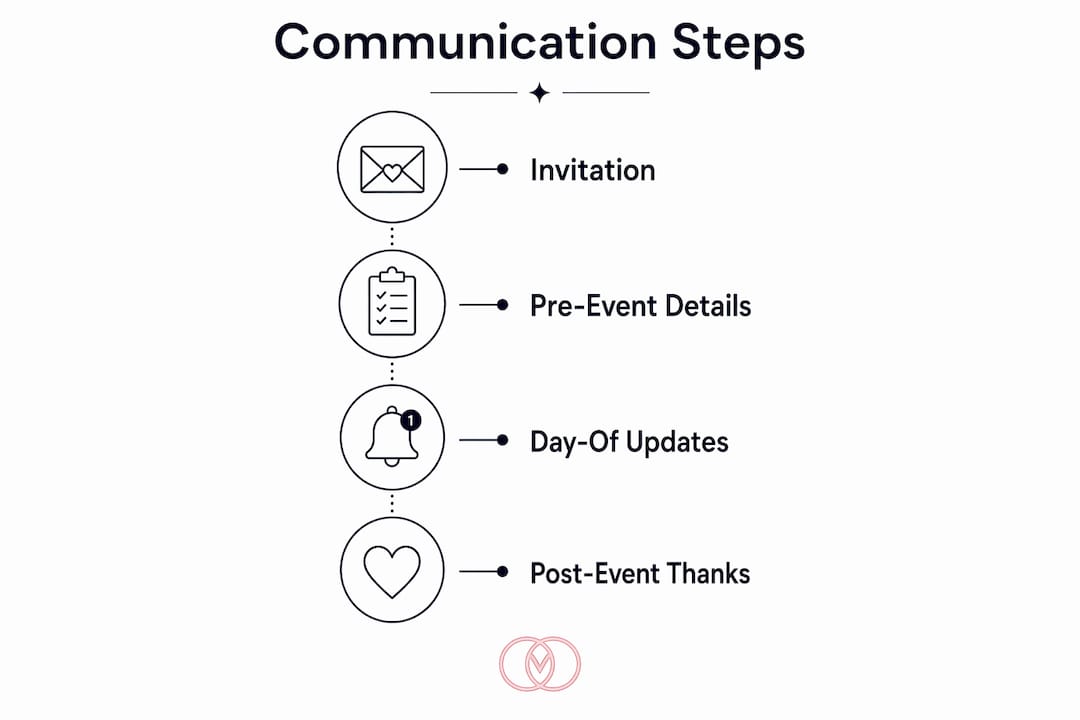
The most effective structure for wedding guest communication follows a three-touchpoint model. Each touchpoint serves a distinct purpose, and the channel should match the urgency of the message.
-
Initial logistics (save-the-date or invitation): Date, location, and RSVP deadline. This is the anchor. Send it early enough for guests to plan travel and accommodations. The wedding website should go live at this stage and serve as the single source of truth for all updates.
-
Detailed information (2–4 weeks before the wedding): Parking instructions, dress code, ceremony timeline, shuttle schedules, and accessibility details. This is the touchpoint most planners underinvest in. Guests need this information to make practical decisions, and sending it too close to the event creates last-minute questions.
-
Day-of updates: Real-time alerts for shuttle departures, ceremony start times, and any schedule changes. SMS outperforms email for this touchpoint. SMS carries a 98% open rate compared to email’s 20%, making it the only reliable channel for time-sensitive operational messages.
Channel selection matters as much as timing. Email works well for detailed pre-event information because guests can reference it later. A wedding website handles FAQs, maps, and accommodation links without cluttering inboxes. SMS handles anything that requires an immediate response or action.
The trap most couples fall into is over-communicating. More messages do not improve the guest experience. Clarity and tact timing do. Sending five emails about the same parking situation creates noise and trains guests to ignore your messages. Send one clear message at the right moment.
Planners managing client communication workflows know that the discipline of restraint is harder than the discipline of sending. Every message you hold back is a message that does not dilute the ones that matter.
Pro Tip: Designate a trusted day-of contact, a coordinator or a reliable family member, who handles all guest inquiries on the wedding day. This single decision protects the couple from a stream of “where do I park?” texts and lets them stay present in the moment.
What types of guest communication content matter most?
Guests need practical information to make decisions. They do not need your vendor negotiations, your seating chart revisions, or your family dynamics. The content you share should answer the questions guests are actually asking.
The core information every guest needs includes:
- Date, time, and location with a direct link to maps or GPS coordinates
- Dress code stated plainly, not euphemistically (“black tie” not “dressy casual”)
- Parking and transportation including shuttle schedules and drop-off points
- Ceremony and reception timeline so guests know when to arrive and when they can leave
- Accessibility details covering elevator access, step-free entrances, and seating options for guests with mobility needs
- A single point of contact for day-of questions, with that person’s name and phone number
What to leave out is equally important. Guests do not need internal planning details or vendor issues. Sharing that the florist delivered the wrong centerpieces or that the caterer changed the menu does not help guests. It transfers your stress to them. Keep the tone of every message calm and confident, even when things are not.
Managing last-minute changes requires a centralized hub. Treat the wedding website as the primary record. Update it first, then send a broadcast message pointing guests there. This prevents the version chaos that happens when some guests have the old shuttle time and others have the new one. Planners who use a wedding guest management system can push updates from a single dashboard rather than editing multiple platforms manually.
The tone of your messages signals your readiness. A message that reads “We’re so excited to celebrate with you. Here’s everything you need for Saturday” conveys confidence. A message that reads “Sorry for the confusion, but the venue changed the parking situation again” conveys chaos. Write from a position of calm authority, regardless of what is happening behind the scenes.
How can interactive experiences be integrated into guest communication?
Interactive weddings are now the standard at the high end of the market. Interactive experiences dominate 65% of luxury event budgets in 2026, reflecting a fundamental shift from passive observation to active participation. Communication is what makes that participation possible without making it feel forced.
The key principle is opt-in design. Passive activities during cocktail hours and receptions engage guests without pressure. A photo scavenger hunt, an advice card station, or a “how we met” trivia display gives guests something to do if they want it. No one is called on. No one is embarrassed. Guests who are socially exhausted can skip it entirely, and guests who are energized can engage deeply.
Communication supports this by setting expectations before the event. A line in the pre-event email that reads “We’ve set up a few fun activities during cocktail hour” primes guests to look for them. Without that nudge, many guests walk past activity stations without registering what they are.
Layout and timing also depend on communication. Social interaction thrives in open layouts with accessible focal points rather than rigid, structured games. When you communicate the flow of the event clearly, guests move through the space with confidence instead of clustering near the bar because they do not know where else to go.
| Approach | Traditional guest engagement | Interactive guest engagement |
|---|---|---|
| Guest role | Passive observer | Active participant |
| Communication need | Basic logistics only | Pre-event priming plus day-of prompts |
| Typical activity | Seated dinner, toasts | Photo hunts, advice cards, trivia displays |
| Guest phone use | High | 47% lower with interactive elements |
| Satisfaction impact | Baseline | 81% increase in positive feedback |
Planners who want to coordinate seating and interactive zones together will find that the two decisions are inseparable. Where you seat guests determines how easily they can access activity stations, and that access determines whether the activities actually get used.
Key Takeaways
Effective guest communication is the single most controllable factor in wedding guest satisfaction, and it requires clarity, timing, and restraint in equal measure.
| Point | Details |
|---|---|
| Three-touchpoint model | Send logistics at invitation, details 2–4 weeks out, and real-time updates via SMS on the day. |
| SMS for day-of alerts | SMS carries a 98% open rate versus email’s 20%, making it the only reliable channel for urgent updates. |
| Content discipline | Share parking, dress code, timeline, and accessibility. Never share vendor issues or internal planning stress. |
| Centralized source of truth | Update the wedding website first, then broadcast to guests to prevent conflicting information. |
| Delegate day-of contact | Assign a coordinator or trusted family member to handle guest inquiries so the couple stays present. |
The part of guest communication most planners get wrong
Most planners treat guest communication as a checklist item. Send the invitation, send the reminder, done. What they miss is that communication is the hospitality layer of the entire event. It is the difference between a guest who arrives oriented and relaxed and one who arrives scanning the room for someone to ask where to sit.
The instinct to over-communicate comes from a good place. Planners want guests to have everything they need. But I have seen couples send seven emails in the two weeks before their wedding, each one adding a small detail the previous one missed. By the time the actual day arrives, guests have stopped reading. The message that matters, the one with the shuttle time, gets buried.
The discipline I advocate is this: write every message as if it is the only one the guest will read. If it cannot stand alone, it is not ready to send. This forces you to prioritize ruthlessly and keeps your communication credible.
The other mistake is keeping the couple as the communication hub on the wedding day itself. Delegating day-of inquiries to a coordinator is not just a convenience. It is a structural decision that determines whether the couple gets to experience their own wedding. Every text a bride answers about parking is a moment she is not spending with her partner. Protect that time by design, not by accident.
Guest communication done well is invisible. Guests do not notice it because they never felt confused. That is the goal.
— JOATLABS
Planning your wedding with the right team behind you
Professional coordination makes the difference between a communication plan that exists on paper and one that actually reaches guests at the right moment.
Thespecialwedding connects couples and planners with vetted vendors who specialize in exactly this kind of execution. From stationery providers like The Inviting Place in Tulsa, who handle the first physical touchpoint guests receive, to full-service planners like Events By Suad in Oklahoma City, who manage day-of communication from start to finish, the Thespecialwedding vendor directory gives you direct access to professionals who understand that guest experience starts long before the ceremony. Browse the directory to find the right team for your event’s scale and communication needs.
FAQ
What is the role of guest communication in weddings?
Guest communication in weddings is the structured process of delivering timely, practical information that helps guests arrive prepared and feel at ease throughout the event. It directly increases satisfaction and reduces the anxiety that comes from uncertainty during long receptions.
How many times should you communicate with wedding guests before the event?
A three-touchpoint model works best: initial logistics at the invitation stage, detailed information 2–4 weeks before the wedding, and real-time updates on the day via SMS. Sending more messages than this creates noise and reduces the impact of critical updates.
What is the best channel for day-of wedding guest updates?
SMS is the most effective channel for day-of updates because it carries a 98% open rate, compared to email’s 20%. Use it for time-sensitive messages like shuttle departures and ceremony start times.
What information do wedding guests actually need?
Guests need the date, location, dress code, parking instructions, event timeline, and accessibility details. They do not need vendor updates, budget decisions, or any internal planning information that transfers stress without helping them make decisions.
How do interactive elements connect to guest communication?
Pre-event communication primes guests to look for and engage with interactive activities like photo scavenger hunts or advice card stations. Without that advance notice, guests often walk past activity stations without understanding their purpose.
Recommended
- Wedding Planner Client Communication: A 2026 Guide | The Special Wedding Blog
- Wedding Lead Management for Planners: 2026 Guide | The Special Wedding Blog
- What Is a Wedding Guest Management System? | The Special Wedding Blog
- Wedding Reception Flow Planning: Your Complete Guide | The Special Wedding Blog
Free wedding planner templates
Skip the blank page — these templates ship with the form fields you actually need.
Browse all 9 free templates →