How to Build a Wedding Planning Client Questionnaire
How to Build a Wedding Planning Client Questionnaire

Most wedding planners lose hours every week chasing down incomplete information. A couple books your services, you ask for details, and then you spend the next month piecing together a coherent picture from scattered emails and voicemails. When you build a wedding planning client questionnaire the right way, that cycle stops. You collect everything you need upfront, walk into consultations prepared, and spend your energy on planning rather than information retrieval. This guide walks you through every stage of creating a questionnaire that actually works for your workflow.
Table of Contents
- Key Takeaways
- Prerequisites for building your wedding planning client questionnaire
- Step-by-step instructions to build your questionnaire
- Common pitfalls when designing your client questionnaire
- How to leverage questionnaire responses after submission
- My honest take on client questionnaires
- Take your client intake to the next level
- FAQ
Key Takeaways
| Point | Details |
|---|---|
| Start with event basics | Collect couple names, wedding date, and guest count first to establish scheduling and contract foundations. |
| Stage your intake | Use a short style quiz to qualify leads, then a detailed form for serious clients to reduce respondent fatigue. |
| Use conditional logic | Show only relevant questions based on prior answers to keep forms concise and completion rates high. |
| Treat responses as workflow tools | Translate questionnaire data directly into draft timelines, vendor shortlists, and budget plans immediately after intake. |
| Avoid vague timing questions | Ask for exact start and end times for each event segment to prevent day-of coordination failures. |
Prerequisites for building your wedding planning client questionnaire
Before you write a single question, you need a clear picture of what your questionnaire is actually supposed to do. Most planners make the mistake of adding questions as they think of them, which produces a form that feels random to clients and useless to you. Define your goals first.
Your questionnaire should align with your planning workflow. Think about the decisions you need to make in the first two weeks after a client books. You need to know whether the date works, what your staffing requirements look like, which vendors you will need to contact, and whether the budget is realistic. Every question on your form should feed one of those decisions.
The core sections of any effective wedding client intake form fall into five categories:
- Couple and event basics: Full names, wedding date, ceremony and reception venues, email and phone contacts, package selection
- Budget and guest count: Total budget range, estimated guest count, flexibility on both
- Vision and style: Aesthetic preferences, color palettes, inspiration images, must-have vendors, style priorities
- Timeline and logistics: Ceremony and reception start and end times, getting-ready location, transportation needs, day-of sequence
- Communication and vendor roles: Designated point of contact, preferred communication method, existing vendor commitments, planner role scope
Planning for multi-stage intake changes how you collect this information. A staged intake process reduces respondent fatigue, routes qualified leads appropriately, and allows you to collect deeper details only from serious prospects. In practice, this means a short style-and-budget quiz at the inquiry stage, a detailed gathering wedding details questionnaire after an initial consultation, and a final logistics form closer to the event.
| Questionnaire section | Purpose | Example questions |
|---|---|---|
| Couple and event basics | Scheduling, contracts, communication setup | Wedding date, full names, venue names, guest count |
| Budget and guest count | Financial feasibility, service scoping | Total budget, flexibility range, estimated headcount |
| Vision and style | Align expectations, guide vendor selection | Style keywords, color palette, Pinterest board URL |
| Timeline and logistics | Day-of coordination, vendor briefings | Ceremony start time, reception end time, getting-ready location |
| Communication protocols | Clarity of approval chain, vendor coordination | Primary contact name, preferred method, who can authorize changes |
Pro Tip: Before you build anything, fill out your questionnaire as if you were a nervous couple who just got engaged last week. If a question confuses you or feels invasive without context, rewrite it.
Step-by-step instructions to build your questionnaire
Now that you know what you need to collect and why, here is the sequence that produces the most complete and usable responses.
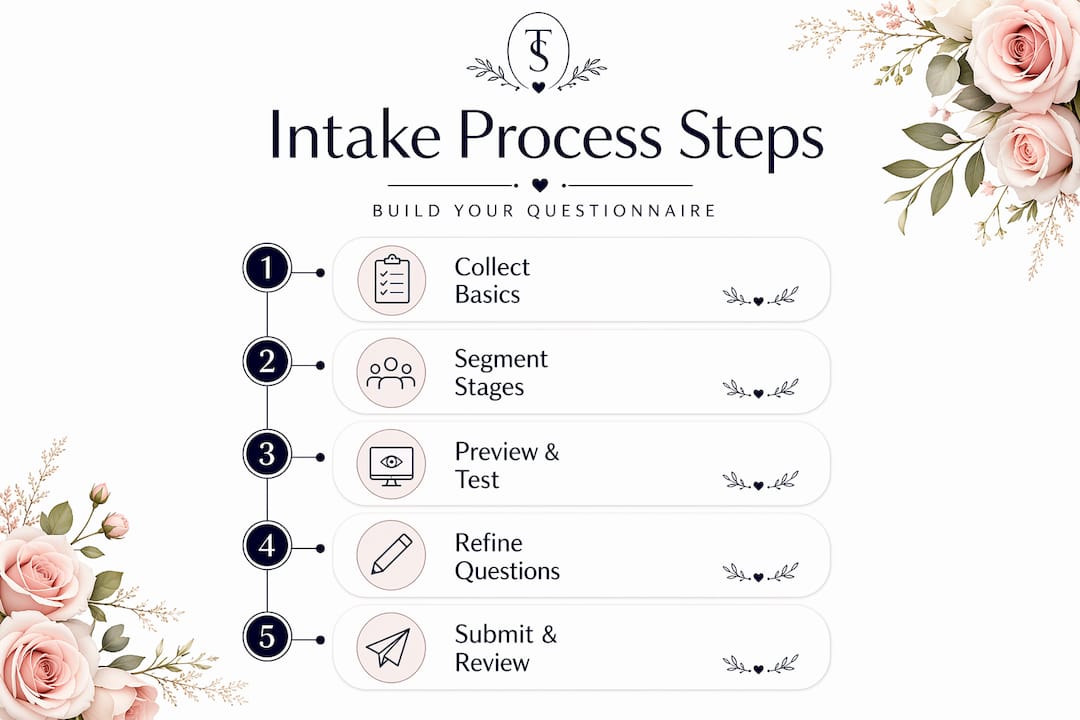
-
Start with contact details and event basics. A wedding planning client questionnaire should begin with couple and event basics because these fields are the foundation for scheduling, contracts, and avoiding coordination problems. Collect full names, wedding date, primary email, phone number, package selection, and number of guests in the first section. Keep it short. Couples should complete this in under two minutes.
-
Ask about budget and guest count immediately after. Do not bury these questions halfway through the form. Budget and guest count inputs help you move from guessing to knowing by validating the couple’s financial plan before you invest significant consultation time. Use a range selector rather than an open text field for budget. Specific ranges like “$15,000 to $20,000” generate more honest answers than a blank box asking for a number.
-
Capture vision and style preferences. This is where your bridal client questionnaire differentiates itself. Ask for style keywords, color palette preferences, and links to inspiration boards. Add a must-have vendors question where clients can list any photographer, florist, or DJ they are already committed to or strongly considering. Vision and priority details reduce misunderstandings and align expectations before your first meeting.
-
Collect detailed timeline and logistics information. Request exact times, not approximations. Day-of coordination guidance emphasizes requesting the entire day from getting-ready through reception end, including ceremony start and end times and reception start and end times. Vague timing information is the most common source of last-minute fixes on wedding day.
-
Include communication protocols. Ask who the designated point of contact is, what their preferred communication method is (email, phone, or text), and who has authority to approve vendor contracts and changes. Communication protocols clarify who is authorized for approvals and streamline vendor-planner-client interactions throughout the planning process.
-
Apply conditional logic. Conditional logic prevents generic, one-size-fits-all questionnaires by showing only relevant follow-up questions based on prior answers. If a couple selects “outdoor ceremony,” your form should automatically reveal questions about weather contingency plans. If they select “destination wedding,” questions about local accommodation blocks should appear.
-
Test before you send. Preview your form on both desktop and mobile. Submit a test response and verify the data lands correctly in your system. Check that conditional logic routes correctly on every path.
Pro Tip: Send a preview link to one trusted colleague and ask them to flag anything confusing. Fresh eyes catch broken logic and unclear phrasing that you will miss after staring at the same questions for an hour.
Common pitfalls when designing your client questionnaire
Even experienced planners build flawed questionnaires. Knowing the failure points ahead of time saves you from collecting data that is too vague to use.
- Questionnaires that are too long. If your form takes more than ten minutes to complete, completion rates drop. Anything beyond 25 to 30 questions for an initial intake form needs to be split into stages.
- Generic questions that produce generic answers. “Tell us about your dream wedding” sounds warm but generates responses you cannot use. Replace it with specific prompts: “List three words that describe the feeling you want guests to have at your reception.”
- Missing specificity on budget. Asking “What is your budget?” without offering ranges or context invites either a wildly optimistic number or no answer at all. Frame it with regional context.
- No mechanism for incomplete responses. Build in a save-and-return feature or break the form into multiple shorter submissions so couples are not penalized for not having all the information at once.
- Skipping form updates. Your questionnaire from two years ago probably does not reflect your current services or vendor network. Review and update it at least twice a year based on patterns in client responses.
When a couple submits a form with obvious gaps, resist the urge to call immediately. Send a specific follow-up message that names exactly which questions need completion and why those details matter for their planning. Vague follow-up requests produce vague answers.
Exact timing inputs are the most commonly skipped detail, so consider making ceremony and reception times required fields rather than optional ones. A form builder that flags incomplete required fields before submission saves significant back-and-forth.
How to leverage questionnaire responses after submission

Collecting data is only half the job. What you do with responses in the 48 hours after submission determines whether your questionnaire actually improves your workflow.
The most effective planners treat their questionnaires as workflow design tools rather than data collection exercises. That mental shift changes how you act on responses. The moment a completed form arrives, use the timeline section to draft a rough day-of schedule. Use the vendor section to identify any gaps in the vendor roster and begin building a shortlist. Use the budget range to check whether the couple’s expectations align with their numbers.
Budget validation deserves special attention. If a client marks their budget as $18,000 but lists expectations that typically cost $30,000 in your market, that gap needs to surface in your consultation rather than three months into planning. Use real-time cost reference tools or your own historical pricing data to flag misalignments before they become conflicts.
Pro Tip: Create a one-page intake summary template that pulls the key fields from every submitted questionnaire: couple names, date, venue, budget, guest count, and top three priorities. Review this summary before every client call so you walk in already knowing what matters most to them.
Communication protocols from the form also set the tone for the entire relationship. If a client marks email as their preferred method and lists a specific person as the decision-maker, log that immediately in your client management system. Sending texts to a client who prefers email or routing questions to the wrong person creates friction that compounds over months.
Couples contact multiple vendors during their search, and planners who respond with speed and precision close more business. A detailed questionnaire gives you the context to write a proposal that speaks directly to what this specific couple wants, rather than a generic services overview. That specificity signals professionalism and builds trust immediately.
Track your questionnaire data over time. If you notice that 60 percent of inquiries list outdoor ceremonies but your outdoor contingency questions are getting skipped, that is a form design problem worth fixing. Patterns in your responses reveal gaps in your intake process and opportunities to refine your services.
My honest take on client questionnaires
I’ve watched planners resist structured intake forms for years because they worry the process feels impersonal or transactional. That instinct is understandable, but it’s backwards. The couples who feel most cared for are the ones whose planners show up to the first consultation already knowing their venue, their budget range, and the three things they care about most.
In my experience, pre-meeting questionnaires that gather vision details, must-have vendors, and dietary needs can cut consultation time significantly and improve close rates. The planners who dismiss questionnaires as cold or impersonal are the same ones spending the first thirty minutes of every consultation asking questions they could have answered in advance.
The biggest misconception I see is that a longer questionnaire shows thoroughness. It doesn’t. A well-constructed short form with conditional logic shows that you respect your client’s time. And couples inquiring with multiple vendors will notice the difference between a planner who asks smart, specific questions and one who sends a wall of generic text fields.
Start with ten focused questions. Test it. Improve it. A questionnaire is never finished, and treating it as a living document is the professional standard.
— JOATLABS
Take your client intake to the next level
Building a strong questionnaire is only the starting point. Managing the responses, tracking follow-ups, coordinating vendors, and keeping clients informed requires a system that works together rather than a collection of disconnected tools.
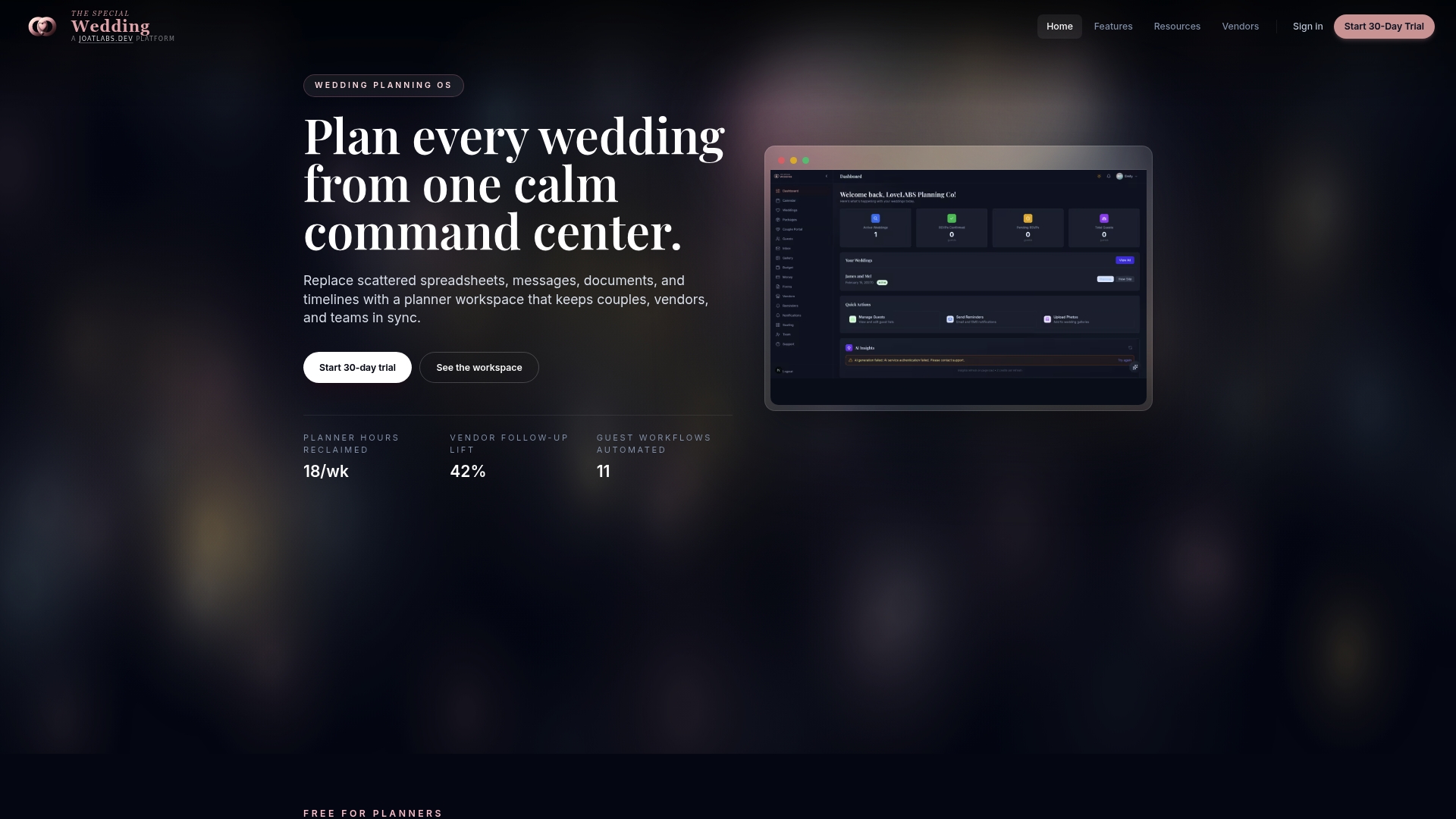
Thespecialwedding gives professional planners and studios a single workspace to handle client intake, vendor coordination, event timelines, and guest management in one place. The platform supports customizable questionnaire templates, automated follow-up workflows, and client portals that keep couples informed without constant back-and-forth. Whether you manage three weddings a year or thirty, the wedding planner software at Thespecialwedding is built to scale with your business. You can also browse the vendor directory to connect with trusted professionals and simplify coordination from intake through the final send-off.
FAQ
What should a wedding planning client questionnaire include?
A complete wedding client intake form should cover couple and event basics, budget range, guest count, vision and style preferences, detailed day-of timeline, and communication protocols including who is authorized to make decisions.
How long should a wedding planning questionnaire be?
Keep initial intake forms to 15 to 25 questions. Anything longer should be split into stages: a short qualifying quiz for new leads followed by a detailed form for confirmed clients.
How do I get couples to complete the questionnaire?
Send the form immediately after booking with a clear deadline and a brief explanation of why each section matters. Use conditional logic to hide irrelevant questions and keep the experience concise.
When should I send a client questionnaire for weddings?
Send a brief style-and-budget quiz at the inquiry stage to qualify leads. Follow up with a detailed gathering wedding details questionnaire within 48 hours of signing the contract.
How does conditional logic improve a bridal client questionnaire?
Conditional logic shows only relevant questions based on a client’s previous answers, which reduces form length, prevents confusion, and increases completion rates significantly.
Recommended
Free wedding planner templates
Skip the blank page — these templates ship with the form fields you actually need.
Browse all 9 free templates →