Multi-Wedding Coordination: A Professional's 2026 Guide
Multi-Wedding Coordination: A Professional’s 2026 Guide
Multi-wedding coordination is the professional practice of managing two or more wedding events simultaneously or consecutively, with shared vendors, overlapping timelines, and centralized communication across multiple venues. The industry term for this specialty is “multi-event coordination,” and it requires a distinct skill set beyond standard single-event planning. Wedding professionals who master what is multi-wedding coordination gain a measurable competitive edge: they can serve more clients, build stronger vendor relationships, and deliver consistent results even under complex logistical pressure. This guide covers the core challenges, vendor management techniques, technology tools, and workflow strategies that define high-performance multi-event coordination in 2026.
What is multi-wedding coordination, and why does it differ from single-event planning?
Multi-wedding coordination is defined as the structured management of multiple wedding events within a shared operational framework, where one lead coordinator oversees vendors, timelines, venues, and client communication across all events. This differs fundamentally from single-event planning because every decision carries downstream consequences. A delay at one venue ripples into the next event’s setup window.
Multi-day wedding coordination services typically start at $4,500, covering guest experience planning, vendor team oversight, and extended timeline management. That price point reflects the operational complexity involved, not just the hours logged. A planner managing a welcome dinner, rehearsal, and ceremony across three days faces a fundamentally different challenge than one managing a single Saturday reception.

The scope also includes what is multi-vendor wedding coordination: the practice of sequencing and supervising multiple vendor teams whose work is interdependent. The florist cannot finish the reception space until the rental company delivers the furniture. The photographer cannot begin portraits until hair and makeup is complete. Every vendor’s output is another vendor’s starting condition.
What challenges arise when coordinating multiple weddings?
Managing multiple weddings at once creates four categories of operational risk: scheduling conflicts, vendor overload, communication breakdown, and venue logistics failure. Each one compounds the others when left unmanaged.
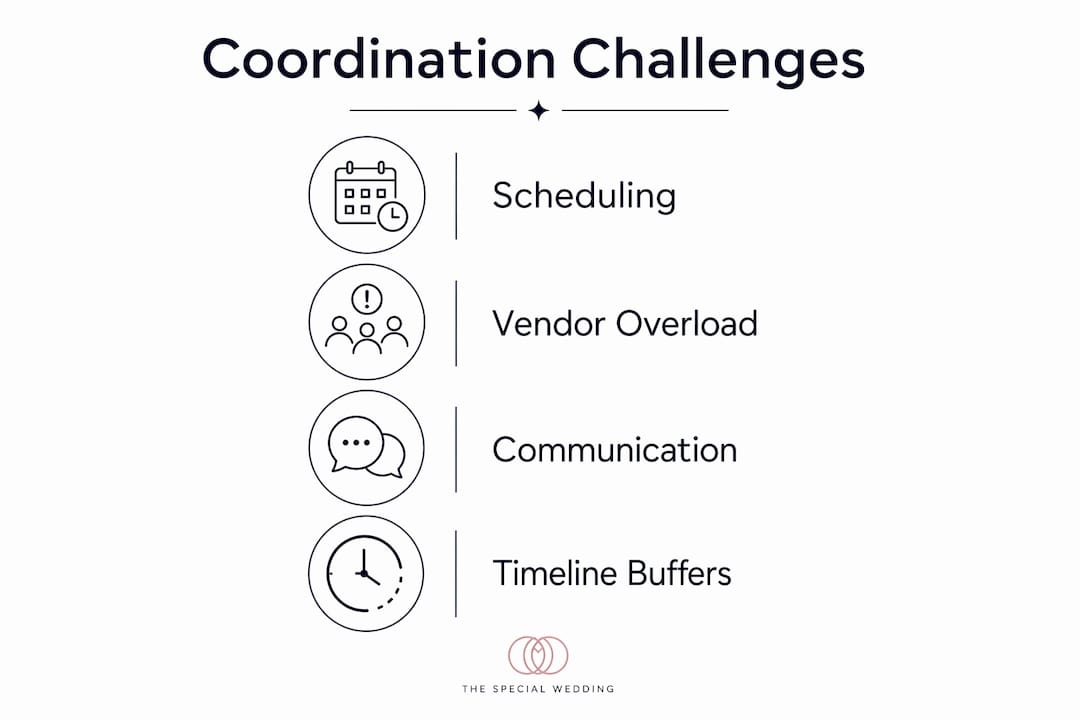
Scheduling and timeline conflicts are the most common pressure point. Multi-day weddings typically last 3–4 days, requiring formal buffer times around venue changeovers, photography travel, and arrivals. Without those buffers built into the master timeline, a 10-minute delay at the ceremony site can collapse the entire reception setup window.
Vendor overload happens when the same vendor serves multiple events in the same weekend. A florist handling two Saturday weddings needs staggered delivery windows, separate load-in routes, and clear point-of-contact instructions for each event. Without this structure, vendors show up at the wrong venue or receive conflicting instructions from different team members.
Communication breakdown is the silent killer of multi-event coordination. When multiple stakeholders issue orders to the same vendor team, service quality drops immediately. The lead planner must act as the single conductor of the master plan.
Venue logistics add another layer of complexity when events span multiple locations. Transportation loops, pick-up and drop-off windows, and load-in/load-out schedules all require precise coordination to keep guests and vendors moving on time.
Key risks to monitor across every multi-event program:
- Overlapping vendor arrival windows at the same venue
- Miscommunication between assistant coordinators and lead vendors
- Timeline slippage caused by missing buffer periods
- Resource conflicts when shared vendors serve back-to-back events
- Inadequate contingency plans for weather or transportation delays
Pro Tip: Build a minimum 20-minute buffer between every major vendor transition. This single habit prevents the majority of cascade delays in multi-venue coordination.
How do you handle multi-venue wedding day coordination with vendors?
Effective vendor coordination in multi-event settings relies on systematic task sequencing, staggered arrivals, and a centralized communication funnel. These three elements work together to prevent the operational conflicts that derail complex events.
Systematic task sequencing
Successful coordination demands systematic sequencing where one vendor’s completion is a strict dependency for the next vendor’s start. This architectural approach means transitions are planned, not reactive. Build your master timeline backward from the ceremony start time, then assign each vendor a confirmed arrival window based on their position in the sequence.
The wedding coordinator’s role in vendor scheduling is to own that sequence entirely. No vendor should receive a schedule change without the lead coordinator approving it first.
Staggered arrival protocols
Managing 7 or more vendors requires staggered arrival protocols with at least 15-minute buffers between each team. Reverse timeline planning, working backward from the ceremony, creates realistic setup windows and prevents spatial conflicts when multiple vendor teams share the same venue floor.
A practical arrival sequence for a multi-vendor ceremony setup looks like this:
- Rental and furniture delivery team arrives first to establish the physical layout
- Florist arrives once furniture is confirmed in place
- Lighting and AV team sets up after florals are positioned
- Catering team begins setup once the room layout is locked
- Entertainment and band arrive for sound check after catering is staged
- Photography team does a venue walkthrough before guests arrive
Centralized communication funnel
Centralized communication led by one point person prevents vendors from receiving conflicting instructions. This is the single most important structural decision in multi-event coordination. Every vendor question, change request, and confirmation goes through the lead coordinator. Assistant coordinators handle on-site logistics and cueing but escalate all decisions upward.
Pro Tip: Create a vendor-specific contact sheet for each event and distribute it 14 days before the wedding. Include each vendor’s arrival time, load-in location, point of contact on-site, and emergency backup number.
What technology tools improve multi-event coordination efficiency?
Digital tools are not optional in multi-wedding coordination. They are the infrastructure that makes centralized management possible across multiple venues and vendor teams.
Layered timelines are the preferred format over single master documents. Each role receives a customized view of the schedule: vendors see only their arrival windows and tasks, the bridal party sees ceremony and portrait timing, and the internal coordination team sees the full operational picture. This approach reduces cognitive overload and prevents accidental schedule changes by people who should not have edit access.
Collaborative mapping tools with layered privacy controls allow planners to maintain a single source of truth for venue locations, vendor routes, guest instructions, and logistics. A planner coordinating a ceremony at one venue and a reception at another can share location-specific layers with each vendor team without exposing the full operational map.
Core technology categories for multi-event coordination:
- Centralized timeline platforms: Allow real-time updates that push to all role-specific views simultaneously
- Project management tools: Track vendor task completion, document confirmations, and flag open items before each event
- Messaging platforms: Keep all vendor communication in one searchable thread per event, not scattered across text messages and email chains
- Collaborative mapping tools: Manage multi-venue logistics with audience-specific layers for vendors, guests, and internal teams
- Document sharing systems: Store contracts, floor plans, and run-of-show documents in one location accessible to the full coordination team
Effective communication relies on a single point of contact, centralized digital platforms, and documented confirmations sent 30 and 14 days before each event. That two-checkpoint system catches errors before they become day-of emergencies.
The types of wedding event management systems available in 2026 range from entry-level scheduling apps to full-service platforms that integrate client portals, vendor onboarding, and automated workflow triggers. Planners managing three or more simultaneous events benefit most from platforms that centralize all of these functions in one workspace.
Practical strategies for managing multiple weddings without sacrificing client service
Workflow optimization in multi-wedding planning starts with one non-negotiable rule: never commit to more events than your team can staff at full capacity. Overcommitment is the primary cause of quality failures in multi-event coordination, and it is entirely preventable.
Wedding agency capacity planning requires honest assessment of your team’s bandwidth before booking. Count not just the wedding day, but the vendor calls, site visits, timeline revisions, and client check-ins that each event requires in the weeks before.
Practical strategies that sustain quality across multiple events:
- Assign venue-specific coordinators. Professional multi-venue coordination teams include a primary coordinator managing vendor communication and an assistant handling on-site logistics, cueing, and problem-solving. One person cannot do both roles effectively across multiple venues.
- Build standard operating procedures for every repeatable task. Templates for vendor confirmation emails, timeline formats, and day-of briefing documents cut preparation time significantly without reducing quality.
- Set client communication schedules in advance. Clients in a multi-event program need to know exactly when they will hear from you and what each touchpoint covers. Unscheduled check-ins create anxiety and consume coordination time.
- Prepare internal “what-if” contingency plans. Real-time adaptability is what separates exceptional coordinators from good ones. Document your response plan for weather delays, vendor no-shows, and transportation failures before the event week begins.
- Use templates and checklists for every event phase. Standardized tools reduce the mental load of managing multiple events and make delegation to assistant coordinators far more reliable.
Solo planners managing multiple events face the additional challenge of doing this without a built-in team. The answer is building a trusted network of freelance assistants who understand your systems and can execute independently on-site.
Key Takeaways
Multi-wedding coordination succeeds when a single coordinator owns the master plan, vendors are sequenced with built-in buffers, and every team member works from a role-specific timeline rather than one shared document.
| Point | Details |
|---|---|
| Define scope before booking | Commit only to events your team can staff at full capacity without cutting corners. |
| Use staggered arrival protocols | Schedule at least 15-minute buffers between vendor arrivals to prevent spatial conflicts. |
| Centralize all communication | One lead coordinator must own every vendor instruction and change request across all events. |
| Layer your timelines | Distribute role-specific schedule views to vendors, guests, and internal teams separately. |
| Build contingency plans early | Document your response to weather, vendor failure, and transport delays before event week. |
Why the “single conductor” principle is the real secret to multi-event success
Most articles on multi-wedding coordination focus on tools and timelines. The real differentiator is simpler and harder to implement: one person must own the master plan completely, and everyone else must respect that authority without exception.
I have seen well-resourced coordination teams collapse on event day because two assistant coordinators gave conflicting instructions to the same catering team. The caterers, trying to please both, pleased neither. The result was a 40-minute delay that pushed the entire reception timeline past midnight. No amount of technology fixes a broken chain of command.
The “single conductor” principle means the lead coordinator is the only person authorized to change the timeline, redirect a vendor, or approve a substitution. Assistants execute. They do not decide. This sounds rigid, but it is the only structure that holds under the pressure of a live multi-venue event.
Thorough preparation is what makes that structure possible. When your contingency plans are documented, your vendor confirmations are sent at 30 and 14 days out, and your layered timelines are distributed a week before the event, the day-of coordinator has the mental bandwidth to handle real surprises calmly. The chaos that clients fear is almost always the result of decisions that were not made in advance.
Client satisfaction in multi-event coordination is not measured by how smoothly things go when everything works. It is measured by how invisible your problem-solving is when things do not. That invisibility requires preparation, clear authority structures, and a team that trusts the system enough to follow it under pressure.
— JOATLABS
Thespecialwedding: your resource for trusted vendors and venues
Coordinating multiple weddings means sourcing reliable vendors and venues quickly, without starting from scratch for every event. Thespecialwedding gives you direct access to a curated vendor directory built for professional planners who need trusted professionals across multiple event types and locations.
From rental companies like Castle Event Rentals in Mustang, OK, to full-service venues and entertainment vendors, the platform connects you with professionals who understand the demands of multi-event coordination. Every listing gives you the contact details and service scope you need to build a reliable vendor roster for your next multi-wedding program. Browse the directory and start building your preferred vendor network today.
FAQ
What is multi-wedding coordination in simple terms?
Multi-wedding coordination is the professional management of two or more wedding events at the same time or back-to-back, using centralized timelines, vendor sequencing, and one lead coordinator to keep all events on track.
How many vendors does a multi-event wedding typically involve?
Multi-event weddings commonly involve 7 or more vendor teams across ceremony, reception, and ancillary events. Staggered arrival protocols with 15-minute buffers are the standard approach for managing that volume without conflicts.
What is the minimum team size for multi-venue wedding coordination?
Professional multi-venue coordination requires at least two people: a primary coordinator managing vendor communication and an assistant handling on-site logistics and cueing at each venue.
How far in advance should vendor confirmations go out for multi-event weddings?
Send documented confirmations to all vendors at 30 days and again at 14 days before each event. This two-checkpoint system catches scheduling errors and substitution needs before they become day-of emergencies.
What is the biggest operational risk in multi-wedding planning?
The biggest risk is overcommitment. Booking more events than your team can staff at full capacity is the primary cause of quality failures in multi-event coordination, and it is entirely preventable through honest capacity planning before contracts are signed.
Recommended
- Solo Wedding Planner Organization Tips That Work | The Special Wedding Blog
- Wedding Agency Team Management: A 2026 Guide | The Special Wedding Blog
- Wedding Transportation Coordination: A Complete Planning Guide | The Special Wedding Blog
- Wedding Event Seating Coordination Tips That Work | The Special Wedding Blog
Free wedding planner templates
Skip the blank page — these templates ship with the form fields you actually need.
Browse all 9 free templates →