Task Delegation in Wedding Agencies: A 2026 Playbook
Task Delegation in Wedding Agencies: A 2026 Playbook
Effective task delegation in wedding agencies means transferring ownership of outcomes to defined roles while you retain control over brand standards and client strategy. Start this week with three moves: assign one associate planner full ownership of a single upcoming wedding’s vendor coordination, document that process as your first SOP, and track one metric (client response time) to prove the handoff worked.
- Pick one pilot role. Choose an associate planner or day-of coordinator and hand them a complete responsibility, not a task list.
- Document one SOP. Write the steps for vendor confirmation calls so the process lives outside your head.
- Set one KPI. Track average client response time before and after the handoff to measure real impact.
Table of Contents
- Why delegation is the growth engine your agency needs
- How to build a role-based delegation model for your agency
- Which tasks should you delegate and which should you keep?
- How to operationalize delegation with SOPs and the right tools
- How to train your team so delegation sticks
- What KPIs actually tell you if delegation is working
- Common delegation failures and how to fix them fast
- A week-by-week rollout to pilot delegation
- Key Takeaways
- What most agency leaders get wrong about delegation
- Thespecialwedding makes delegation repeatable from day one
- Useful sources and further reading
Why delegation is the growth engine your agency needs
The business case for delegation is direct: it creates capacity, protects margins, and produces repeatable quality when structured around role ownership rather than ad hoc task handoffs. Without it, your revenue ceiling is your personal bandwidth.
- Scalability. Role-based delegation lets you add weddings without adding proportional founder hours.
- Revenue leverage. When associates handle vendor timelines and RSVP tracking, you free hours for higher-margin client work.
- Reduced burnout. Founder burnout is the most common reason agencies plateau at six to eight weddings per year.
- Faster client response. A dedicated account manager or associate can reply to client questions same-day without pulling you off design work.
A practical illustration: if an associate or VA absorbs vendor outreach, CRM updates, and timeline drafts across a single wedding, you reclaim roughly four to six hours per event. Across twenty weddings a year, that compounds into real capacity for business development or a second revenue stream.
“Delegation enables scalable business growth and prevents founder burnout — it is the mechanism by which a solo operator becomes an agency leader.” — Event Planner Expo, 2025
Nicole Coon, CMP, writing for MPI in 2025, puts it plainly: delegate based on each team member’s unique strengths, not just available time. That distinction separates development-focused delegation from task dumping.
How to build a role-based delegation model for your agency
Use role-based delegation: assign ownership of outcomes to a defined role, not a rotating list of tasks. The principal defines the what and why; the role owner controls the how. WeddingProCEO makes the point clearly: agencies stay overwhelmed when the principal remains the cognitive hub for every decision.

Core role archetypes
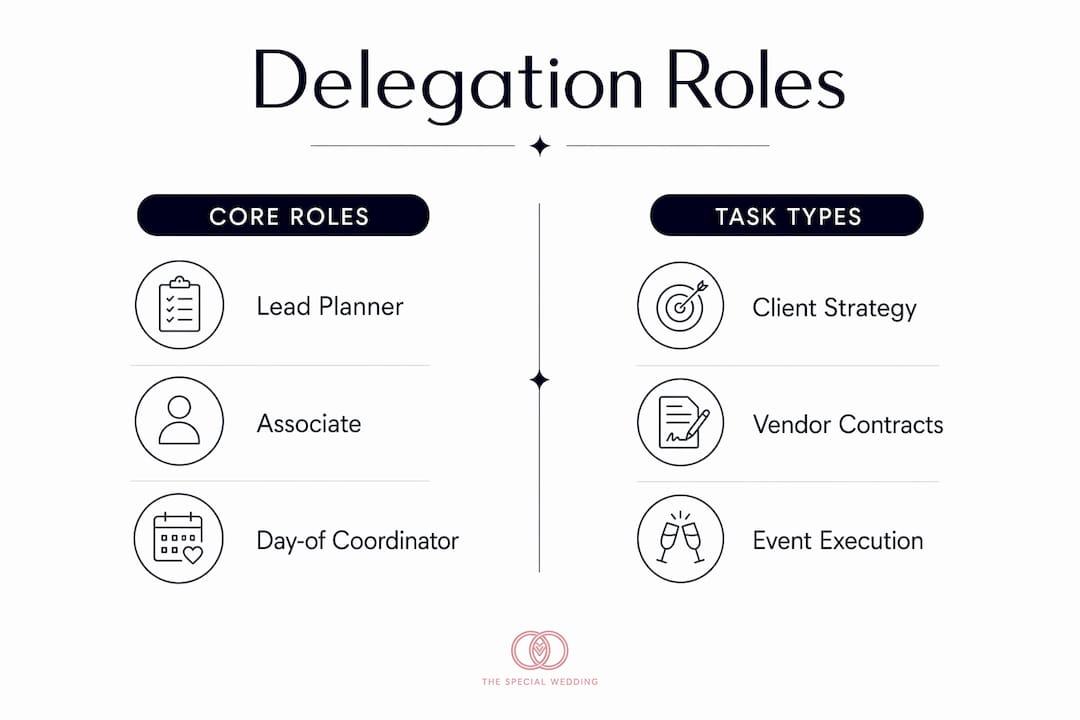
| Role | Primary Responsibility |
|---|---|
| Lead Planner | Client strategy, pricing, brand standards, escalation decisions |
| Associate Planner | Vendor coordination, timeline management, budget tracking |
| Day-of Coordinator | On-site execution, vendor check-ins, timeline adherence |
| Account Manager | Client communication, follow-ups, milestone updates |
| Admin / VA | CRM upkeep, RSVP tracking, contract filing, inbox management |
Sample RACI for a wedding milestone
| Activity | Lead Planner | Associate | Day-of Coordinator | Admin/VA |
|---|---|---|---|---|
| Vendor contract review | A | R | I | I |
| Timeline draft | I | R | C | I |
| Client milestone update | A | R | I | I |
| Day-of vendor check-in | I | I | R | I |
| Post-event invoice filing | I | I | I | R |
R = Responsible, A = Accountable, C = Consulted, I = Informed
Escalation rule: any decision touching pricing, a client complaint, or a vendor contract dispute escalates to the lead planner immediately. Everything else stays with the assigned role.
Pro Tip: When handing off a role, give the team member a written one-pager that states their decision authority explicitly — what they can approve without asking you. Ambiguity is what pulls you back into the weeds.
Per Aiconiq Events, many professionals perform six roles simultaneously without naming any of them. Naming roles and publishing them internally resolves that overload faster than any tool.
Which tasks should you delegate and which should you keep?
Delegate repeatable, high-volume, low-judgment work. Retain decisions that require brand judgment, pricing authority, or sensitive client conversations. The filter is simple: if a task can be documented in an SOP and executed consistently by a trained team member, it belongs on someone else’s plate.
Risk × impact scoring checklist
Score each task on four dimensions (1 = low, 3 = high):
- Confidentiality sensitivity — does it involve pricing, contracts, or personal client data?
- Brand visibility — will the client or a vendor see this output directly?
- Revenue impact — could an error affect invoicing or a deposit?
- Timing sensitivity — does a mistake cascade into other milestones?
Tasks scoring 8 or above stay with the lead planner. Tasks scoring 4 or below are prime delegation candidates.
Phase-by-phase examples
- Inquiry phase: Delegate initial inquiry responses and CRM entry; retain pricing conversations and proposal approval.
- Vendor selection: Delegate outreach, quote collection, and comparison drafts; retain final vendor approval.
- Planning phase: Delegate timeline builds, RSVP tracking, and vendor follow-ups; retain budget sign-off.
- Final week: Delegate confirmation calls and logistics sheets; retain client-facing final review calls.
- Day-of: Delegate vendor check-ins and timeline execution; retain any real-time client escalations.
A typical wedding involves multiple vendors and numerous milestones. Trying to personally manage every touchpoint across that scope is where quality breaks down, not where it is protected.
Decision flow: If the task is documented, repeatable, and low-risk, delegate it. If it requires live judgment about brand, money, or a client relationship, retain it until the team member has a proven track record in that area.
How to operationalize delegation with SOPs and the right tools
Delegation only scales when you pair it with airtight workflows. A handoff without documentation is just hope. Every delegated responsibility needs an SOP, a shared task system, and a clear handoff protocol.
What a single SOP must include
- Goal: one sentence on what success looks like
- Acceptance criteria: how you know the task is done correctly
- Step-by-step process: numbered, specific, no assumed knowledge
- Artifacts: templates, email scripts, or checklists the role owner uses
- Escalation path: exactly when and how to loop in the lead planner
Recommended tool stack
| Function | Tool Options |
|---|---|
| Project and event management | Asana, Thespecialwedding |
| CRM and client communication | HoneyBook, Dubsado, Thespecialwedding |
| Shared documentation | Google Workspace, Notion |
| Automation | Zapier, native platform workflows |
Thespecialwedding centralizes client portals, vendor timelines, milestone invoicing, and customizable templates in one workspace, which maps directly to the SOP and handoff needs above. When your associate updates a vendor timeline in the platform, the client portal reflects it automatically — no separate email thread required. For wedding-specific project management, that kind of connected dependency tracking prevents the cascading failures that plague agencies running on spreadsheets.
Coordinating vendor teams on the day of the event is one of the highest-stakes handoffs in any wedding. A practical resource on photographer and videographer coordination shows how clear role assignments and pre-event briefings prevent on-site confusion.
Pro Tip: Automate status updates (vendor confirmations, milestone completions) but keep a human review step before anything goes to the client. Automation catches volume; human review catches tone and context.
How to train your team so delegation sticks
Treat delegation as a development program with milestones and competency gates, not a one-time task transfer. The Eventible framework is direct: delegating responsibility without authority leaves the principal as the bottleneck anyway.
Five-step onboarding recipe
- Document the SOP before the team member starts.
- Demonstrate the process via a recorded walkthrough or live session.
- Supervised run — the team member executes while you observe and debrief.
- Independent run — they execute solo; you review the output.
- Audit — after three independent runs, review quality against acceptance criteria.
Competency checklist
- Timeline accuracy (no missed vendor windows)
- Vendor communication tone matches brand voice
- Budget reconciliation completed within 24 hours of each milestone
- Crisis escalation triggered correctly and promptly
- Client updates sent on schedule without prompting
For succession planning, rotate ownership of each responsibility across at least two team members. If only one person can run a process, it is a single point of failure. MPI’s guidance reinforces this: training teams to own outcomes creates internal succession paths that reduce founder dependence over time.
What KPIs actually tell you if delegation is working
Measure time saved, client response speed, error rate, and financial impact. Completion counts alone tell you nothing about quality or business effect. Event systems architect Arielle Jones recommends prioritizing time savings and client satisfaction metrics early in any pilot, before layering in financial analysis.
| KPI | Definition | Tracked By | Frequency |
|---|---|---|---|
| Hours reclaimed per wedding | Lead planner hours vs. pre-delegation baseline | Lead planner timesheet | Per wedding |
| Client response time | Avg. hours from client message to reply | CRM / platform log | Weekly |
| Repeat corrections | Number of rework requests per wedding | Project management tool | Monthly |
| Margin per wedding | Revenue minus direct labor cost | Accounting / invoicing | Monthly |
Run a three-month pilot across two to four weddings. By week twelve, you should have enough data to project annual ROI from reclaimed hours and improved utilization.
Common delegation failures and how to fix them fast
Most delegation stalls because of unclear ownership, missing SOPs, or broken communication workflows. The fix is almost always structural, not a people problem.
- Micromanagement: You delegated the task but kept approving every step. Fix: publish decision authority in writing and honor it.
- Task-based handoffs: You handed out a to-do list, not a role. Fix: rewrite the handoff as an outcome statement with acceptance criteria.
- Missing escalation routes: The team member hit a wall and guessed. Fix: add an escalation path to every SOP.
- Undertrained staff: The team member lacked context. Fix: run the five-step onboarding recipe before the next handoff.
Quick-fix checklist for a stalled handoff (10 minutes)
- Confirm the role owner can state the outcome in one sentence.
- Verify the SOP exists and is current.
- Check that decision authority is documented.
- Confirm the escalation path is clear.
- Review the last three client-facing outputs for tone and accuracy.
Red flags that delegation is hurting client experience: response times creeping past 24 hours, the same correction requested more than twice, vendor confusion about who their contact is.
A week-by-week rollout to pilot delegation
Use a scoped pilot across two to four weddings over six to nine weeks. Define success criteria before you start so the audit is objective.
- Weeks 1–2: Map current tasks, identify delegation candidates, assign pilot roles.
- Week 3: Write SOPs for the top three delegated responsibilities.
- Week 4: Onboard the pilot team member using the five-step recipe.
- Weeks 5–6: Supervised runs on live weddings; debrief after each.
- Week 7: Independent runs; lead planner reviews output only.
- Week 8: Audit against KPIs; calculate hours reclaimed.
- Week 9: Decision point — scale, adjust, or extend the pilot.
Pilot checklist:
- Roles assigned and documented
- Three SOPs written and reviewed
- KPIs baselined before week one
- Escalation paths confirmed with the team
- Lead planner retains final approval on all client-facing financial communications
For capacity planning and ROI modeling during your pilot, the agency capacity planning guide from Thespecialwedding offers practical frameworks for estimating reclaimed hours and billable capacity.
Key Takeaways
Effective delegation in a wedding agency requires transferring outcome ownership to defined roles, backed by SOPs, a shared task system, and measurable KPIs tracked from week one of any pilot.
| Point | Details |
|---|---|
| Delegate outcomes, not tasks | Assign role ownership with decision authority, not a to-do list, to remove yourself as the bottleneck. |
| Use a risk × impact filter | Score tasks on confidentiality, brand visibility, revenue impact, and timing before deciding what to hand off. |
| Measure what matters | Track hours reclaimed, client response time, repeat corrections, and margin per wedding, not just completion counts. |
| Train before you transfer | Run the five-step onboarding recipe (document, demonstrate, supervised run, independent run, audit) before any live handoff. |
| Thespecialwedding as your hub | Thespecialwedding centralizes SOPs, vendor timelines, client portals, and milestone invoicing to make role-based delegation repeatable across your agency. |
What most agency leaders get wrong about delegation
The conventional wisdom says delegation is about freeing up your calendar. That framing is too narrow, and it is why most pilots stall after the first month.
The real shift is organizational: you are not offloading tasks, you are building a second layer of leadership. The agencies that scale past twenty weddings a year are not the ones with the best planners at the top. They are the ones where associates can run a wedding end-to-end without checking in. That requires documented processes, real decision authority, and a measurement system that catches problems before clients do.
What most leaders underestimate is the cost of not measuring. If you hand off vendor coordination but never track client response time or rework rate, you have no signal that quality is holding. You are flying blind and calling it trust. The KPI dashboard is not bureaucracy. It is the feedback loop that makes delegation safe enough to scale.
The other overlooked piece: delegation is your succession plan. Every associate who learns to own a wedding outcome is a future lead planner or agency partner. That internal pipeline is worth more than any single reclaimed hour.
Thespecialwedding makes delegation repeatable from day one
Running delegation across multiple weddings without a central system means your SOPs live in someone’s inbox and your vendor timelines are three versions out of date. Thespecialwedding solves that directly.
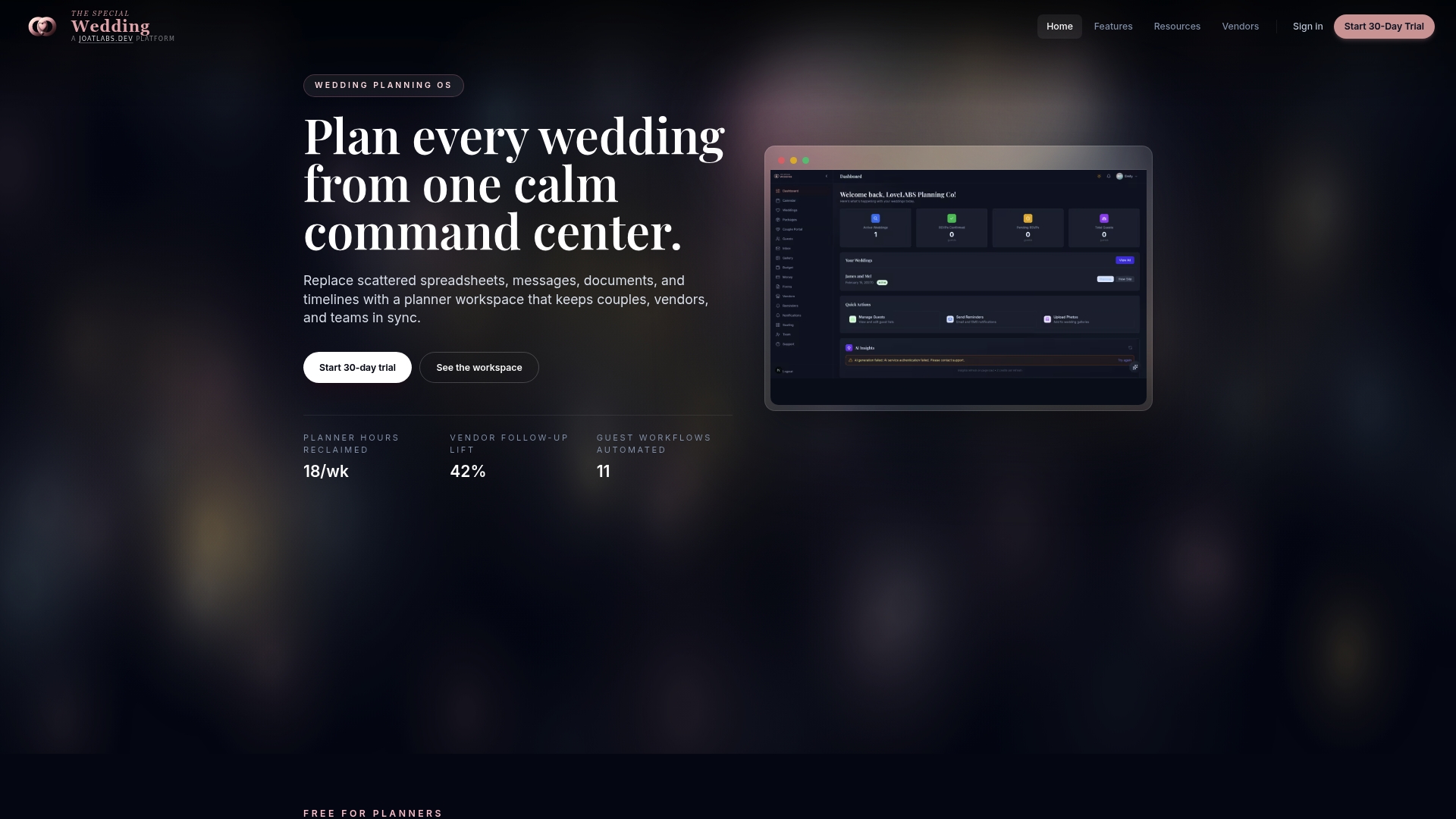
The platform gives your team a single workspace where client portals, vendor timelines, milestone invoicing, and customizable templates all connect. Associates update a vendor confirmation and the client portal reflects it instantly. Role permissions mean each team member sees exactly what they need, nothing more. You can explore the vendor directory to see how vendor profiles, contract tracking, and task assignments work inside the platform before committing to a full rollout. Start your pilot on Thespecialwedding at thespecialwedding.io and run your first delegated wedding with every handoff documented and tracked in one place.
Useful sources and further reading
Use these sources to build your SOPs, KPI dashboards, and role definitions. The Thespecialwedding blog posts include practical templates you can adapt immediately.
- Why delegation is the secret weapon for event growth — Event Planner Expo
- Why you should be delegating tasks during planning your meeting/event — MPI (Nicole Coon, CMP)
- Outsource confidence: a guide to delegating — Arielle Jones
- Overcoming overwhelm in your wedding business — WeddingProCEO
- Project management for wedding planners in 2026 — Plutio
- How to delegate tasks effectively — Eventible
- Wedding Agency Team Management: A 2026 Guide — Thespecialwedding Blog
- Wedding Agency Staff Role Assignments: 2026 Guide — Thespecialwedding Blog
- Multi-Wedding Coordination: A Professional’s 2026 Guide — Thespecialwedding Blog
Recommended
- Wedding Agency Staff Role Assignments: 2026 Guide | The Special Wedding Blog
- Wedding Agency Team Management: A 2026 Guide | The Special Wedding Blog
- Wedding Agency Capacity Planning: A 2026 Guide | The Special Wedding Blog
- Why Agencies Use Wedding Software Platforms in 2026 | The Special Wedding Blog
Free wedding planner templates
Skip the blank page — these templates ship with the form fields you actually need.
Browse all 9 free templates →