Types of Wedding Vendor Collaboration Tools in 2026
Types of Wedding Vendor Collaboration Tools in 2026
Wedding vendor collaboration tools are defined as software systems that centralize communication, task management, and document sharing between planners and their vendor networks. The average wedding planner manages 14 vendors per event and handles 8–15 weddings per year. That volume makes scattered spreadsheets and group texts a liability, not a workflow. The three main types of wedding vendor collaboration tools are specialized wedding planning platforms, all-in-one business management software, and general project management applications. Each category solves a different problem, and choosing the wrong one costs you time every single day.
1. Types of wedding vendor collaboration tools: the three core categories
The industry recognizes three distinct categories of vendor collaboration tools, and they are not interchangeable. Costs range from $19 to $120+ per month depending on which category you choose and what features you need. That price gap reflects a real difference in depth, not just branding. Specialized platforms handle wedding-specific workflows. All-in-one business tools cover contracts, billing, and vendor tracking in one system. General project management apps offer flexibility but require significant setup to work for weddings.
Understanding which category fits your business is the most important decision you will make before buying any software. A solo planner managing five weddings per year has different needs than an agency coordinating 40 events with a team of six. The sections below break down each category in detail so you can match the tool type to your actual workload.

2. Specialized wedding planning platforms
Specialized wedding planning platforms are built from the ground up for the wedding industry. They include features that generic tools simply do not offer out of the box, such as multicultural tradition support, multi-day event timelines, and role-based vendor access for complex event types. These platforms understand that a ceremony timeline and a reception timeline are linked, and that a delay in one cascades into the other.
Core features in this category include:
- Timeline creation with task dependencies so vendor assignments shift automatically when one milestone moves
- Client portals that give couples real-time visibility into checklists, budgets, and vendor status without requiring an app download
- Design boards for visual collaboration with florists, decorators, and photographers
- Vendor task assignments with deadline tracking and confirmation receipts
- Budget management tied directly to vendor contracts and payment schedules
Shared portals eliminate the problem of multiple document versions circulating by email. Every change syncs instantly for planners, couples, and vendors. That alone removes a category of confusion that derails dozens of planning conversations per event.
Pro Tip: Set up your vendor task assignments at least 90 days before the event date. Platforms with task dependency logic will automatically flag conflicts before they become day-of problems.
3. All-in-one business management software
All-in-one business management platforms go beyond event logistics. They consolidate proposals, contracts, invoicing, payment tracking, and vendor communication into a single system. The core benefit is eliminating data fragmentation. Typical planners juggle multiple disconnected apps costing between $79 and $180 per month combined, with no data sharing between them. That means manually updating vendor contact information in three places every time something changes.
Key capabilities in this category include:
- Proposal and contract generation with e-signature support
- Invoice creation and payment tracking linked to specific vendors and events
- Centralized messaging logs that record every vendor communication in one place
- Client onboarding workflows that move from inquiry to signed contract without switching tools
- White-label portals for agencies that want branded client experiences
The consolidation benefit is real and measurable. When your contract, invoice, and vendor contact all live in the same record, you stop losing 30 minutes per day searching across fragmented sources. That time compounds across 15 weddings per year into weeks of recovered capacity.
The trade-off is cost. Premium white-label tiers in this category often exceed $100 per month. For full-service agencies managing high volumes, the return justifies the investment. For solo planners with lighter workloads, the feature depth may exceed what you actually use.
4. General project management apps adapted for weddings
General project management tools like Airtable, Asana, and Trello are not built for weddings, but they are widely used by planners who need flexibility on a budget. These tools excel at vendor tracking, task lists, and basic timeline views. Their strength is customization. You can build a vendor database in Airtable with custom fields for contract status, payment due dates, and contact notes.
The limitations are significant, though. None of these tools include native contract management, e-signature workflows, or wedding-specific timeline logic. You will need separate tools for invoicing and document signing, which reintroduces the fragmentation problem. Timeline cascade failures, where a 30-minute vendor delay triggers downstream shifts across the entire event schedule, are much harder to manage in static task boards without linked dependencies.
| Feature | Specialized platforms | All-in-one tools | General project apps |
|---|---|---|---|
| Wedding-specific timelines | Yes | Partial | No |
| Contract and invoicing | No | Yes | No |
| Client portals | Yes | Yes | No |
| Vendor task assignments | Yes | Yes | Yes |
| Cost range per month | $30–$80 | $50–$120+ | $0–$25 |
Pro Tip: If you use a general project management app, pair it with a dedicated e-signature tool like DocuSign or HelloSign for contracts. Never manage vendor agreements through email alone.
5. How to choose the right tool type for your business
Matching the tool type to your business size and workflow style is the deciding factor. Follow this framework:
- Count your concurrent weddings. If you manage more than 10 events per year, a specialized platform or all-in-one system pays for itself in time saved.
- Audit your current tool stack. If you already pay for separate invoicing, contract, and communication tools, an all-in-one platform likely costs less in total.
- Assess your vendor network size. Planners coordinating 14 or more vendors per event need linked timelines and automated alerts, not manual spreadsheets.
- Evaluate your team size. Solo planners can manage with a mid-tier specialized platform. Agencies with multiple coordinators need role-based access controls and team dashboards.
- Check for cultural workflow support. If you plan multicultural or multi-day events, only specialized platforms built for those event types will handle the complexity without workarounds.
Centralized communication is the single most important feature regardless of which category you choose. Collaboration builds vendor trust and referral likelihood through consistent, reliable communication. That trust translates directly into repeat business and word-of-mouth referrals from vendors who enjoy working with organized planners.
6. Common features that improve vendor teamwork across all tool types
Certain features deliver value regardless of which tool category you use. These are the capabilities that separate functional collaboration from genuine coordination.
- Shared timelines with milestone alerts so every vendor knows exactly when their tasks are due and receives automatic reminders as deadlines approach
- Integrated communication logs that record every message, confirm delivery, and create an auditable record of vendor instructions
- Document management linked to vendor contacts so contracts, insurance certificates, and setup instructions live in one accessible location
- Role-based access controls that give vendors visibility into only the information relevant to their role, reducing confusion and protecting client privacy
- Automated reminders and real-time updates that prevent the timeline cascade effect by notifying all affected vendors the moment a schedule change occurs
AI-supported communication logs take this further by verifying message delivery and flagging unacknowledged instructions before they become day-of surprises. This shifts your role from chasing confirmations to managing outcomes. The workflow improvements from centralized tools are well-documented among agencies that have made the switch from scattered apps to unified platforms.
Key takeaways
The most effective wedding vendor collaboration tools fall into three categories, and matching the right category to your business size and workflow is the decision that determines your daily efficiency.
| Point | Details |
|---|---|
| Three tool categories exist | Specialized platforms, all-in-one software, and general project apps each solve different problems. |
| Centralized communication is non-negotiable | Planners lose over 30 minutes daily when vendor information is scattered across disconnected tools. |
| Timeline cascade failures are preventable | Linked dynamic tools with automated alerts stop small delays from becoming day-of crises. |
| Tool choice depends on volume | Planners managing 10+ weddings per year need specialized or all-in-one platforms, not general apps. |
| Collaboration builds referral networks | Standardized, reliable communication turns vendors into active referral partners over time. |
Why I think most planners are choosing the wrong tool category
Most wedding planners I have observed pick their collaboration tool based on price or familiarity, not fit. They land on a general project management app because it is free or cheap, then spend months building workarounds for features that specialized platforms include by default. That is a false economy.
The real cost of the wrong tool is not the subscription fee. It is the 30 minutes per day lost searching for information, the missed vendor confirmation that turns into a day-of crisis, and the client who senses disorganization before the ceremony even starts. AI-powered communication logs that verify message delivery are not a luxury feature. They are the difference between reactive and proactive coordination.
The planners who build the strongest vendor networks are not the ones with the lowest overhead. They are the ones whose vendors trust them to communicate clearly and consistently. Standardized professional communication is a business development asset, not just an operational nicety. When your florist, caterer, and photographer all know exactly what to expect from you, they recommend you to their own clients. That referral loop is worth far more than the monthly cost of a proper collaboration platform.
My honest recommendation: start with the all-in-one category if you are running a full-service operation. The contract, invoicing, and communication features in one system will pay back their cost within the first two events.
— JOATLABS
Thespecialwedding: your vendor collaboration hub
Thespecialwedding is built specifically for wedding professionals who need more than a task list. The platform combines vendor onboarding, timeline management, client portals, and communication workflows in one workspace, replacing the scattered stack of apps that costs you time and clarity every week.
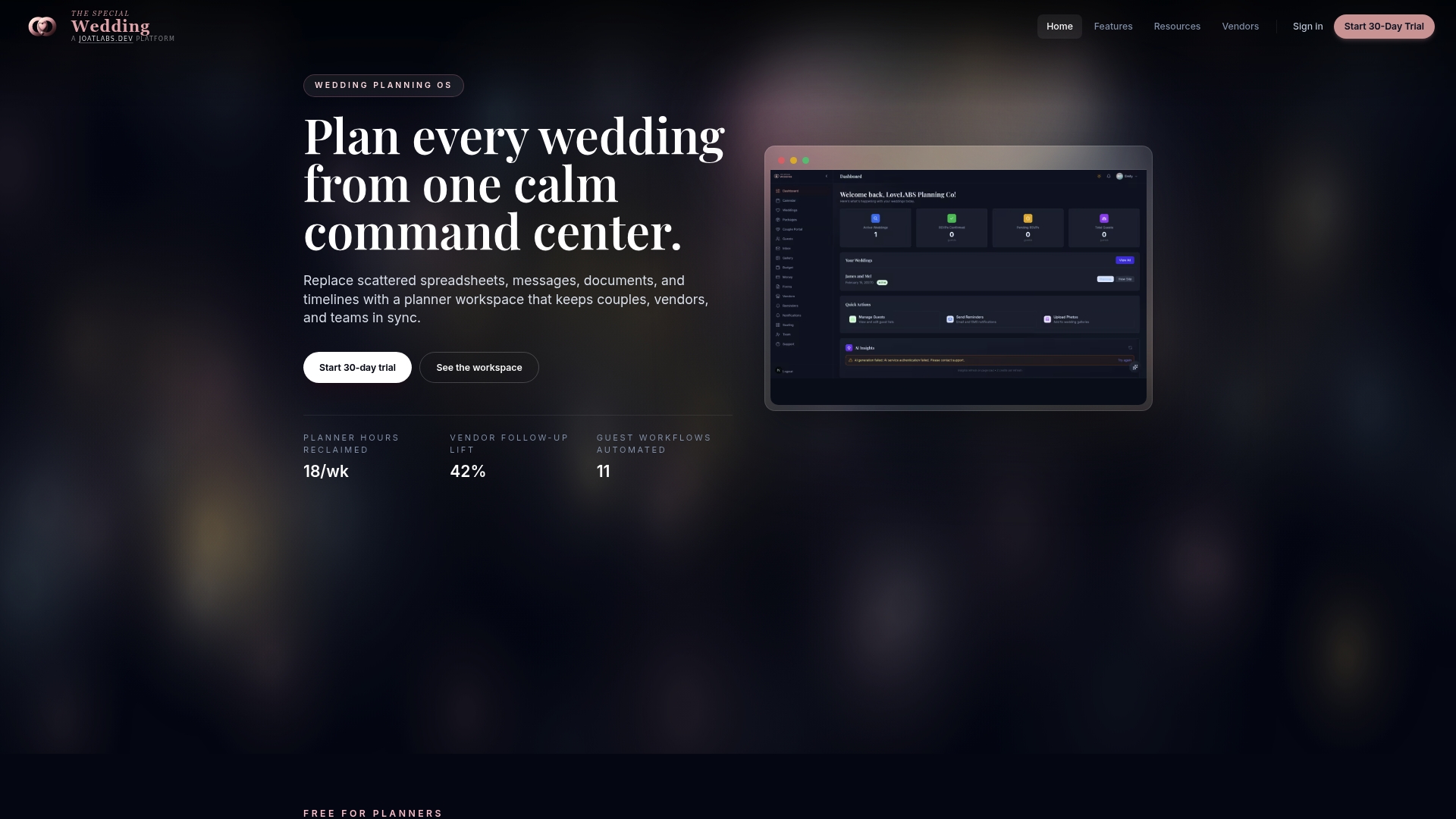
Whether you are coordinating a single-day ceremony or a multi-day celebration with 20 vendors, Thespecialwedding gives your team a shared view of every milestone, task, and message thread. You can browse verified local professionals through the vendor directory or connect directly with specialists like Events By Suad in Oklahoma City for full-service planning support. The platform scales from solo planners to full agencies, with role-based access and branded portals included.
FAQ
What are the three types of wedding vendor collaboration tools?
The three types are specialized wedding planning platforms, all-in-one business management software, and general project management apps. Each category differs in feature depth, wedding-specific functionality, and monthly cost.
Why do wedding vendors need collaborative tools?
Wedding planners average 14 vendors per event and lose over 30 minutes daily when information is fragmented across disconnected apps. Centralized tools eliminate that waste and reduce day-of errors caused by missed communications.
What is a timeline cascade failure in wedding planning?
A timeline cascade failure occurs when a single vendor delay triggers a chain of downstream schedule shifts across the entire event. Dynamic linked tools with automated alerts prevent this by notifying all affected vendors the moment a change occurs.
How much do wedding vendor collaboration tools cost?
Costs range from $19 to $120+ per month depending on the category and feature tier. General project management apps often start free, while premium all-in-one platforms with white-label portals sit at the higher end of that range.
How do collaboration tools help build vendor referral networks?
Standardized, reliable communication through centralized platforms builds trust with vendors over time. Vendors who consistently receive clear instructions and timely updates are more likely to recommend the planner to their own clients.
Recommended
- Why Agencies Use Wedding Software Platforms in 2026 | The Special Wedding Blog
- Types of Wedding Event Management Systems in 2026 | The Special Wedding Blog
- Introducing The Special Wedding: One Platform to Replace Your Entire Tool Stack | The Special Wedding Blog
- Why Vendors Use Shared Wedding Timelines | The Special Wedding Blog
Free wedding planner templates
Skip the blank page — these templates ship with the form fields you actually need.
Browse all 9 free templates →