Vendor Categorization on a Wedding Platform Explained
Vendor Categorization on a Wedding Platform Explained
Vendor categorization on a wedding platform is defined as the structured grouping of wedding service providers into specialized categories so that planners can search, vet, and manage them through tailored workflows. Platforms typically manage 8–12 core categories including venue, catering, photography, entertainment, florals, videography, and transport, each with its own data fields, contract logic, and verification steps. This classification system is the engine behind search filters, compliance tracking, and booking timelines. Without it, planners juggle a chaotic mix of spreadsheets, text threads, and disconnected documents. Understanding what vendor categorization does on a wedding platform is the first step toward running a tighter, faster operation.
What is vendor categorization on a wedding platform?
Vendor categorization is the practice of assigning every service provider to a defined category so the platform can apply the right rules, fields, and workflows to that vendor automatically. A caterer needs a health permit field and liability insurance tracking. A photographer needs a portfolio review and copyright terms. A DJ needs equipment specs and a noise ordinance acknowledgment. One generic profile template cannot handle all three correctly.
Multi-category vendor profiles require unique fields and logic per category to handle specific legal requirements, payment schedules, and operational workflows. That specificity is what makes the system work at scale. When a planner searches for a florist, the platform returns florists ranked by category-relevant signals, not a mixed list of every vendor in the database.

The industry term for this practice is vendor classification or vendor taxonomy, though “vendor categorization” is the phrase most planners use day to day. Both terms describe the same thing: a deliberate structure that turns a raw list of contacts into a manageable, searchable, and verifiable directory.
How does vendor categorization improve operational management?
Categorization gives planners a live view of where every vendor stands across every event they are managing. Without it, tracking a caterer’s contract status alongside a florist’s deposit deadline requires separate spreadsheets and constant manual updates. With it, a single dashboard shows both, filtered by category and event.
Planners managing multiple events track vendors through statuses from “Contacted” to “Fully Onboarded” to efficiently manage documentation and compliance. That progression is not just a label. Each stage triggers specific tasks: sending a contract, collecting insurance, confirming a deposit. Category determines which tasks appear at each stage.
Here is how categorization changes day-to-day management for planners:
- Booking status tracking. Each vendor category has its own booking milestones. A venue moves from “Site Visit Scheduled” to “Contract Signed” to “Deposit Paid.” A florist moves from “Proposal Sent” to “Design Approved.” The platform tracks each path separately.
- Compliance document collection. Caterers require food handler certificates and liability insurance. Photographers require signed copyright releases. The platform prompts for the right documents based on category, not a one-size-fits-all checklist.
- Insurance renewal alerts. Vendor insurance expires on different schedules. Category-aware platforms flag renewals automatically, so a caterer’s lapsed coverage does not become a surprise two weeks before the event.
- Multi-event vendor overlap management. When the same DJ is booked for two events in the same month, category filters let you spot the conflict before it becomes a problem.
Pro Tip: Set up category-specific document checklists before you onboard your first vendor in each category. Retrofitting requirements after the fact costs far more time than building the structure upfront.
The shift from static spreadsheets to dynamic platform workflows is not just a convenience upgrade. It is a risk management move. A missed insurance renewal or an unsigned contract can expose a planner to real liability. Category-aware lifecycle stage tracking catches those gaps before they become crises.
How does categorization power platform search, vetting, and verification?
Category assignment is what makes platform search useful rather than overwhelming. When a planner filters for photographers in a specific city, the algorithm returns photographers ranked by category-specific performance signals, not a generic relevance score. Algorithms prioritize active, reliable vendors based on category-specific performance indicators like response time and recent reviews. A photographer with a fast response rate and recent five-star reviews ranks higher than one with an older profile and no recent activity.
Verification works the same way. Each category has its own onboarding requirements:
- Venues submit capacity documentation, liability insurance, and venue photos.
- Caterers provide health permits, food handler certifications, and liability coverage.
- Photographers submit portfolio samples, copyright agreement acknowledgment, and business registration.
- DJs and bands confirm equipment lists, noise compliance awareness, and backup equipment policies.
- Florists provide business licenses and sample work galleries.
Verified onboarding typically involves 4–5 stages including identity verification, bank linking for payouts, and insurance submission. Each stage is gated, meaning a vendor cannot advance until the previous step is complete. That structure reduces fraud and improves the quality of leads that reach planners.
Categorization also powers recommendation engines. Vendor categorization powers algorithmic discovery by matching couples and planners with vendors based on category relevance, location, and business health metrics. A planner searching for a caterer in Oklahoma City gets results ranked by catering-specific signals, not by how many total bookings a vendor has across all categories.
Pro Tip: When evaluating a wedding platform, ask specifically how it handles category-specific verification. A platform that applies the same onboarding checklist to every vendor type is not built for professional planner use.
Essential vs. enhancement vendors: what the distinction means for your timeline
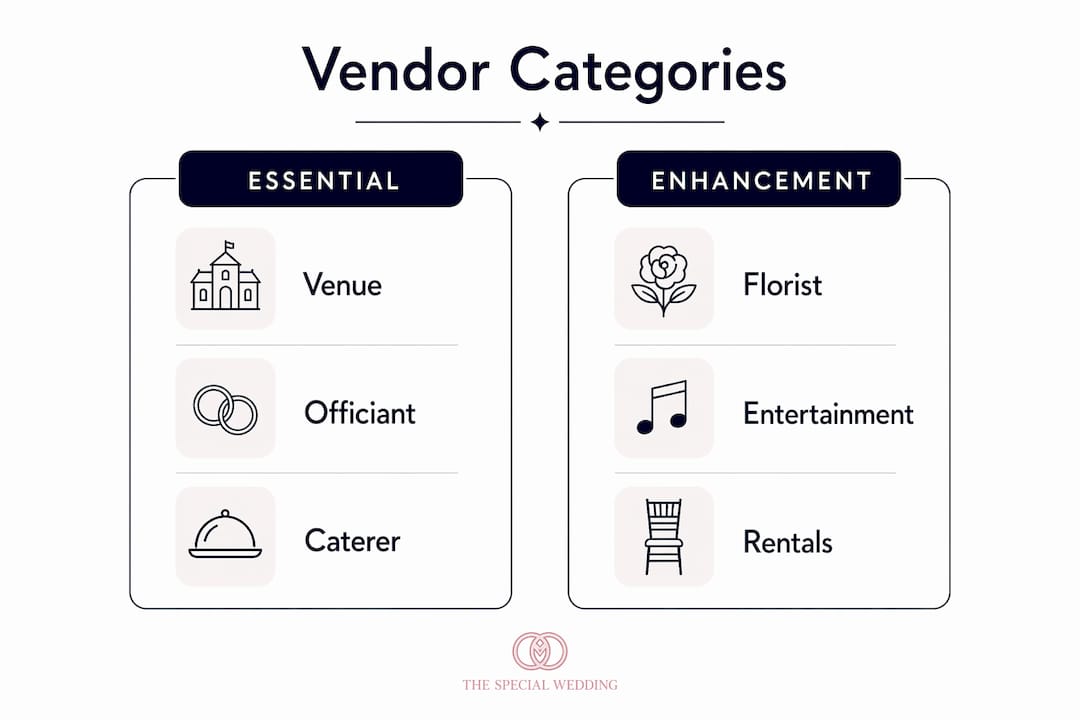
The most operationally significant categorization split is between essential and enhancement vendors. Essential vendors include venue, officiant, caterer, and photographer and should be booked 12–18 months in advance due to their foundational role. Enhancement vendors like florists and DJs offer scheduling flexibility and are typically booked 6–9 months out.
| Category type | Examples | Booking window | Planning impact |
|---|---|---|---|
| Essential | Venue, officiant, caterer, photographer | 12–18 months out | Determines event feasibility and legal validity |
| Enhancement | Florist, DJ, cake baker, videographer | 6–9 months out | Shapes guest experience and event atmosphere |
Essential vendors underpin the legal and logistical feasibility of the event. Without a licensed officiant, the marriage is not legal. Without a venue, nothing else matters. Platforms that recognize this distinction apply stricter verification requirements and earlier booking prompts to essential categories.
Enhancement vendors are experience-elevating but flexible. If your first-choice florist is unavailable, you have options. If your venue cancels six weeks out, you have a crisis. That difference in stakes is why category-aware platforms treat these groups differently in their contract and payment logic.
Pro Tip: Use your platform’s category filters to build a booking priority list at the start of every new event. Lock in essential vendors first, then open the enhancement category searches once those contracts are signed.
Best practices for integrating vendor categorization into your workflow
The planners who get the most out of vendor categorization treat it as a live operational system, not a filing method. The goal is to see the status of every vendor, in every category, across every active event, without opening a single spreadsheet.
Kanban-style onboarding stages per vendor category allow planners to identify and resolve bottlenecks such as missing contracts or deposits across multiple simultaneous events. The stages typically run: Contacted, Quote Received, Contract Out, Contract Signed, Deposit Paid, Fully Onboarded. Each column shows you exactly where every vendor sits.
Practical ways to apply this in your daily workflow:
- Filter by category and event simultaneously. When you are two months out from a specific wedding, filter your vendor board to show only that event’s caterers and photographers. Spot gaps instantly.
- Set automated alerts by category. Insurance renewals for caterers, deposit deadlines for venues, and contract expiration dates for photographers all run on different schedules. Automated reminders and lifecycle tracking improve operational efficiency and reduce compliance surprises.
- Use category-specific communication templates. The message you send to a florist confirming a floral design is different from the one you send to a caterer confirming a tasting. Templates built per category save time and reduce errors.
- Track document lifecycles by category. A caterer’s health permit expires annually. A photographer’s contract is event-specific. Platforms that manage these separately prevent you from applying the wrong renewal logic to the wrong vendor type.
The wedding coordinator’s role in vendor scheduling becomes far more manageable when category filters replace manual cross-referencing. You stop asking “did I follow up with the florist?” and start seeing the answer on your dashboard in real time.
Key Takeaways
Vendor categorization is the structural foundation of effective wedding platform management, and planners who use it correctly reduce compliance gaps, speed up onboarding, and manage more events with less friction.
| Point | Details |
|---|---|
| Categorization drives platform logic | Each vendor category gets unique fields, verification steps, and contract requirements. |
| Essential vendors need earlier booking | Venue, caterer, officiant, and photographer require a 12–18 month booking window. |
| Kanban stages replace spreadsheets | Tracking vendors from “Contacted” to “Fully Onboarded” by category prevents missed steps. |
| Verification is category-specific | Caterers need health permits; photographers need portfolio reviews and copyright terms. |
| Algorithms rank by category signals | Response time and recent reviews within a category determine vendor visibility to planners. |
Why generic tools will always fall short here
Generic vendor management dashboards overlook category-specific requirements, causing operational failures. I have seen this play out repeatedly. A planner builds a beautiful spreadsheet with columns for every vendor. Six months in, they are managing four weddings, and the spreadsheet has 14 tabs. The caterer’s insurance expired three weeks ago. Nobody noticed because the spreadsheet does not send alerts.
The uncomfortable truth about vendor management in wedding planning is that the problem is not organization. Most planners are organized. The problem is that different vendor categories have genuinely different legal, operational, and financial requirements, and no single generic system handles all of them correctly at the same time.
The future of this space points toward AI-enhanced categorization, where platforms auto-assign vendor types based on profile content and flag anomalies in real time. AI is already changing how wedding platforms surface vendor recommendations and validate profile data. That shift will make category-aware tooling even more powerful, but only for planners who have already built their workflows around proper categorization.
My honest recommendation: stop evaluating platforms by their feature count. Evaluate them by whether they treat a caterer differently from a photographer at every stage of the vendor lifecycle. If they do not, you will spend more time managing the platform than managing your events.
— JOATLABS
Thespecialwedding’s vendor directory built for planners
Thespecialwedding is built around the categorization logic this article describes. Every vendor in the platform carries a category-specific profile with the right fields, verification requirements, and booking data for that vendor type.
Planners can browse the full vendor directory to find categorized providers across venues, entertainment, rentals, lighting, stationery, and more, each with tailored profile data that reflects their specific service requirements. The platform tracks contracts, deposits, and insurance renewals by category across all your active events. Whether you are sourcing a lighting vendor like JAM Events and Productions or an MC for the reception, every search returns category-relevant results with the operational detail you need to make a confident booking decision.
FAQ
What is vendor categorization on a wedding platform?
Vendor categorization is the practice of grouping wedding service providers into defined categories so a platform can apply the right data fields, verification steps, and workflow logic to each vendor type automatically.
What are the main vendor categories on wedding platforms?
Platforms typically manage 8–12 core categories including venue, catering, photography, videography, florals, entertainment, transport, and rentals, each with category-specific profile fields and compliance requirements.
Why does vendor categorization matter for wedding planners?
Categorization lets planners track booking statuses, collect the correct compliance documents, and manage vendor lifecycles across multiple events without relying on manual spreadsheets or generic contact lists.
What is the difference between essential and enhancement vendors?
Essential vendors such as venues, officiants, caterers, and photographers underpin event feasibility and require booking 12–18 months in advance. Enhancement vendors like florists and DJs are experience-focused and are typically booked 6–9 months out.
How does vendor categorization affect platform search results?
Algorithms rank vendors within their category using performance signals like response time and recent reviews, so planners see the most active and reliable providers first when filtering by vendor type.
Recommended
- Types of Wedding Event Management Systems in 2026 | The Special Wedding Blog
- Why Agencies Use Wedding Software Platforms in 2026 | The Special Wedding Blog
- Introducing The Special Wedding: One Platform to Replace Your Entire Tool Stack | The Special Wedding Blog
- Vendor Directory | The Special Wedding
Free wedding planner templates
Skip the blank page — these templates ship with the form fields you actually need.
Browse all 9 free templates →