Wedding Agency Capacity Planning: A 2026 Guide
Wedding Agency Capacity Planning: A 2026 Guide
Wedding agency capacity planning is defined as the strategic process of matching your team’s available time, skills, and budget against client demand to deliver every event without overloading staff or leaving resources idle. In the wedding industry, this practice goes by a more formal name in operations management: resource capacity management. Both terms describe the same discipline, and understanding it is the difference between an agency that grows and one that stalls. Capacity planning focuses on whether your team has enough bandwidth to take on and deliver client projects, preventing emergency staffing gaps before they happen. For wedding planners managing multiple events at once, that discipline is not optional. It is the foundation of a profitable, sustainable agency.
What is wedding agency capacity planning and why does it matter?
Wedding agency capacity planning is the method agencies use to align human resources, time, and operational budgets with the volume of weddings they commit to delivering. The core goal is balance. Too many bookings without enough staff creates burnout and quality failures. Too few bookings with a full team creates idle time and cash flow problems.

The industry has historically run on instinct. A planner books a saturday in june, then another, then a third, and suddenly the calendar is full with no clear picture of who is doing what. That approach works for solo operators managing two or three events per year. It breaks down fast when an agency scales to ten or twenty weddings per season.
Effective capacity management for weddings requires tracking three things simultaneously: who is available, when they are available, and what each project actually demands in hours. Without that data, every booking decision is a guess. With it, you can price accurately, hire proactively, and protect your team from the kind of overcommitment that leads to staff turnover and client complaints.
What are the core components of agency resource allocation?
Wedding agency resource allocation rests on four measurable components: human capital, time availability, budget limits, and pipeline visibility. Each one feeds the others.
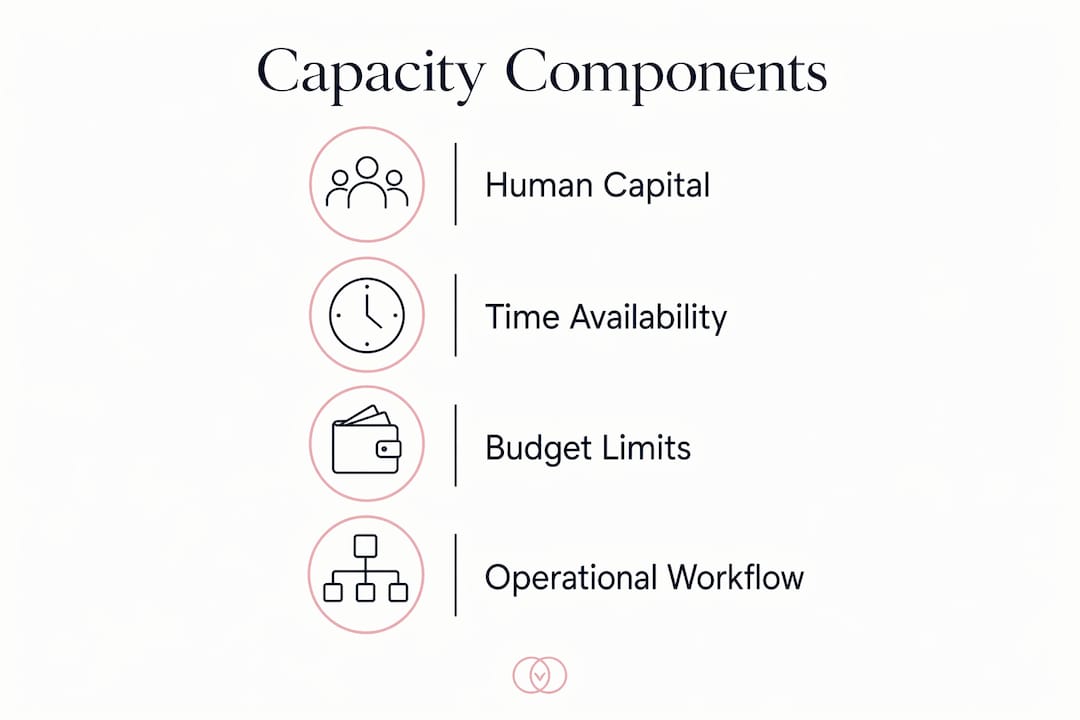
Human capital covers every role in your agency, from lead planners to associate coordinators to day-of staff. Each role carries a different hourly capacity and a different skill set. A lead planner might have 30 billable hours per week available after admin tasks. An associate coordinator might have 20. Knowing those numbers precisely is the starting point for every capacity decision.
Time availability is not just about open calendar slots. It accounts for travel time, vendor meetings, client calls, and the administrative load that comes with each wedding. A planner booked for a saturday wedding is often unavailable for the two days before and the day after for setup, execution, and wrap-up tasks.
Budget and operational limits set the ceiling on how many events you can staff without hiring. If your current payroll supports five concurrent active weddings, booking a sixth requires either outsourcing or a new hire. That decision should be data-driven, not reactive.
Pipeline metrics are where most agencies fall short. Tracking billable hours, close rates, and pipeline velocity gives you a forward view of demand. Agencies should categorize their forecast using three buckets: committed capacity (signed contracts), probable capacity (proposals in final negotiation), and speculative capacity (early inquiries). When your speculative pipeline exceeds twice your probable pipeline, that signals growth opportunity, but also real risk if conversions run higher than expected.
- Committed capacity: Signed contracts with confirmed dates and deposits received.
- Probable capacity: Active proposals where the client has expressed strong intent to book.
- Speculative capacity: Inquiries and consultations with no commitment yet.
- Idle capacity: Available team hours with no assigned project.
Pro Tip: Build a simple weekly tracker that shows each team member’s committed hours versus available hours. That single view will surface overcommitment faster than any calendar review.
How do agencies move from founder-led scheduling to scalable systems?
The shift from manual, founder-led scheduling to a repeatable system is the single most important transition a growing wedding agency makes. Being booked solid caps income and growth because a solo planner is limited by the number of weekends in a year and the hours in a day. Scalability requires defined roles, standardized workflows, and real delegation.
Here is how successful agencies make that transition:
- Document every task in the wedding lifecycle. List every action from initial inquiry to post-event follow-up. Assign each task a role, a time estimate, and a trigger date relative to the wedding date. This becomes your master workflow template.
- Define role boundaries clearly. A lead planner owns client relationships and vendor negotiations. An associate coordinator owns logistics execution and vendor day-of communication. A coordinator assistant handles setup, guest management, and timeline tracking. Blurring these lines is where agencies lose hours.
- Automate task assignment from the wedding date backward. If a wedding is on a saturday in october, the system should auto-generate a florist confirmation task for eight weeks prior, a venue walkthrough for six weeks prior, and a final timeline delivery for two weeks prior. Structured workflows reduce administrative time from hours to minutes per event.
- Separate capacity planning from daily scheduling. Capacity planning answers “can we take this wedding?” Scheduling answers “who does what and when?” Mixing these two functions creates confusion and avoidable disputes in small agencies.
- Involve the whole team in forecasting. Team-wide participation in capacity forecasting produces more accurate availability data and reduces burnout risk. A planner who flags their own overload early is far less likely to drop the ball on a client.
Pro Tip: Use a wedding agency team management framework to assign role ownership before peak season starts, not during it. Reactive role assignment during a busy weekend is a recipe for missed tasks.
What frameworks help forecast wedding agency capacity effectively?
The most reliable forecasting framework for wedding agencies is the rolling 4–6 week forecast with three capacity categories. Rolling forecasts outperform detailed long-term predictions because they stay close to real conditions. A forecast built in january for a june wedding is largely guesswork. A forecast updated weekly for the next six weeks is a decision tool.
The framework works like this. Each week, your agency reviews committed, probable, and speculative capacity across all active and pending weddings. You compare total projected hours against total available team hours. The gap tells you whether to accept new inquiries, push back timelines, or start a hiring conversation.
Separating strategic capacity planning from daily scheduling strengthens this process. Strategic planning happens at the agency level, monthly or quarterly, to assess overall growth trajectory. Scheduling happens at the project level, weekly, to assign specific tasks to specific people. Agencies that conflate the two end up making growth decisions based on this week’s chaos rather than next quarter’s pipeline.
Two additional practices sharpen forecast accuracy:
- Use signed contracts as your only committed capacity. A verbal yes is speculative until a deposit clears. Treating verbal agreements as committed leads to overstaffing and awkward conversations when deals fall through.
- Set a capacity threshold before hiring. Define the percentage of team utilization that triggers an outsourcing or hiring decision. Many agencies use 80% as the threshold. Above that, quality and team morale both decline. Data-driven hiring decisions avoid the crisis of overcommitment that forces agencies to turn away qualified clients at peak season.
For managing lead pipelines effectively, tracking inquiry-to-booking conversion rates gives you a more accurate picture of how much speculative capacity will actually convert to committed work.
How to apply capacity planning when managing multiple simultaneous weddings
Managing multiple weddings at once requires a structured approach to role assignments, timeline overlaps, and stress signals. The planning strategies that work for one wedding a month break down completely when you are running four weddings in a single weekend.
Start by mapping the full lifecycle of each wedding into your workflow system. Every wedding should have the same structural template: inquiry, consultation, proposal, contract, planning phases, vendor coordination, final confirmation, execution, and post-event wrap-up. Consistency in structure is what makes delegation possible.
- Assign a single lead planner per wedding. That person owns client communication and final decisions. No client should ever wonder who their main contact is.
- Use associate planners for parallel execution. When two weddings fall on the same weekend, your lead planner handles the higher-complexity event while an associate manages the second with clear escalation protocols.
- Build buffer time into every weekend block. A planner executing a saturday wedding should not be scheduled for a friday rehearsal dinner at a different venue unless travel and prep time are explicitly accounted for.
- Watch for capacity stress signals. Turning away qualified inquiries, stretched response times, and planners skipping their own days off are all signs your agency is operating above sustainable capacity.
- Review staff role assignments before each peak season block. Role clarity before a busy stretch prevents the mid-season scramble that burns out your best people.
Capacity planning as a recurring ritual means weekly allocation updates and monthly pipeline checks. Agencies that treat it as a one-time setup task lose the predictability that makes growth possible.
Pro Tip: Color-code your team calendar by wedding, not by task type. At a glance, you should be able to see which planner is touching which event on any given day. If one color dominates one person’s week, that is your overcommitment signal.
Key takeaways
Wedding agency capacity planning is the core discipline that separates agencies that scale sustainably from those that stall at founder capacity, and it requires weekly forecasting, defined roles, and clear separation of planning from scheduling.
| Point | Details |
|---|---|
| Define capacity before booking | Track committed, probable, and speculative hours before accepting new clients. |
| Separate planning from scheduling | Strategic capacity decisions and daily task assignments require different processes and different cadences. |
| Rolling forecasts beat long-term plans | A 4–6 week rolling forecast stays accurate; annual projections drift too far from real conditions. |
| Role clarity enables delegation | Lead planners, associates, and coordinators each need defined ownership to prevent task overlap and missed handoffs. |
| Capacity planning is a weekly habit | Monthly pipeline checks and weekly allocation reviews keep agencies agile and profitable through peak season. |
Why “booked solid” is the wrong goal
The wedding industry celebrates full calendars. Planners post about being booked through the next two years as proof of success. I have watched that mindset quietly destroy agencies that had real potential.
Being fully booked without a scalable system does not mean you are thriving. It means your income is capped by your own physical availability. Every weekend you are on-site is a weekend you cannot take a new client, build a new process, or train a new team member. Without delegation and standardization, your agency’s revenue ceiling is your personal calendar.
The agencies I have seen grow past that ceiling share one habit: they treat capacity planning as a recurring ritual, not a one-time setup. They review their pipeline every week. They update role assignments before each season. They make hiring decisions based on utilization data, not gut feel. That discipline is not glamorous. It does not make for a good instagram post. But it is what turns a busy solo planner into a real agency.
The cultural shift matters as much as the process. When your team participates in capacity forecasting, they flag their own limits before those limits become your client’s problem. That kind of transparency is only possible when planning is a team activity, not a founder’s private spreadsheet.
— JOATLABS
How Thespecialwedding supports your capacity planning workflow
Capacity planning works best when your team data, vendor contacts, and event timelines all live in one place. Jumping between spreadsheets, email threads, and separate calendar tools adds hours of administrative work that your planners should be spending on clients.
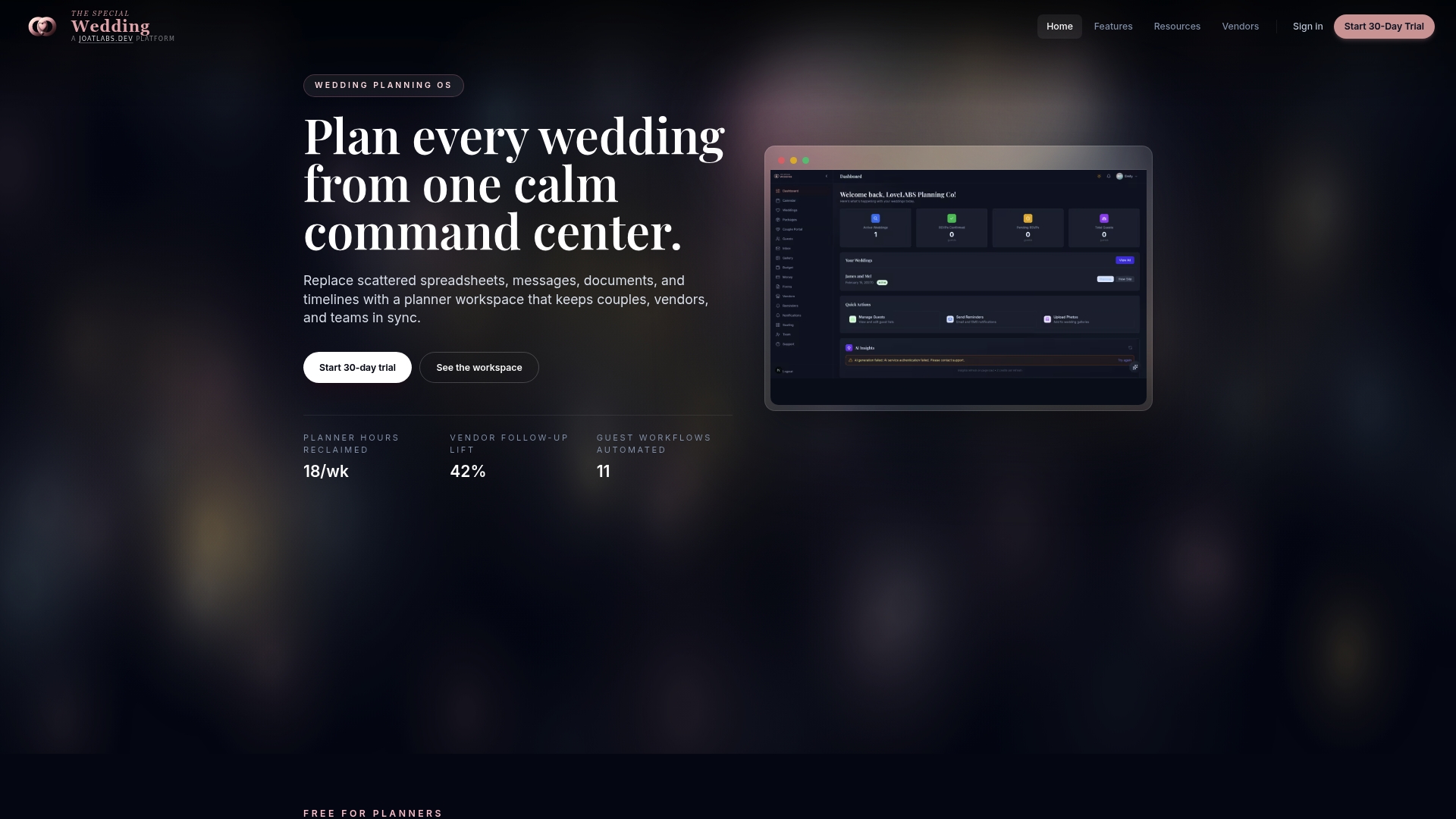
Thespecialwedding gives wedding agencies a centralized workspace where client intake, vendor coordination, event timelines, and team communication run together. The vendor directory connects you directly to vetted vendors, so resource allocation decisions happen faster and with better information. Whether you are a solo planner building your first repeatable system or an agency managing a full season of events, Thespecialwedding is built to replace the scattered tools that slow your team down and replace them with one organized, collaborative platform.
FAQ
What is wedding agency capacity planning in simple terms?
Wedding agency capacity planning is the process of matching your team’s available hours and skills to the weddings you have booked or plan to book. It prevents overcommitment and idle time by giving you a clear picture of what your agency can realistically deliver.
How often should a wedding agency review its capacity?
Weekly allocation updates combined with monthly pipeline checks give agencies the best balance of agility and predictability. Reviewing only at the start of a season leaves too many gaps.
What are the signs a wedding agency is over capacity?
The clearest signs are turning away qualified inquiries, planners missing their own days off, and client response times stretching beyond 24 hours. These signals indicate your team is operating above a sustainable workload.
Should vendors be included in agency capacity counts?
Vendors are external resources, not internal capacity. Track their availability separately from your team’s hours. Vendor bottlenecks affect delivery timelines but do not replace the need to manage your own team’s bandwidth.
What is the difference between capacity planning and scheduling?
Capacity planning answers “can we take this wedding?” while scheduling answers “who does what and when?” Keeping these two functions separate reduces confusion and makes allocation decisions easier to defend.
Recommended
- Wedding Agency Team Management: A 2026 Guide | The Special Wedding Blog
- Wedding Agency Staff Role Assignments: 2026 Guide | The Special Wedding Blog
- Why Agencies Use Wedding Software Platforms in 2026 | The Special Wedding Blog
- Wedding Lead Management for Planners: 2026 Guide | The Special Wedding Blog
Free wedding planner templates
Skip the blank page — these templates ship with the form fields you actually need.
Browse all 9 free templates →