4 Phase Wedding Contract Management Migration for Planning Studios
4 Phase Wedding Contract Management Migration for Planning Studios
A wedding contract management system centralizes contract creation, e-signatures, payment milestones, and vendor tracking inside one per-event workspace instead of spreading them across email, spreadsheets, and shared drives. For a studio running a dozen weddings at once, that consolidation cuts reconciliation time, prevents missed vendor payments, and keeps every signed document ready for an audit. The right setup pairs templated contracts with event-anchored payment schedules and a searchable archive.
TL;DR:
- Centralized contract management reduces reconciliation time and prevents missed vendor payments by consolidating all event-related documents into one system.
- Templates, role-based permissions, and timestamped signatures streamline workflows and improve tracking of signatures, amendments, and approvals.
- Using milestone-relative scheduling and automated payment reminders minimizes manual errors and eases cash flow management across multiple weddings.
- Phased migration from spreadsheets to dedicated software minimizes risks, with structured setup, testing, and backup protocols ensuring data integrity.
- Enforcing strict data privacy rules and comprehensive audit logs protects sensitive information and supports dispute resolution.
Thespecialwedding thespecialwedding.io
Bring Wedding Workflows Together
TheSpecialWedding brings contracts, vendor coordination, timelines, guest management, and communication into one collaborative workspace for planning studios.Explore TheSpecialWedding
Table of Contents
- What Contract and Payment Management Looks Like Inside a Wedding SaaS
- What to Require From a Contract Workflow: A Prioritized Checklist
- Payment and Milestone Workflows That Scale Across Many Weddings
- Migrating From Spreadsheets: A Phased Rollout Plan
- Governance Rules That Keep Records Accurate Across a Growing Team
- Handling Cancellations and Refunds in Contract Terms
- Common Legal Pitfalls in Wedding Contracts and How to Avoid Them
- Standard Clauses and Terms Unique to Wedding Contracts
- Data Privacy and Security for Contract Management Systems
- JOATLABS Perspective: What Centralization Actually Fixes
- How TheSpecialWedding.io Fits Your Contract Workflow
- Sources
What Contract and Payment Management Looks Like Inside a Wedding SaaS
Picture every wedding as its own project container. Inside that container sit the signed contracts, the invoices, the vendor contact records, and every payment receipt tied to that specific event. That is the data model behind a working wedding contract management workflow, and it is the piece most spreadsheet-based studios never build because spreadsheets have no concept of a “project.”
Templates do the heavy lifting inside that structure. A planner picks a contract type, and the system auto-populates the client name, event date, venue, and fee schedule straight from the event record. Nobody retypes a couples’ names into a fourth document.
E-signature flows live in the same workspace, so a signed contract does not need to be downloaded, renamed, and re-uploaded somewhere else. The signature event gets timestamped and attached directly to the record, which matters later when you need signing evidence, not just a signed PDF floating in an email thread.
The clearest operational win, though, is the ledger. Instead of a coordinator toggling between six wedding folders to answer “who still owes a deposit,” a consolidated view shows deposits collected, balances pending, and vendor payment status across every active wedding at once. That single view is what an event-anchored contract and payment platform is built to deliver, replacing the email-and-spreadsheet hunt with one connected record.
Rounding out the model:
- Per-event containers holding contracts, invoices, and vendor records together
- Template-driven contract generation pulling fields from the client record
- Timestamped e-signature evidence attached to the event, not floating in inbox
- A cross-event ledger showing balances and vendor payment status
- Payment processor and accounting integrations that avoid duplicate data entry
What to Require From a Contract Workflow: A Prioritized Checklist
Not every feature carries equal weight. Some are the floor you cannot operate without; others are the difference between “functional” and “genuinely fast.”
Start with the non-negotiables, then move down the list as budget and complexity allow:
- Per-event folders that keep every contract, amendment, and receipt tied to one wedding record.
- Native e-signature with timestamped proof, not a bolted-on third-party tool.
- Milestone-relative scheduling so payment due dates move automatically when an event date shifts.
- Searchable contract text, so you can find every contract with a specific liability clause in seconds, not by opening forty PDFs.
- Role-based permissions that control who can send a contract or approve a vendor payment.
- Audit logs recording who viewed, edited, or signed what, and when.
Beyond that floor, a handful of features pay for themselves fast: automatic filing of email attachments into the correct event folder, clean version control for change orders, a multi-vendor ledger that consolidates every wedding’s balances, and either direct payment initiation or a clean handoff to whatever processor you already use.
Nice-to-haves round things out. AI parsing that auto-files incoming vendor emails, client upload links that skip account creation, and branded client portals all add polish, but they solve convenience problems, not risk problems.
Pro Tip: Rank your evaluation list by what actually causes late-night panic. Missed signatures and missing payment status cause more studio crises than the absence of a fancy client portal ever will.
Payment and Milestone Workflows That Scale Across Many Weddings
A predictable payment cadence is what keeps a busy wedding season from turning into separate improvisations. Most studios settle on some version of a multi-stage payment structure including a retainer collected at signing, a progress payment some weeks before the event, and a final balance due shortly before the event.
The mistake many studios make is anchoring those dates to the calendar instead of the event itself. Anchor every milestone as an offset from the wedding date, and a reschedule becomes a one-field edit instead of a manual scramble across a dozen line items. That is precisely the mechanic milestone-relative payment scheduling is designed to solve: change the anchor date once, and every downstream trigger recalculates on its own.
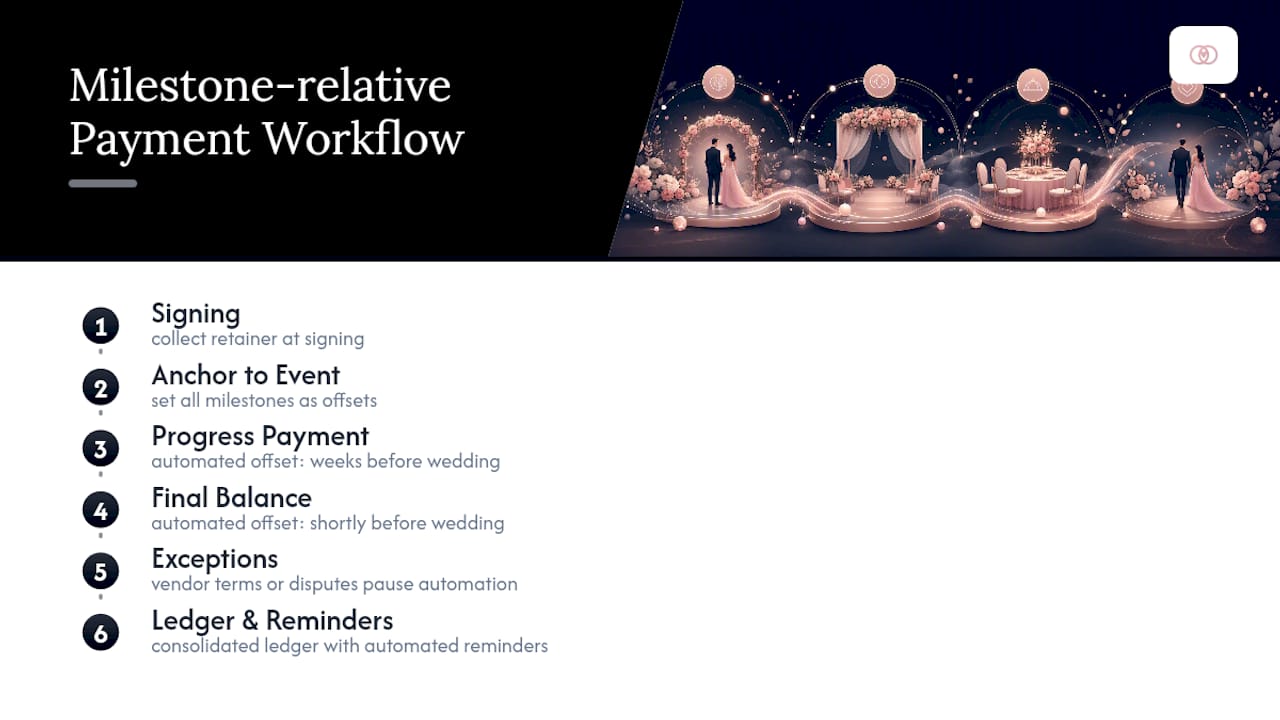
Exceptions still need a path. Some vendors work on 50/50 splits instead of three-stage cadences; some clients dispute a line item mid-cycle. Build conditional branches for vendor-specific terms, and make sure a dispute flag pauses automated payment initiation until a coordinator resolves it. Automating a payment nobody agreed to send is worse than sending no automation at all.
Cash flow strain is not a hypothetical for small planning firms. The SBA’s small business research consistently flags cash flow management as a top operational stress point, and a manual payment cadence run across ten or more concurrent weddings compounds that stress fast.
A consolidated ledger with automated reminders solves the practical version of this problem: fewer day-of payment crises, faster reconciliation, and a clear paper trail if a vendor disputes what was owed.
Migrating From Spreadsheets: A Phased Rollout Plan
Ripping out your entire contract workflow overnight is how studios lose signed documents mid-transition. Do it in phases instead.
- Phase 0, audit. Inventory every contract template, every vendor’s payment terms, and your current cadence. Pick one upcoming wedding, ideally a mid-complexity one, as your pilot.
- Phase 1, structure. Set up per-event folders, import that pilot wedding’s active contracts, and configure standard templates with e-signature flows attached.
- Phase 2, automate. Turn on milestone-relative scheduling, connect payment and accounting integrations, and run one vendor and one client contract fully end to end.
- Phase 3, parallel run. Track both systems side by side for two to four weeks. Log every exception you hit, train the rest of the team on the new flow, and only then retire the spreadsheets.
A few items belong on every migration checklist regardless of platform: back up the old files before anyone deletes anything, confirm audit logs are actually capturing signature and edit events, assign permission roles before go-live rather than after a mistake, and write down your change-order process so amendments do not get treated as brand-new contracts.
This phased approach mirrors how a structured quote-to-contract workflow should already move a lead from proposal to signed agreement.
Pro Tip: Run your pilot wedding on a client who is organized and low drama. A migration test on your most complicated event will confuse “system issue” with “this couple has six vendors changing their minds weekly.”
Governance Rules That Keep Records Accurate Across a Growing Team
A file naming standard sounds like a small thing until three coordinators are each naming contracts differently. Settle on one pattern early: something like Events/[Event Name]/Contracts/[Vendor]-Contract-[version].pdf, with signed documents kept in a separate folder from drafts so nobody accidentally sends an unsigned version to a vendor.
Permissions need equal rigor. Decide, in writing, who can send a contract for signature, who can approve a vendor payment, and who has authority to resolve a client dispute. Vague ownership is how a $3,000 deposit gets released twice.
Audit logs and retention policy matter more than most studios realize until a dispute lands. At minimum, keep:
- Who sent, viewed, and signed each contract, with timestamps
- Signed contracts and payment receipts retained for a defined period after the event
- A record of every permission change on sensitive documents
Change orders deserve their own discipline. Attach every amendment to the original contract rather than treating it as a standalone document, and keep the version history visible so anyone reviewing the file later can see exactly what changed and when.
Handling Cancellations and Refunds in Contract Terms
Cancellation terms are where vague wedding contracts turn into disputes. A workable clause spells out three things clearly: what triggers a cancellation, what portion of payments already made is refundable at each stage, and how quickly a refund (if owed) gets processed.
Most studios structure refund terms on a sliding scale tied to how close the cancellation falls to the wedding date. A retainer paid at signing is typically non-refundable, since it compensates for holding the date and turning down other bookings. Progress payments made closer to the event often become partially or fully non-refundable, since vendors have already committed labor, rentals, or ordered materials by that point.
Force majeure clauses need separate treatment from ordinary cancellations. A couple canceling because of cold feet is a different legal situation than a wedding canceled because of a natural disaster or a venue closure, and your contract should not lump both scenarios under one refund rule.
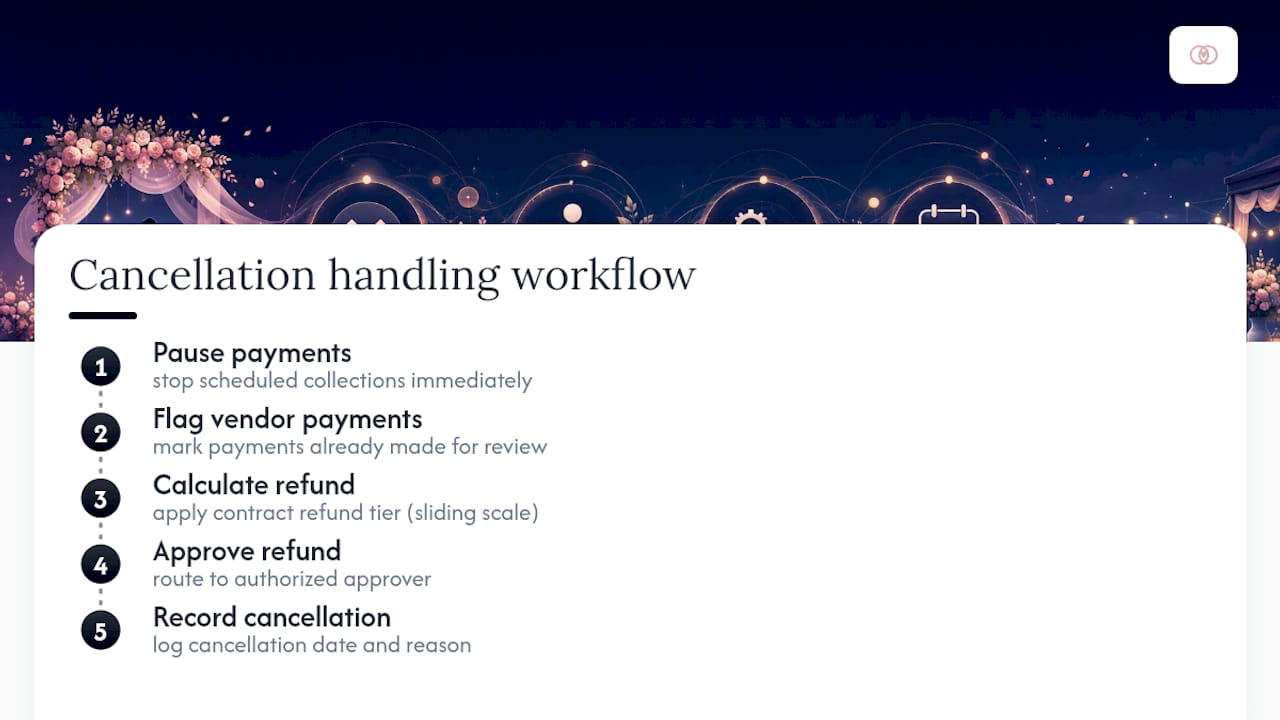
Inside a contract management workflow, this is where automation needs a manual override. A cancellation should immediately pause any scheduled payment collection tied to that event, flag the vendor payments already made for review, and route the refund calculation to whoever has authority to approve it. Never let an automated payment schedule keep firing after a wedding has been called off. Document the cancellation date and the reason inside the event record itself, since that timestamp often determines which refund tier applies.
Common Legal Pitfalls in Wedding Contracts and How to Avoid Them
The most frequent legal mistake in wedding contracts is vague scope language. A contract that says “planner will coordinate the wedding” without defining what coordination includes leaves both sides guessing when a dispute arises over whether setup, vendor management, or day-of logistics were covered.
A second common pitfall is missing liability language. Contracts should state clearly what happens if a vendor fails to show, if weather forces a venue change, or if a planner becomes unavailable due to illness. Silence on these points does not protect you; it just pushes the disagreement into a courtroom or a small claims filing later.
Payment terms that lack specific dates cause a surprising number of disputes. “Final payment due before the wedding” is not a date. Specify an exact number of days before the event, and tie that number to the event date itself so it survives a reschedule without needing a manual rewrite.
Signature and consent gaps matter more than planners expect. A contract signed by only one member of a couple, or an amendment agreed to verbally and never documented, weakens your position if a dispute reaches a lawyer. Every amendment needs its own signature or documented consent, attached to the original agreement rather than existing as a side conversation.
Finally, jurisdiction and governing law clauses get skipped constantly. Naming which state’s law governs the contract, and where any dispute would be resolved, saves real cost if a disagreement ever escalates.
Standard Clauses and Terms Unique to Wedding Contracts
Wedding contracts carry a handful of clauses that rarely show up in general service agreements, mostly because weddings involve a fixed, unmovable date and a large upfront financial commitment.
A date exclusivity clause confirms the planner is reserving that specific date and turning away other business, which is the legal basis for a non-refundable retainer. A force majeure clause defines what qualifies as an uncontrollable event, ranging from severe weather to venue closures, and states what happens to payments already made if one occurs.
A scope of services clause lists exactly what the planner delivers, from vendor coordination to day-of timeline management, and just as importantly, what is excluded. A change order clause sets the process for adding services after signing, typically requiring written consent and an updated payment schedule rather than a verbal add-on.
Liability and indemnification language limits what the planner is responsible for when a third-party vendor fails to perform, since a planner coordinating a caterer or florist is not usually liable for that vendor’s own failures. A termination clause spells out how either party can end the agreement before the wedding and what financial obligations survive that termination.
Wedding contracts also commonly include a payment schedule clause tied explicitly to the event date rather than fixed calendar dates, which is exactly the structure that keeps automated milestone tracking accurate through a reschedule.
Data Privacy and Security for Contract Management Systems
Wedding contracts hold sensitive personal and financial information: full legal names, addresses, payment card details, and sometimes household income context tied to budget discussions. Treat that data with the same seriousness a financial services firm would.
Access control is the first line of defense. Not every team member needs to see every client’s payment information, and a role-based permission structure limits exposure if a login credential is ever compromised. Encryption matters both at rest and in transit; contracts and payment records sitting in an unencrypted shared drive are a liability waiting to surface.
Audit logging plays a security role beyond dispute resolution. A log that records every access to a contract or payment record makes it possible to spot unusual activity, like a former employee’s credentials still being used after departure.
Payment data specifically should never be stored as raw card numbers inside a contract management tool. Integration with a PCI-compliant payment processor keeps that sensitive data off your own servers entirely, which reduces both your compliance burden and your breach exposure. Retention policy matters here too: decide how long signed contracts and payment records need to be kept for legal and tax purposes, then delete or archive what falls outside that window rather than keeping everything indefinitely by default.
JOATLABS Perspective: What Centralization Actually Fixes
The failure pattern is consistent: contracts scattered across inboxes, a vendor payment missed because nobody cross-checked three spreadsheets, and a coordinator reconstructing what happened after the fact instead of during it. Centralizing contract and payment data does not eliminate every problem, but it removes the specific failure mode of information existing in a place nobody remembered to check.
The studios that benefit most are running enough concurrent weddings that manual cross-referencing stops scaling. Time savings from consolidating scattered tools show up fastest in reconciliation and dispute resolution. This is exactly where manual systems break down under volume.
— JOATLABS
How TheSpecialWedding.io Fits Your Contract Workflow
Thespecialwedding is built around the exact checklist covered above: per-event workspaces, contract templates, e-signature capture, and milestone scheduling anchored to each wedding’s date rather than a fixed calendar. Team permissions control who sends contracts and who approves vendor payments, and every signed document files itself into that event’s archive automatically.
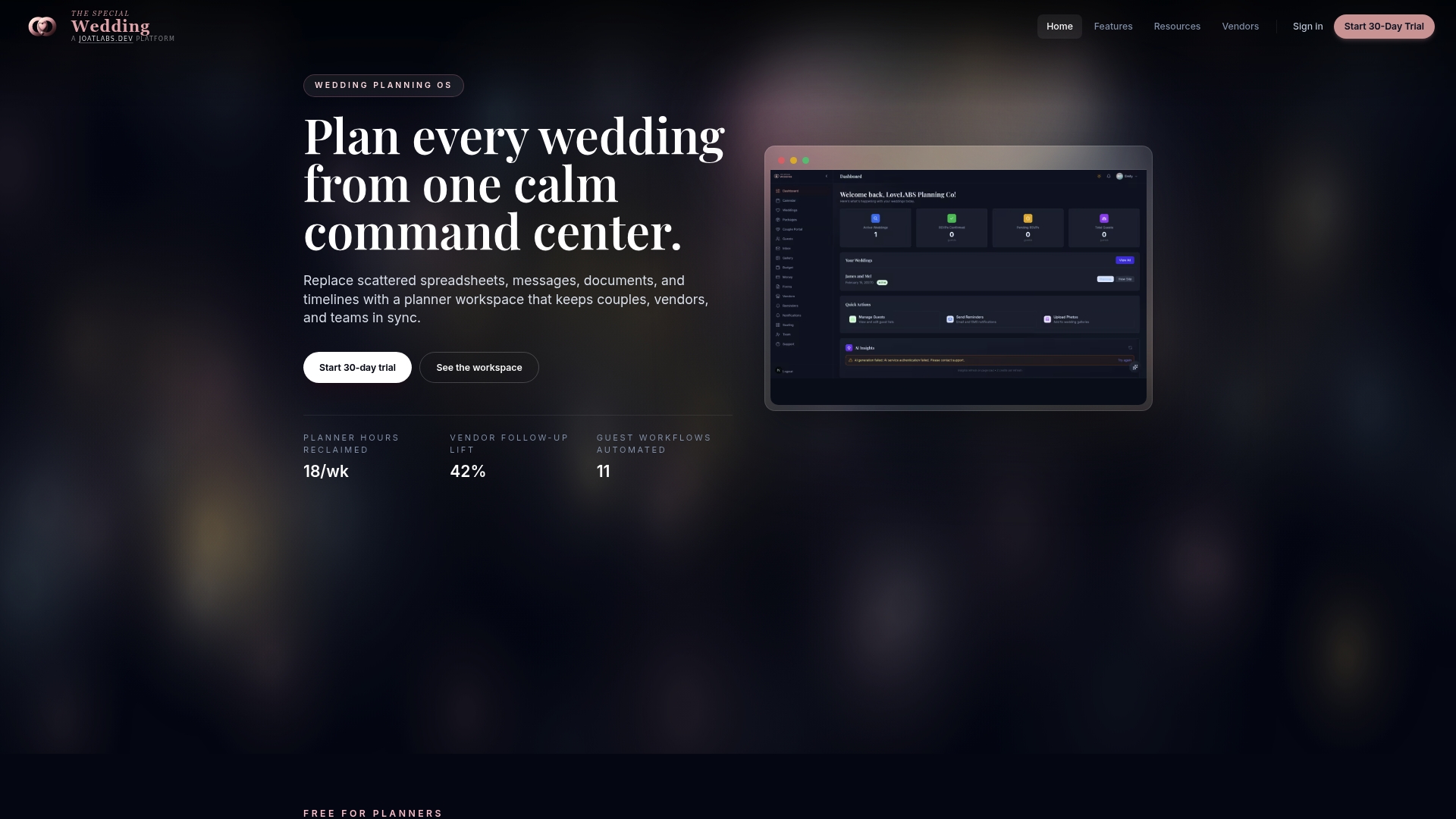
That structure fits studios juggling multiple active weddings who are tired of stitching together spreadsheets, email threads, and separate e-signature tools to answer one simple question: what’s signed, and what’s still owed. Instead of rebuilding that answer manually every week, the ledger view surfaces it across every event at once, the same consolidated visibility outlined in the payment workflow guidance above.
If your studio is still tracking contracts by folder name and gut memory, start with one pilot wedding on TheSpecialWedding.io’s planner software platform and compare a full event cycle against your current process. Explore the vendor directory to see how vendor records populate inside an active event before you commit a full season to the switch.
Sources
For deeper detail on the pieces covered here, these resources go further on specific workflows:
- How Event Contract and Payment Software Simplifies Live Music
- Automate Vendor Payment Scheduling Events: 6 Hours Per 2026
Recommended
Free wedding planner templates
Skip the blank page — these templates ship with the form fields you actually need.
Browse all 9 free templates →