Wedding Coordinator Client Handoff Strategies That Work
Wedding Coordinator Client Handoff Strategies That Work
Wedding coordinator client handoff strategies are the structured processes that transfer event knowledge, vendor contacts, timelines, and decision rights from planners to coordinators before the wedding day. Without a defined handoff process, critical details fall through the cracks, vendors contact the wrong people, and couples absorb stress that should never reach them. The industry term for this process is “event transition management,” though most working coordinators simply call it the handoff. Done well, it is the single biggest factor separating a smooth wedding day from a chaotic one.
1. What are the core components of an effective wedding coordinator client handoff?
A complete handoff package includes six non-negotiable elements: vendor contracts, finalized timelines, floor plans, family sensitivity notes, decision hierarchies, and a full contact list. Comprehensive documentation is necessary for smooth day-of execution and reduced surprises. Each element serves a distinct purpose, and missing even one creates a gap that shows up at the worst possible moment.
The core components break down as follows:
- Vendor contracts and contacts: Every vendor file should include the signed contract, the direct contact name, cell number, and arrival window.
- Finalized run of show: A minute-by-minute timeline covering ceremony, cocktail hour, reception, and breakdown.
- Floor plans and logistics: Venue layout, load-in routes, power source locations, and any venue-specific restrictions.
- Decision hierarchy: A written record of who has final authority on site. Knowing whether the couple or the mother of the bride makes last-minute calls prevents real conflicts.
- Communication ownership: A clear list of which vendors contact the coordinator and which contact the couple directly.
- Single source of truth: One centralized file or portal where every team member and vendor finds the same information.
Pro Tip: Create a one-page “quick reference” sheet that lives at the front of your handoff package. It should list the top five vendor contacts, the ceremony start time, and the couple’s emergency contact. Anyone picking up this document mid-event can orient themselves in under two minutes.
2. How staged intake processes improve client handoff quality

Layered intake consistently outperforms the single-questionnaire approach. Breaking handoff data collection into logical stages improves client responsiveness and data quality. When you send one massive form, clients stall. When you send focused questions tied to a specific planning phase, they answer.
A practical three-stage intake model works like this:
- Stage one (initial logistics, 8 weeks out): Collect venue address, ceremony start time, vendor names, and the couple’s primary contact preferences.
- Stage two (vendor details, 5–6 weeks out): Gather signed contracts, vendor arrival times, setup requirements, and payment confirmation status.
- Stage three (day-of specifics, 2–3 weeks out): Finalize the run of show, collect family photo lists, confirm dietary restrictions, and lock in the decision hierarchy.
This structure also protects your clients emotionally. Receiving 40 questions at once feels like a second job. Receiving 8 focused questions three times feels manageable. The result is better data and a calmer client relationship.
Pro Tip: Tie each intake stage to a calendar milestone and send an automated reminder 48 hours before the deadline. Clients who miss the first reminder almost always respond to the second.
3. Digital tools and systems that support client handoff
The right event management systems make the difference between a handoff that lives in your inbox and one that every stakeholder can access in real time. The core tool categories coordinators rely on fall into three groups.
Centralized client portals give couples a single place to upload documents, review timelines, and track outstanding tasks. Without a centralized file or portal, vendor information becomes fragmented, increasing the risk of errors. A portal eliminates the “I sent that in an email three weeks ago” problem entirely.
Vendor packet tools let you build and distribute a clean, formatted document for each vendor. Clear, concise vendor packets improve vendor coordination and reduce misunderstandings. Each packet should include the vendor’s specific arrival time, setup location, point of contact on site, and any venue rules that affect their work.
Workflow management platforms track which handoff stages are complete and which are blocked. Thespecialwedding is built specifically for this use case, offering client portals, automated workflows, vendor onboarding tools, and real-time dashboards in one workspace. Coordinators managing multiple weddings simultaneously benefit most from this type of integrated approach, since managing multiple clients across scattered tools creates version-control problems that compound quickly.
The table below compares the three tool categories by function:
| Tool category | Primary function | Best for |
|---|---|---|
| Client portal | Document sharing and timeline review | Couple-facing communication |
| Vendor packet builder | Formatted vendor instructions | Vendor alignment and clarity |
| Workflow platform | Stage tracking and automation | Multi-event coordinator management |
4. Operational strategies for triaging issues before the wedding day
Proactive triaging is the practice of identifying blocked decisions and unresolved vendor issues before they become day-of emergencies. By event week, coordinators identify immovable moments and blocked tasks to minimize client emergency decisions. The goal is to absorb every possible problem before the couple wakes up on their wedding morning.
The most effective triage strategies include:
- Define decision rights in writing. Knowing who has final decision authority on site, whether that is the couple, a parent, or the coordinator, prevents chain-of-command confusion when something changes last minute.
- Assign day-of operational roles. Assigning roles like show caller and vendor point person before the event enhances on-site communication flow. Every team member should know their lane.
- Run a timeline stress test. Walk through the run of show and identify any gap shorter than 15 minutes. Those gaps are where delays compound.
- Confirm vendor communication channels. Assigning which vendor contacts communicate with coordinators avoids client interference and stress on the day itself.
“The best handoffs enable coordinators to prevent client interruptions and last-minute decisions through proactive triaging.” This is not a luxury for high-budget weddings. It is standard practice for any coordinator who wants to protect their reputation.
5. Common mistakes coordinators should avoid in the handoff process
The most damaging mistake is treating day-of coordination as a task that starts the morning of the wedding. Most professional coordinators start intake and alignment 45 to 60 days out. Starting late means compressed timelines, incomplete vendor information, and no time to resolve conflicts before they become crises.
Other common errors that undermine the handoff process:
- No centralized information hub. Failing to establish a single, authoritative information hub is the biggest cause of confusion on wedding days. Scattered files across email, text, and shared drives guarantee that someone is working from outdated information.
- Unclear vendor communication ownership. When vendors do not know whether to call the coordinator or the couple, they call both. That creates duplicate instructions and contradictory decisions.
- One-time massive intake forms. Sending a 60-question form in week one overwhelms clients and produces incomplete answers. Staged intake, as described above, solves this directly.
- Ignoring family decision hierarchies. Skipping the step of documenting decision hierarchies to reduce conflicts between family members and the couple is a mistake that shows up in real time, usually during the ceremony setup.
- No defined handoff ownership. Clear ownership and operational guides ease transitions and reduce ambiguity. If no one is explicitly responsible for a task, it does not get done.
Review your current process against this list. If two or more of these apply, your handoff needs a structural fix, not just a better checklist.
Key takeaways
Effective wedding coordinator client handoff strategies require staged intake, centralized documentation, and defined decision rights established at least 45 to 60 days before the event.
| Point | Details |
|---|---|
| Start early | Begin intake and vendor alignment 45–60 days before the wedding, not the week of. |
| Use staged intake | Break data collection into three phases to improve client completion and reduce stress. |
| Centralize everything | One shared hub for all vendor, timeline, and contact information prevents day-of errors. |
| Define decision rights | Document who has final authority on site before the event to avoid family conflicts. |
| Assign communication ownership | Specify which vendors contact the coordinator so the couple is never interrupted. |
What I’ve learned about handoffs that most articles won’t tell you
The handoff is where coordinators either earn or lose their reputation, and most of the damage happens quietly, weeks before the wedding day.
After working through dozens of event transitions, the pattern is consistent. Coordinators who struggle with handoffs are not disorganized. They are under-systematized. They rely on memory, personal relationships with vendors, and the assumption that everyone read the same email chain. That works until it does not, and when it fails, it fails publicly.
The staged intake approach changed how I think about client relationships entirely. Clients do not resist giving you information. They resist being overwhelmed. When you ask focused questions at the right moment in the planning timeline, clients respond faster and with more detail. The client communication guide framework reinforces this: touchpoints tied to milestones outperform open-ended check-ins every time.
The decision hierarchy piece is the one most coordinators skip because it feels awkward to ask. “Who is actually in charge on the day?” is an uncomfortable question. Ask it anyway. The alternative is finding out the answer in real time when the mother of the bride overrules the couple’s florist instruction and the florist looks to you for direction.
Proactive triaging is not pessimism. It is professionalism. The coordinators who walk into a wedding day calm and prepared are the ones who spent the previous two weeks eliminating every decision that did not need to happen on the day itself.
— JOATLABS
How Thespecialwedding supports your client handoff process
Coordinators managing multiple weddings need more than a good checklist. They need a system that holds every piece of the handoff in one place and keeps it current.
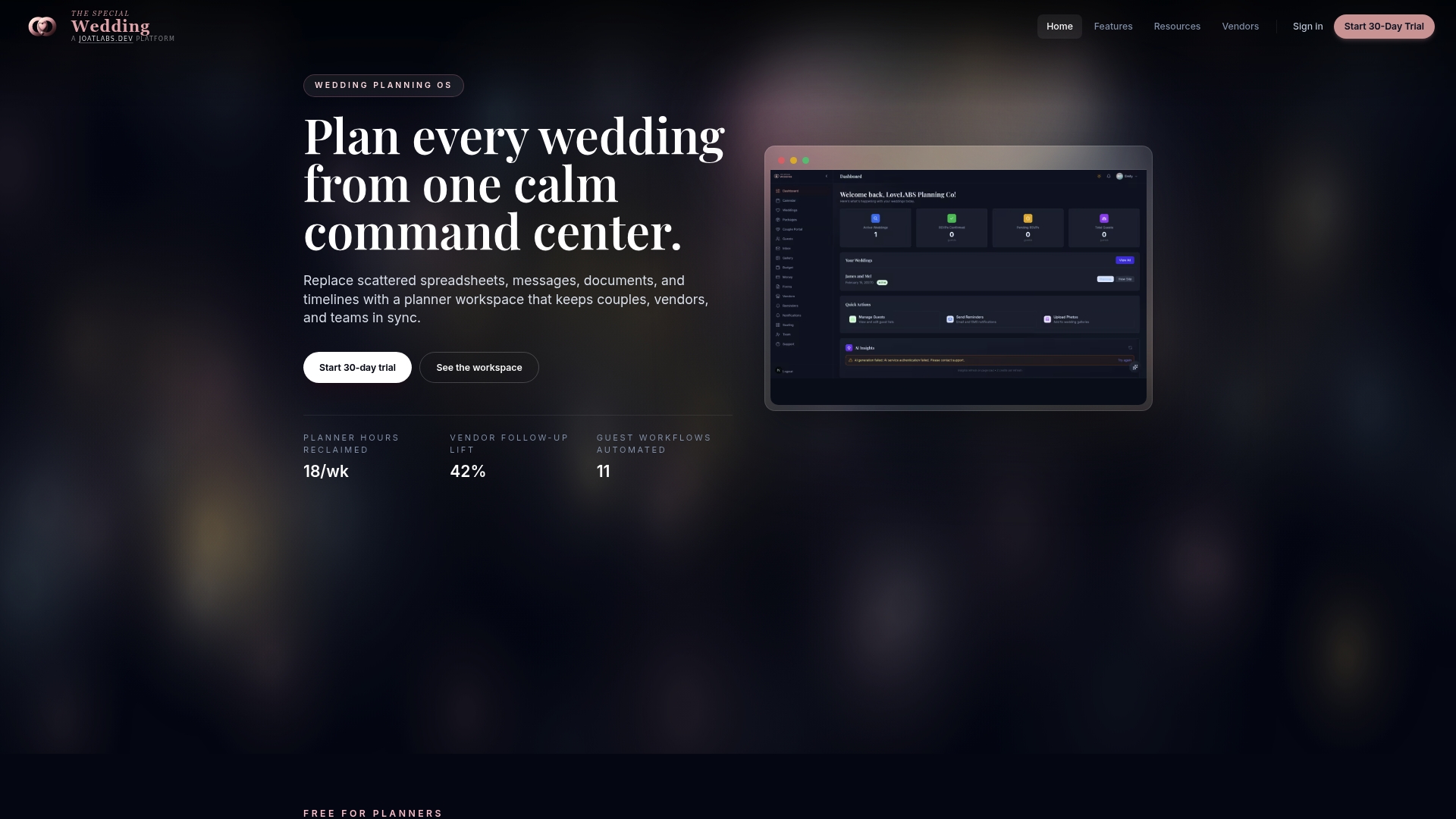
Thespecialwedding is built for exactly this. The platform combines client portals, vendor onboarding workflows, event timelines, and communication tools in a single workspace. You can manage staged intake, distribute vendor packets, and track outstanding decisions without switching between tools. The vendor directory gives coordinators direct access to vetted local vendors, making it faster to build complete handoff packages from the start. Whether you are a solo planner or running a full agency, Thespecialwedding scales to match your volume and keeps every client handoff organized from first contact to final walkthrough.
FAQ
What is a wedding coordinator client handoff?
A wedding coordinator client handoff is the structured transfer of event details, vendor contacts, timelines, and decision rights from a planner to a coordinator before the wedding day. It typically begins 45 to 60 days before the event.
What should a wedding vendor client handoff checklist include?
A complete checklist covers vendor contracts, arrival times, the run of show, floor plans, family sensitivity notes, the decision hierarchy, and a communication ownership list specifying which vendors contact the coordinator versus the couple.
How does staged intake improve client onboarding for wedding coordinators?
Staged intake breaks data collection into three focused phases tied to planning milestones, which improves client response rates and produces more complete information than a single large questionnaire.
When should the wedding planning handover process begin?
The handover process should begin 45 to 60 days before the wedding. Starting earlier allows time to resolve vendor conflicts, complete the run of show, and confirm all decision rights before the final weeks.
How do coordinators prevent vendor communication problems during the handoff?
Coordinators assign explicit communication ownership before the event, specifying which vendors call the coordinator and which contact the couple directly. This prevents duplicate instructions and keeps the couple free from operational interruptions on their wedding day.
Recommended
- Wedding Planner Client Communication: A 2026 Guide | The Special Wedding Blog
- Wedding coordinator’s role in vendor scheduling | The Special Wedding Blog
- Wedding Agency Staff Role Assignments: 2026 Guide | The Special Wedding Blog
- Wedding Event Runsheet Best Practices for Planners | The Special Wedding Blog
Free wedding planner templates
Skip the blank page — these templates ship with the form fields you actually need.
Browse all 9 free templates →