Wedding Day Vendor Runsheet: A Planner's Complete Guide
Wedding Day Vendor Runsheet: A Planner’s Complete Guide
A wedding day vendor runsheet is defined as a minute-by-minute operational document that maps every vendor task, event transition, and location from morning setup through the final send-off. Every professional planner needs one. Typical wedding days span 8–14 hours, covering beauty appointments, travel, ceremony, cocktail hour, dinner, and reception logistics. That scope involves photographers, caterers, florists, entertainment, and venue staff all working in parallel. Without a shared operational schedule, even one late vendor can throw the entire day off course.
What is a wedding day vendor runsheet?
A vendor runsheet is the master operational timeline that every professional planner builds before the wedding day. It differs from a general wedding day timeline in one critical way: it assigns specific responsibilities, locations, and contact details to each vendor alongside every time block. The document functions as the single source of truth for all timing decisions on the day.
Using one master runsheet reduces miscommunication risk among critical vendors like caterers and entertainment teams. That reduction matters because a miscommunication between the catering team and the band about dinner service timing can delay speeches, push the first dance, and compress the entire evening program. The runsheet prevents that chain reaction before it starts.
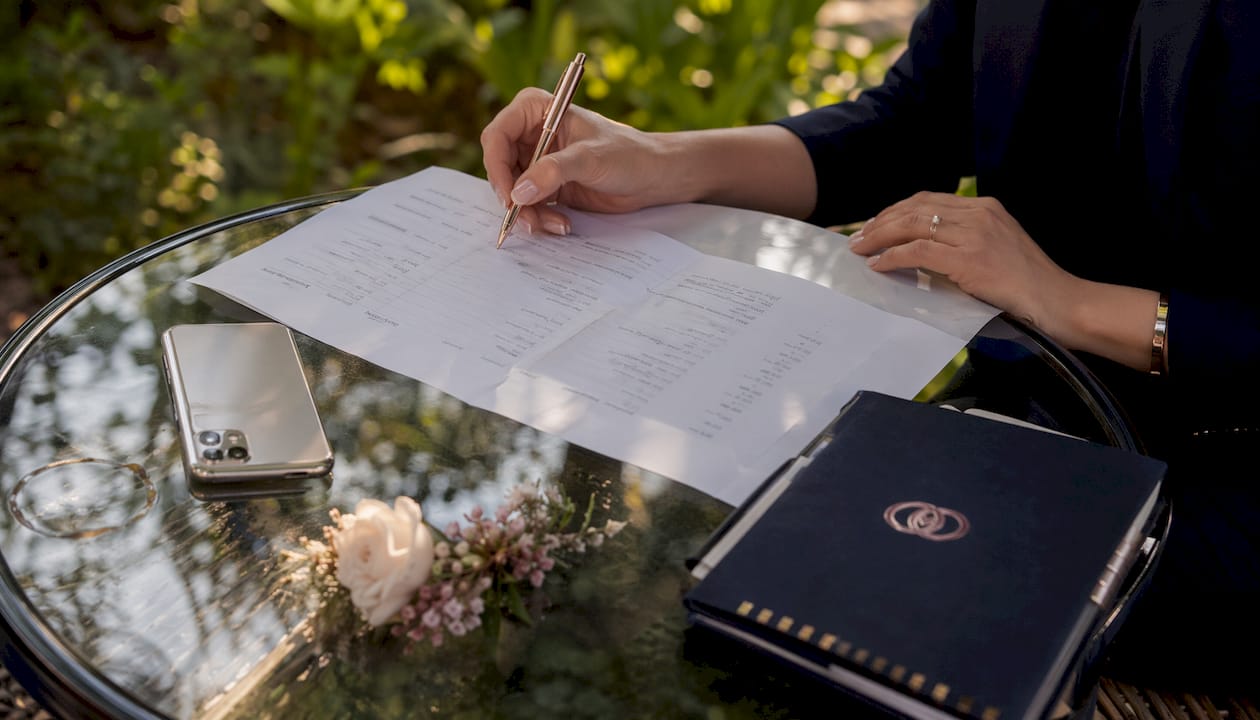
The term “runsheet” is the recognized industry standard for this document. You may also hear it called a “day-of schedule” or “event order,” but runsheet is the term most vendors and coordinators use in professional settings. Knowing the standard terminology helps when briefing new vendors or onboarding team members.
What essential elements must a wedding day vendor runsheet include?
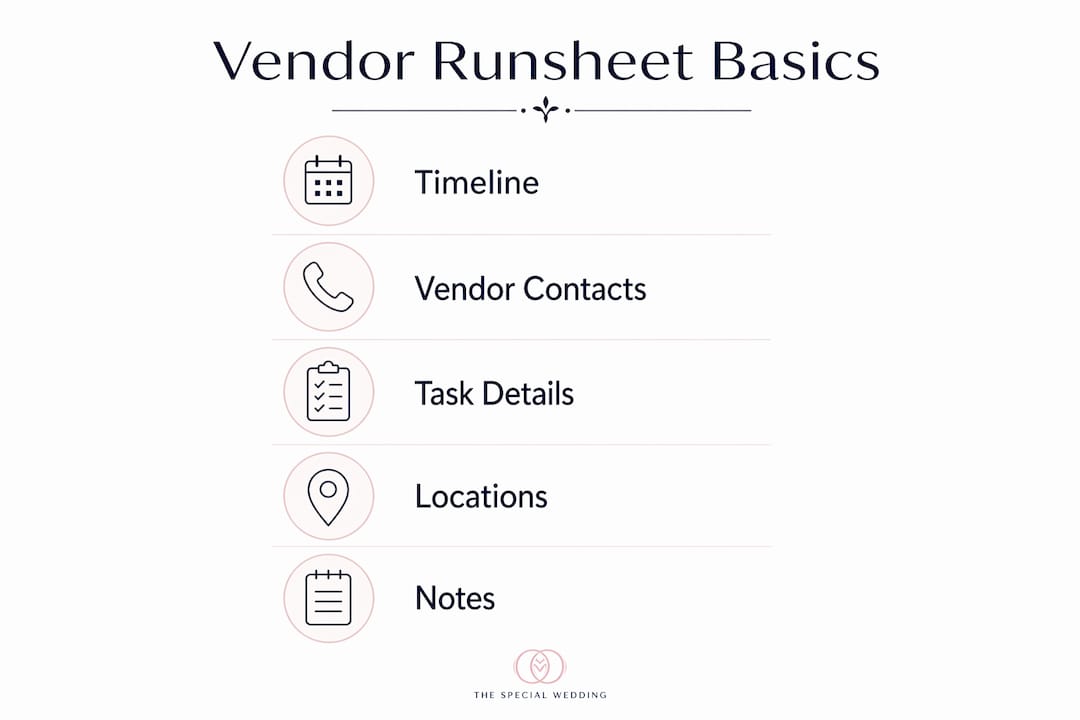
A professional vendor runsheet covers six core categories of information. Each category serves a distinct coordination function, and missing any one of them creates gaps that vendors will fill with guesswork.
- Vendor arrival and load-in times. Every vendor needs a specific arrival window, not just a general start time. Industry standard adds 15–30 minutes for travel and 30–45 minutes per person for hair and makeup services. Build those figures directly into the runsheet.
- Event start and end times. List every segment: ceremony, cocktail hour, dinner service, speeches, first dance, cake cutting, and send-off. Each block needs a hard start time and a projected end time.
- Transition buffers. Buffers of 10–15 minutes between major events are critical tools for absorbing unexpected delays. Add a 30-minute buffer at the end of morning preparations before the couple departs for the venue.
- Contact information. Include the direct phone number for every vendor lead, the venue coordinator, and the planner. Vendors should never have to search for a number when something goes wrong.
- Vendor responsibilities and locations. Specify where each vendor needs to be at each time block. The florist setting up the ceremony arch needs a different location note than the florist delivering centerpieces to the reception hall.
- Key personnel for each segment. Name the person responsible for each transition. “Photographer moves couple to garden for portraits at 4:30 PM” is more useful than “portraits at 4:30 PM.”
Pro Tip: Include a “notes” column next to each time block. Use it to flag conditional items like “if rain, move portraits to foyer” so vendors can act without calling you.
How to create and distribute an effective vendor runsheet
Building a runsheet that actually works on the day requires a specific construction method. Follow these steps in order.
- Anchor the timeline to fixed points. Build the timeline backward from ceremony start to cover beauty and travel, and forward from reception end for evening events. Fixed points give every other time block a logical reference.
- Collaborate with key vendors on timing. Ask your photographer how long family formals take. Ask the caterer how long plated dinner service runs per course. Vendor-supplied estimates are more accurate than planner assumptions.
- Build the master runsheet first. The master document contains every detail: all vendor contacts, all locations, all responsibilities, and all contingency notes. This version stays with the lead planner and core coordination team.
- Create filtered versions for each vendor category. Most planners avoid sending the entire master runsheet to all vendors. A band or DJ receives only the entertainment schedule and relevant transition times. A florist receives setup windows and location details. Filtered versions reduce confusion and protect sensitive information.
- Send a draft 2–3 weeks before the wedding. Sharing a draft runsheet 2–3 weeks before the wedding gives vendors time to flag conflicts. A caterer may identify that the proposed dinner service start conflicts with their kitchen setup window. Catching that three weeks out is manageable. Catching it the morning of the wedding is not.
- Distribute the final version 5–7 days before the wedding. The final runsheet reflects all vendor feedback and confirmed logistics. Sending it five to seven days out gives everyone time to review it before the day arrives.
Pro Tip: Use a shared document platform so vendors can access the latest version at any time. A PDF sent by email becomes outdated the moment you make a change. A live shared link stays current.
For a deeper look at sharing timelines with vendors, Thespecialwedding has a step-by-step breakdown built specifically for planners managing multiple events.
How does a vendor runsheet differ from a guest itinerary?
The runsheet is an operational tool distinct from the guest itinerary. Confusing the two is one of the most common mistakes planners make when they first formalize their documentation process. The table below clarifies the difference.
| Feature | Vendor runsheet | Guest itinerary |
|---|---|---|
| Primary audience | Vendors, planners, coordinators | Wedding guests |
| Level of detail | Minute-by-minute with responsibilities | Broad event summary |
| Includes contact info | Yes, for all key personnel | No |
| Includes vendor locations | Yes, with specific room or area | No |
| Includes contingency notes | Yes | No |
| Tone | Operational and precise | Warm and welcoming |
A guest itinerary tells attendees that dinner begins at 6:30 PM. The vendor runsheet tells the catering team to begin plating at 6:00 PM, confirms the venue coordinator opens the dining room at 6:15 PM, and notes that the band starts background music at 6:20 PM. Guests do not need that level of detail. Vendors cannot function without it.
Filtering information also protects the couple’s privacy. Vendor contact lists, budget-related notes, and internal coordination cues stay inside the operational document. Guests receive only what they need to enjoy the day.
Common pitfalls and expert tips for managing runsheets on the wedding day
Even a well-built runsheet fails if it is not managed correctly on the day. These are the mistakes that experienced planners see most often.
- Not assigning a timeline owner. Assigning a single timeline owner on the wedding day ensures small adjustments are handled without stressing the couple. The planner, coordinator, or a designated point person manages live updates and communicates changes to vendors. Without one person in that role, every vendor calls the couple directly.
- Skipping buffer times. Planners who build tight schedules with no buffers create a document that looks efficient but fails in practice. Experienced planners treat 10–15 minute buffers between major transitions as non-negotiable. A ceremony that runs seven minutes long should not delay the cocktail hour.
- Sending the master runsheet to every vendor. Overwhelming vendors with irrelevant information causes them to miss the details that matter to them. A lighting technician does not need the hair and makeup schedule. Send each vendor only what applies to their role.
- Failing to update the runsheet after vendor changes. When a vendor cancels and a replacement is booked, the runsheet must be updated immediately. An outdated contact number on the day of the wedding is a coordination failure waiting to happen.
- Not confirming receipt. Distributing the runsheet is not the same as confirming that vendors have read it. Follow up with each vendor lead to confirm they received the document and have no questions.
For planners who want to go deeper on runsheet best practices, Thespecialwedding publishes operational guides written specifically for professional coordinators.
Key Takeaways
A vendor runsheet is the single most important operational document a planner creates, and its effectiveness depends entirely on structure, timing, and distribution discipline.
| Point | Details |
|---|---|
| Define the runsheet correctly | A vendor runsheet is a minute-by-minute operational document, not a general day-of schedule. |
| Build around fixed points | Anchor the timeline to ceremony start and reception end, then fill in all other blocks. |
| Use hierarchical versions | Create one master runsheet and filtered versions for each vendor category to reduce confusion. |
| Distribute on a firm schedule | Send a draft 2–3 weeks out and the final version 5–7 days before the wedding. |
| Assign a timeline owner | One designated person manages live adjustments on the day so the couple stays stress-free. |
Why runsheets are the most underrated tool in wedding planning
After coordinating weddings across venues ranging from intimate backyard ceremonies to large ballroom events, the pattern is consistent: the weddings that run smoothly are the ones where the planner treated the runsheet as a living document, not a checklist printed and forgotten.
The most common failure I see is planners who build a detailed runsheet and then stop updating it after the final vendor call. By the time the wedding day arrives, the document reflects a plan from three weeks ago. The florist has changed their arrival time. The photographer added a first-look session. The band’s load-in window shifted. None of those changes made it into the runsheet, and the day-of coordinator is working from a document that no longer matches reality.
The hierarchical approach, one master document plus filtered vendor versions, is the practice that separates planners who manage chaos from planners who prevent it. Expert planner Tessa Lyn Brand notes that a detailed runsheet prevents small delays from cascading into evening schedule failures. That observation matches what I have seen firsthand. A seven-minute ceremony overrun is invisible when you have buffers. Without them, it becomes a 45-minute domino effect by the time dinner service starts.
The evolution of runsheet practices by 2026 has moved toward collaborative, shared documents rather than static PDFs. Planners who still email final PDFs are creating a version-control problem. The vendors who show up with the most current information are the ones whose planners use shared platforms where updates are visible in real time. That shift is not a technology preference. It is a coordination standard.
— JOATLABS
Vendor coordination tools on Thespecialwedding
Thespecialwedding gives professional planners a centralized workspace to build, update, and share wedding day timelines without jumping between spreadsheets and email threads. The platform supports vendor onboarding, event timelines, and communication workflows in one place.
When your runsheet is ready, you need vendors who understand how to work within a coordinated schedule. Thespecialwedding’s vendor directory connects planners with professionals experienced in runsheet-driven events. For Oklahoma City weddings, Genesis Master of Events is a trusted MC and host who keeps the program on time and communicates directly with your coordination team. Planners managing complex days will find the directory a reliable starting point for building a vendor team that executes on schedule.
FAQ
What is a vendor runsheet in wedding planning?
A vendor runsheet is a minute-by-minute operational document that maps every vendor task, event transition, and contact detail from setup through the final send-off. It serves as the single source of truth for all timing decisions on the wedding day.
How long should a wedding day vendor runsheet be?
A runsheet for a typical 8–14 hour wedding day typically runs several pages for the master version. Filtered vendor versions are shorter, covering only the segments relevant to each vendor’s role.
When should I send the runsheet to vendors?
Send a draft 2–3 weeks before the wedding and distribute the final version 5–7 days before the event. This schedule gives vendors time to flag conflicts and confirm their availability.
What is the difference between a runsheet and a guest itinerary?
A runsheet contains operational details including vendor contacts, locations, and responsibilities. A guest itinerary summarizes major events for attendees and excludes all vendor-specific information.
Who manages the runsheet on the wedding day?
A single timeline owner, typically the lead planner or coordinator, manages live adjustments and communicates changes to vendors throughout the day. This keeps the couple free from coordination calls and maintains schedule integrity.
Recommended
- Wedding Event Runsheet Best Practices for Planners | The Special Wedding Blog
- Solo Planner Wedding Day Coordination Checklist | The Special Wedding Blog
- Wedding coordinator’s role in vendor scheduling | The Special Wedding Blog
- Wedding Event Setup Breakdown Checklist for Planners | The Special Wedding Blog
Free wedding planner templates
Skip the blank page — these templates ship with the form fields you actually need.
Browse all 9 free templates →