Wedding Planner Client Communication: A 2026 Guide
Wedding Planner Client Communication: A 2026 Guide
Client communication is the single most important skill a wedding planner can develop, shaping every decision from the first consultation to the final send-off. Responsiveness is a primary trust factor for 52% of couples selecting a planner, and personality fit drives the choice for 50%. Those numbers tell you one thing: clients hire you before they trust your logistics skills. The role of wedding planner client communication goes far beyond sending emails. It defines whether you function as a vendor or as a true partner in one of the most emotionally charged events of your clients’ lives.
What are the key client communication skills a wedding planner must develop?
Strong planner-client dialogue starts with clarity. Every message you send, whether a welcome email or a budget update, should leave the client with zero ambiguity about what happens next. Warm, direct language builds rapport faster than formal corporate phrasing. Clients are not reading contracts for fun. They want to feel guided.
Active listening is the skill most planners underestimate. 84% of women in opposite-sex relationships carry the majority of the wedding planning load. That means your primary contact is often managing enormous decision fatigue on top of a full personal and professional life. When you listen to understand rather than to respond, you reduce that fatigue and position yourself as a relief, not another source of pressure.
Professional boundary-setting is not a soft skill. It is a business requirement. Clear communication boundaries prevent planner burnout and protect the quality of your service. Clients do not actually want 24/7 access. They want predictability. Tell them when you respond, how you respond, and what channel you use. Then hold to it.
- Verbal and written clarity: Set expectations in every message. Confirm what was decided, what is pending, and what the client needs to do next.
- Active listening and empathy: Reflect back what clients say before offering solutions. This alone reduces friction in tense conversations.
- Boundary-setting: Define office hours, preferred channels, and response windows during onboarding, not after a problem surfaces.
- Templates and automation: Use structured email templates to deliver consistent milestone updates without reinventing every message.
- Negotiation and conflict resolution: Approach budget disagreements with options, not ultimatums. Give clients a path forward, not a wall.
Pro Tip: Build a short communication guide for every new client. One page, delivered at the first meeting, covering your response time, preferred channels, and how you handle urgent requests. Clients who receive this guide ask fewer off-hours questions.
How does proactive communication prevent planning misunderstandings?
Proactive communication is the practice of sending information before clients ask for it. Setting clear expectations during onboarding prevents roughly 80% of common client frustrations. That figure reflects a simple truth: most client complaints trace back to a gap between what they expected and what they received.
The onboarding phase is your highest-leverage communication window. A well-structured welcome packet should cover your working process, key milestones, vendor communication protocols, and what clients can expect from you at each stage. Planners who skip this step spend the rest of the engagement managing confusion they created themselves.
Scheduled updates matter as much as the content inside them. When clients know they will hear from you every Tuesday with a progress summary, they stop sending anxious check-in messages. The update does not need to be long. It needs to be consistent.
- Send a welcome packet within 24 hours of signing. Include response time commitments, communication channels, and a planning timeline overview.
- Schedule milestone check-ins at booking confirmation, 6 months out, 3 months out, 30 days out, and 7 days out.
- Document every major decision in writing within 24 hours of the meeting. Send it to the client for confirmation.
- Define one primary communication channel per client and redirect off-channel messages back to it consistently.
- Send a pre-event briefing 48 hours before the wedding covering the full day timeline, vendor contacts, and emergency protocols.
“The planner’s communication role is to lead the client experience by setting expectations and educating proactively, not reactively.” — Lead Like a Pro
Documenting decisions immediately after meetings creates what experienced planners call a paper trail of reassurance. Written summaries reduce disputes and increase client confidence by giving both parties a shared record of what was agreed. This practice protects you legally and emotionally.
What is the role of wedding planner communication in vendor coordination?
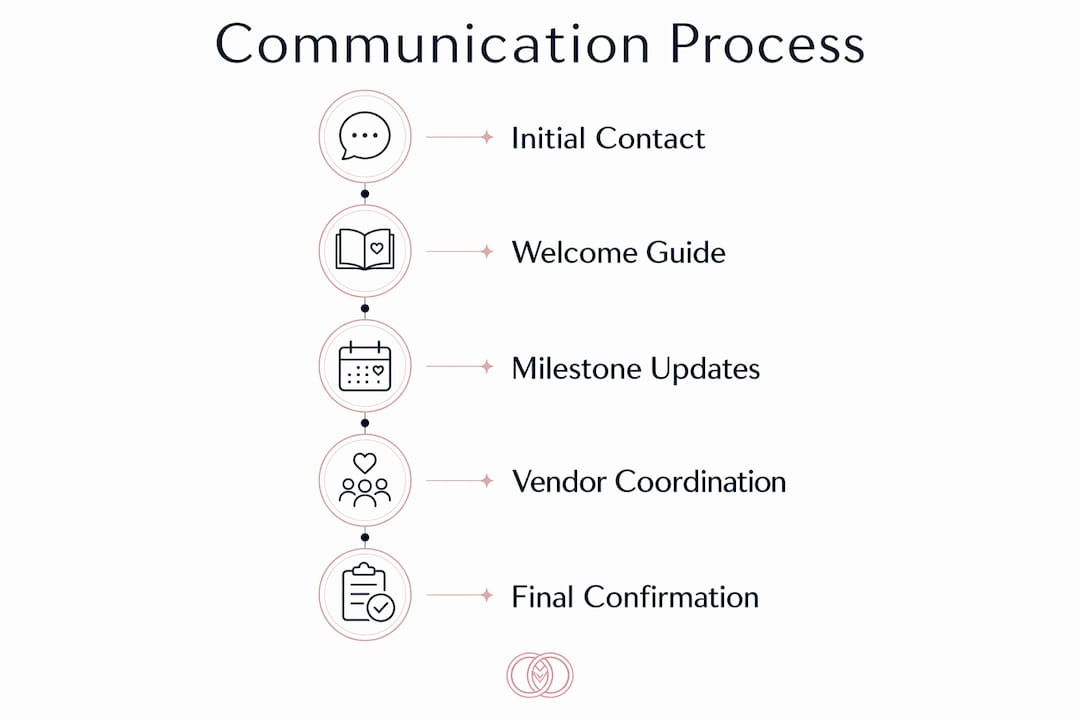
Vendor communication is where planning either holds together or falls apart on the wedding day. New planners assume vendors understand the full plan after one briefing call. Experienced planners know that assumption causes most day-of failures. Verified vendor details at four critical milestones prevent timing conflicts and setup errors: at booking, 14 days out, 7 days out, and on-site.
Each confirmation serves a different purpose. The booking confirmation locks in the contract terms. The 14-day check covers logistics, load-in times, and any changes since signing. The 7-day call confirms the final timeline and answers last-minute questions. The on-site check at arrival verifies setup is proceeding as planned.
| Milestone | Communication goal | Format |
|---|---|---|
| At booking | Confirm contract terms, contact details, and payment schedule | Email + signed contract |
| 14 days out | Review logistics, load-in times, and any scope changes | Phone call + email summary |
| 7 days out | Confirm final timeline, headcount, and special instructions | Email with attached timeline |
| Day of arrival | Verify setup progress and resolve any on-site issues | In-person or phone |
Your tone with vendors on the wedding day sets the pace for the entire team. Calm, direct, and authoritative communication keeps everyone focused. Panic is contagious. Confidence is too. Planners who communicate with clarity under pressure earn a professional reputation that generates referrals from vendors, not just clients.
Pro Tip: Create a vendor contact sheet for every event that includes name, role, cell number, arrival time, and load-out time. Share it with your second coordinator and keep a printed copy on the day. Digital-only contact lists fail when phone batteries die.
How can planners handle difficult conversations without damaging client relationships?
Difficult conversations are not optional in wedding planning. Budget overruns, vendor cancellations, scope creep, and family conflicts all require you to deliver unwelcome news with professionalism. Maintaining professionalism and summarizing conversations in writing helps preserve client trust even during conflict.
The foundation of any hard conversation is calm intention. You are not there to win an argument. You are there to solve a problem together. Lead with empathy, state the facts neutrally, and present options before asking for a decision.
- Use neutral, factual language. “The florist’s pricing has increased by 15% since we booked” lands better than “the florist is charging more than we planned.” One is a fact. The other sounds like a failure.
- Offer options, not verdicts. When a budget line breaks, present two or three alternatives with trade-offs. Clients who feel empowered to choose are far less likely to feel blindsided.
- Leverage your contract constructively. Embedding communication policies in your contract prevents informal drift and gives you a neutral reference point during disputes. Reference it as a shared agreement, not a threat.
- Follow up in writing every time. After any difficult conversation, send a brief email summarizing what was discussed, what was decided, and what the next steps are. This protects both parties and closes the loop.
- Separate the emotional from the logistical. Acknowledge feelings first, then move to solutions. Clients who feel heard are far more receptive to practical options.
The planners who handle hard conversations well build the strongest long-term reputations. Referrals come from clients who trusted you when things got complicated, not just when everything went smoothly. Effective wedding planning communication during difficult moments is what separates good planners from great ones.
Key Takeaways
Strong planner-client communication requires proactive structure, consistent documentation, and clear boundaries at every stage of the planning process.
| Point | Details |
|---|---|
| Communication drives client selection | 52% of couples cite responsiveness as a top trust factor when choosing a planner. |
| Onboarding sets the tone | A structured welcome packet prevents the majority of client frustrations before they start. |
| Vendor verification is non-negotiable | Confirm vendor details at booking, 14 days out, 7 days out, and on-site to avoid day-of failures. |
| Written summaries protect everyone | Documenting decisions after every meeting reduces disputes and builds client confidence. |
| Boundaries improve service quality | Defined response windows and communication channels prevent burnout and set client expectations. |
Why communication is the real product you sell
After working with planners across every budget and market, one pattern stands out clearly: the planners who struggle most are not the ones with weak vendor networks or thin margins. They are the ones who treat communication as an afterthought rather than a core deliverable.
Clients cannot evaluate your logistics skills before the wedding day. What they can evaluate from day one is how you make them feel. Do they leave your meetings with clarity or confusion? Do they hear from you before they have to ask? Do they trust that you have it handled? Those feelings are built entirely through communication.
The 2026 shift I find most significant is the move away from “always available” as a selling point. Clients expect structured, bounded communication with defined expectations, not a planner who responds to texts at midnight. That shift is good for the industry. It forces planners to build real systems instead of relying on personal availability as a substitute for process.
The planners I respect most treat their communication workflows the same way they treat their vendor relationships: with intention, documentation, and regular review. They use wedding software platforms to centralize client messages, automate milestone reminders, and keep every conversation in one place. That is not a luxury. That is how you scale without burning out.
Communication is not the thing you do alongside your service. It is the service.
— JOATLABS
Thespecialwedding makes vendor communication faster
Finding the right vendors is only half the challenge. Keeping communication with them organized, timely, and professional is where most planners lose time.
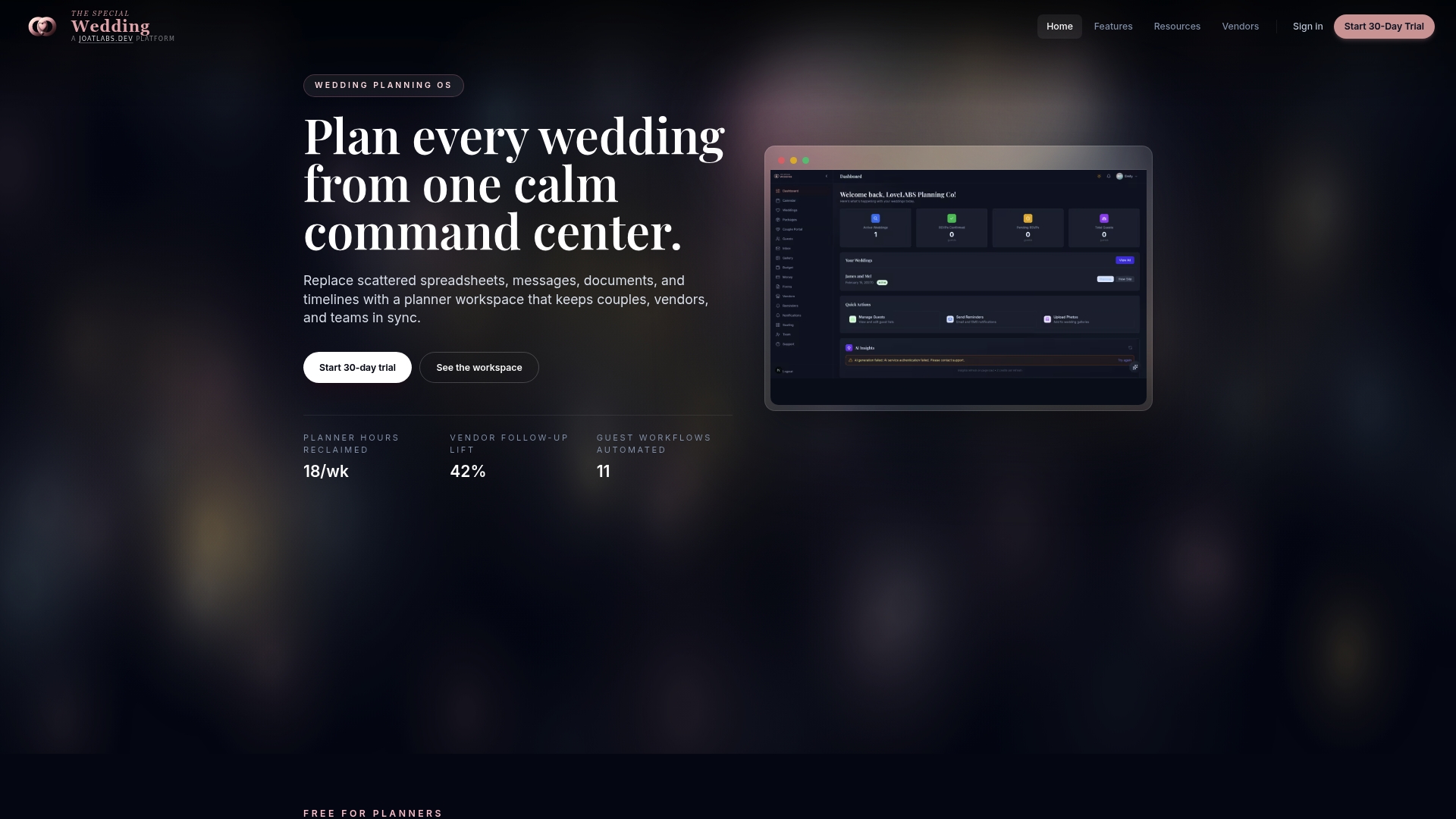
Thespecialwedding’s vendor directory gives you direct access to vetted professionals across every category, from DJs and decorators to caterers and stationery designers. When your vendor list is curated and centralized, your communication workflows get faster and your clients see the difference. Fewer dropped details, faster confirmations, and a more confident planning experience from first meeting to final dance. Thespecialwedding is built for planners who take their client relationships seriously.
FAQ
Why is client communication so critical for wedding planners?
Client communication builds the trust that drives every other part of the planning process. Research shows 52% of couples select their planner based on responsiveness, making communication style a primary business differentiator.
How often should a wedding planner communicate with clients?
Scheduled milestone updates at key intervals, such as 6 months, 3 months, 30 days, and 7 days before the wedding, prevent anxiety and reduce off-hours check-ins from clients.
What is the best way to handle a difficult conversation with a wedding client?
Lead with empathy, use neutral factual language, offer options, and follow up with a written summary of what was decided. This approach preserves trust even when the news is unwelcome.
How do communication templates help wedding planners?
Templates ensure consistent, professional messaging at every milestone without requiring planners to draft each message from scratch. Top planners use automation as a core part of their client education process.
Should communication expectations be included in a planner’s contract?
Yes. Embedding response time commitments, preferred channels, and approval workflows in your contract prevents informal drift and gives both parties a clear reference point throughout the engagement.
Recommended
Free wedding planner templates
Skip the blank page — these templates ship with the form fields you actually need.
Browse all 9 free templates →