Wedding planner invoice management examples for pros
Wedding planner invoice management examples for pros

Managing invoices as a wedding planner is nothing like sending a simple bill for services rendered. You are tracking retainers, milestone payments, vendor pass-through costs, and last-minute add-ons across engagements that can stretch 18 months. Without clear wedding planner invoice management examples to guide your billing structure, it is easy to lose track of cash flow, frustrate clients with confusing statements, or find yourself chasing payments during the most demanding weeks of your season. This article gives you practical frameworks, real-world invoice examples, and a side-by-side comparison of billing models so you can build a workflow that protects your business and earns client trust.
Table of Contents
- 1. Essential criteria for effective wedding planner invoice management
- 2. Milestone billing examples with retainer and phase payments
- 3. Itemized invoice templates showcasing services, vendor costs, and add-ons
- 4. Comparison table of popular invoice structures and billing models
- 5. Choosing the right invoice management approach for your wedding planning business
- Unique perspective: Why traditional invoice management methods no longer suffice for wedding planners
- Explore invoice management software tailored for wedding planners
- Frequently asked questions
Key Takeaways
| Point | Details |
|---|---|
| Front-load retainers | Collect 25-50% upfront to cover initial labor and vendor deposits, protecting your cash flow. |
| Use milestone payments | Split billing into phases aligned with planning progress over 6–18 months for client ease and financial control. |
| Separate planner fees and vendor costs | Transparency builds trust and clarifies billing for services versus pass-through expenses. |
| Link invoices to contracts | Automate payment schedules and reduce errors by syncing invoices with signed agreements. |
| Automate reminders | Set up timely payment notifications to reduce manual tracking and improve on-time payments. |
1. Essential criteria for effective wedding planner invoice management
Before you look at specific invoice examples, it helps to know what separates a well-built billing system from one that creates problems down the road. The criteria below form the foundation of every strong invoice management approach.
What your invoice system must handle:
- Multi-phase billing across engagements that last 6 to 18 months
- Retainer collection at booking to cover early labor and vendor deposits
- Milestone payments tied to specific planning events, not arbitrary calendar dates
- Clear separation of your planning fees from vendor pass-through costs
- Automated payment reminders to reduce manual follow-up
- Transparent late fee and overtime terms stated before work begins
WPIC’s Danielle Andrews emphasizes healthy payment schedules that front-load retainers to cover onboarding and align payments with workload milestones to avoid cash flow gaps. That insight matters more than most planners realize. Many billing problems are not caused by difficult clients. They are caused by invoice structures that ask for money at the wrong time.
A practical setup checklist:
- Collect a retainer at contract signing to secure the date and fund early deposits
- Schedule a second payment when major vendor contracts are confirmed (typically 6 months out)
- Issue a third invoice around the 3-month mark when design decisions and logistics intensify
- Collect the final balance at least 30 days before the wedding day, not after
- Send automated reminders 7 days and 1 day before each due date
- State all late fees and pause-of-work policies in the contract, not just the invoice
That last point matters. Clients who see late fee terms for the first time on an overdue invoice feel blindsided. Clients who signed a contract acknowledging those terms are far more likely to pay on time. You can read more about managing cash flow with retainer practices to build this structure into your onboarding process.
Having established what makes an effective invoice management system, let’s explore concrete invoice examples meeting these criteria.
2. Milestone billing examples with retainer and phase payments
Milestone billing is the most widely used invoice structure among full-service wedding planners, and for good reason. It breaks a large fee into digestible payments that match the natural rhythm of planning work.
A standard 4-phase milestone schedule looks like this:
- Retainer at signing: 25% to 50% of the total planning fee, collected immediately to secure the date and cover initial vendor outreach
- Milestone 2 at vendor confirmation: A second payment (typically 25%) once major vendors are booked and contracts are signed, usually 6 to 9 months before the wedding
- Milestone 3 at design approval: Another installment (typically 15 to 25%) when the design direction, floor plan, and logistics are locked in, around 3 months out
- Final balance 30 days before the wedding: The remaining balance collected well before the event, not after your hardest week of work
Plutio’s 2026 invoicing guide details milestone schedules with a 25% to 50% retainer, milestones at vendor confirmation and design approval, and a final balance 30 days before the wedding. InvoiceZap’s billing guide takes a slightly different approach, recommending a 4-step schedule with the final balance collected 7 to 14 days before the event for tighter cash flow protection.
Example milestone invoice table for a $6,000 full-service planning fee:
| Invoice | Trigger | Amount | Due Date |
|---|---|---|---|
| Invoice 1: Retainer | Contract signed | $2,400 (40%) | Day of signing |
| Invoice 2: Vendor milestone | All major vendors confirmed | $1,500 (25%) | 6 months out |
| Invoice 3: Design milestone | Design and logistics approved | $1,200 (20%) | 3 months out |
| Invoice 4: Final balance | 30 days before wedding | $900 (15%) | 30 days pre-wedding |
Pro Tip: Never tie your final invoice to the wedding day itself. By the time the event arrives, you are executing, not chasing payments. Collect the final balance at least 30 days out so your energy is fully on the client experience. You can review an example of retainer upfront billing to see how this structure looks in practice.
Let’s look next at how itemized invoice templates structure line items clearly for clients and accounting.
3. Itemized invoice templates showcasing services, vendor costs, and add-ons
An itemized invoice does more than document what a client owes. It shows them exactly what they are paying for, which reduces confusion, builds trust, and dramatically cuts down on the “can you explain this charge?” emails.
Core line items every wedding planner invoice should include:
- Planning hours: Broken down by phase (initial consultation, vendor research, site visits, design development)
- Vendor coordination fee: A flat or hourly rate for managing vendor communications and contracts
- Day-of execution: Hourly rate for on-site coordination, typically listed separately from pre-event planning
- Vendor pass-through costs: Florist deposits, venue fees, catering advances — listed at cost with a clear note that these are client expenses paid on their behalf
- Add-ons: Rehearsal dinner coordination, post-wedding brunch setup, or overtime billed as separate line items
Bonsai’s event planner invoice template features line items for planning hours, design coordination, and day-of services with hourly rates and net 30 terms. That structure works well because it gives clients a clear picture of where their money goes without requiring a phone call to interpret the bill.
The most important rule in itemized invoicing: never bundle your planning fee with vendor costs. InvoiceZap recommends separating planner fees from vendor costs to build client trust and including overtime rates in contracts to prevent conflicts at final billing. When a client sees a $12,000 invoice with no breakdown, they question everything. When they see $4,500 in planning fees and $7,500 in vendor deposits listed separately, they understand exactly what they approved.

Pro Tip: Bill add-ons like rehearsal dinner coordination as a separate invoice linked to the main project file. This keeps your primary billing clean and gives clients a clear record of what they requested beyond the original scope. See how an itemized service and vendor cost breakdown can be structured for a real engagement.
With clear itemization in place, let’s compare popular invoice management approaches side by side for pros and cons.
4. Comparison table of popular invoice structures and billing models
Not every billing model fits every planning business. Here is a direct comparison of the four most common invoice structures used by professional wedding planners.
| Billing model | Best for | Cash flow control | Client clarity | Flexibility for add-ons |
|---|---|---|---|---|
| Milestone invoicing | Full-service planners | High | High | Moderate |
| Flat fee (single invoice) | Simple packages | Low | High | Low |
| Hourly with line items | Partial or day-of planners | Moderate | Very high | Very high |
| Blended (flat fee + hourly add-ons) | Mid-range full service | High | High | High |
Full-service planning fees typically run 18% to 25% of the total wedding budget, or flat fees between $3,000 and $10,000, with milestone billing schedules. That range means a $50,000 wedding could generate $9,000 to $12,500 in planning fees alone. Managing that across 4 invoices over 12 months requires a system, not a spreadsheet.
“The billing model you choose signals how you run your business. Milestone invoicing tells clients you are organized, proactive, and professional. A single invoice at the end tells them you are still figuring it out.”
Key factors to weigh when choosing a billing model:
- Volume of weddings: If you manage 10 or more weddings per year, milestone billing with automated reminders is essential
- Service scope: Day-of coordinators can use simpler flat or hourly billing; full-service planners need structured milestones
- Client sophistication: Corporate or high-budget clients often expect itemized billing with detailed line items
- Add-on frequency: If scope changes are common, a blended model protects you better than a flat fee
Plutio integrates milestone payments, automated reminders, and contract linkage for efficient multi-phase invoicing. That kind of integration is what separates a billing system that runs itself from one that requires constant manual attention. You can explore invoice management software options that bring these capabilities together in one place.
Finally, let’s guide you through deciding which invoice management examples best suit your unique planning business.
5. Choosing the right invoice management approach for your wedding planning business
The best invoice structure is the one that matches your service model, your client base, and the volume of work you manage. Here is a practical decision framework.
- Identify your service type. Full-service planners handling 12 to 18 months of engagement should use milestone invoicing. Day-of coordinators with shorter engagements can use a simpler 2-invoice structure: deposit at booking, balance 30 days before the event.
- Front-load your retainer. Collect 25% to 50% upfront regardless of your billing model. WPIC advises front-loading retainers and aligning payments to workload continuity to protect cash flow, especially during peak wedding season.
- Use separate invoices for add-ons. When a client adds a rehearsal dinner or a post-wedding brunch, issue a new invoice tied to the original project. This keeps your main billing clean and your records accurate.
- Connect invoices to signed contracts. Every invoice should reference the contract it belongs to. Plutio’s platform automates milestone triggers and reminders linked to signed contracts, reducing manual billing errors and overdue payments.
- State late fees and pause-of-work policies upfront. A clear policy in the contract, not just the invoice, gives you standing to pause work on overdue accounts without damaging the client relationship.
- Integrate your invoicing with vendor management. Tracking client payments alongside vendor deposit deadlines in one system prevents the scenario where you pay a vendor before the client has paid you.
Pro Tip: If a client misses a payment milestone, pause non-critical planning work and communicate clearly about the hold. This is not punitive. It is a professional boundary that protects your time and signals that your billing terms are real. Explore workflows integrating invoicing with vendor management to see how this works in practice.
Unique perspective: Why traditional invoice management methods no longer suffice for wedding planners
Here is the uncomfortable reality most billing advice avoids: the problem is not that planners forget to send invoices. The problem is that traditional invoicing tools treat billing as a standalone task, completely disconnected from the rest of the planning workflow.
When your invoice lives in one app, your contract in another, your vendor deadlines in a spreadsheet, and your client communication in email, you are not managing a business. You are managing chaos. And chaos costs money. Many planners lose time manually chasing payments across lengthy engagements; integrated tools automate reminders and link billing closely with contracts and project milestones.
The planners who thrive financially are not necessarily the ones with the best pricing. They are the ones who built a billing system that runs predictably without constant intervention. Milestone invoicing tied to contract events, automated reminders sent before due dates, and vendor costs tracked alongside client payments. That is not a luxury. It is the baseline for running a profitable wedding planning business in 2026.
There is also a client experience argument here. When a client receives a well-timed, clearly itemized invoice that matches exactly what they signed in their contract, it reinforces confidence in your professionalism. When they receive a confusing bill weeks late, it creates doubt. Your invoicing is not just an administrative function. It is part of the experience you are selling. Explore modern invoicing automation solutions that make this kind of integrated billing the default, not the exception.
Explore invoice management software tailored for wedding planners
Managing invoices, contracts, vendor deposits, and client communication across dozens of weddings is a lot to hold together manually.
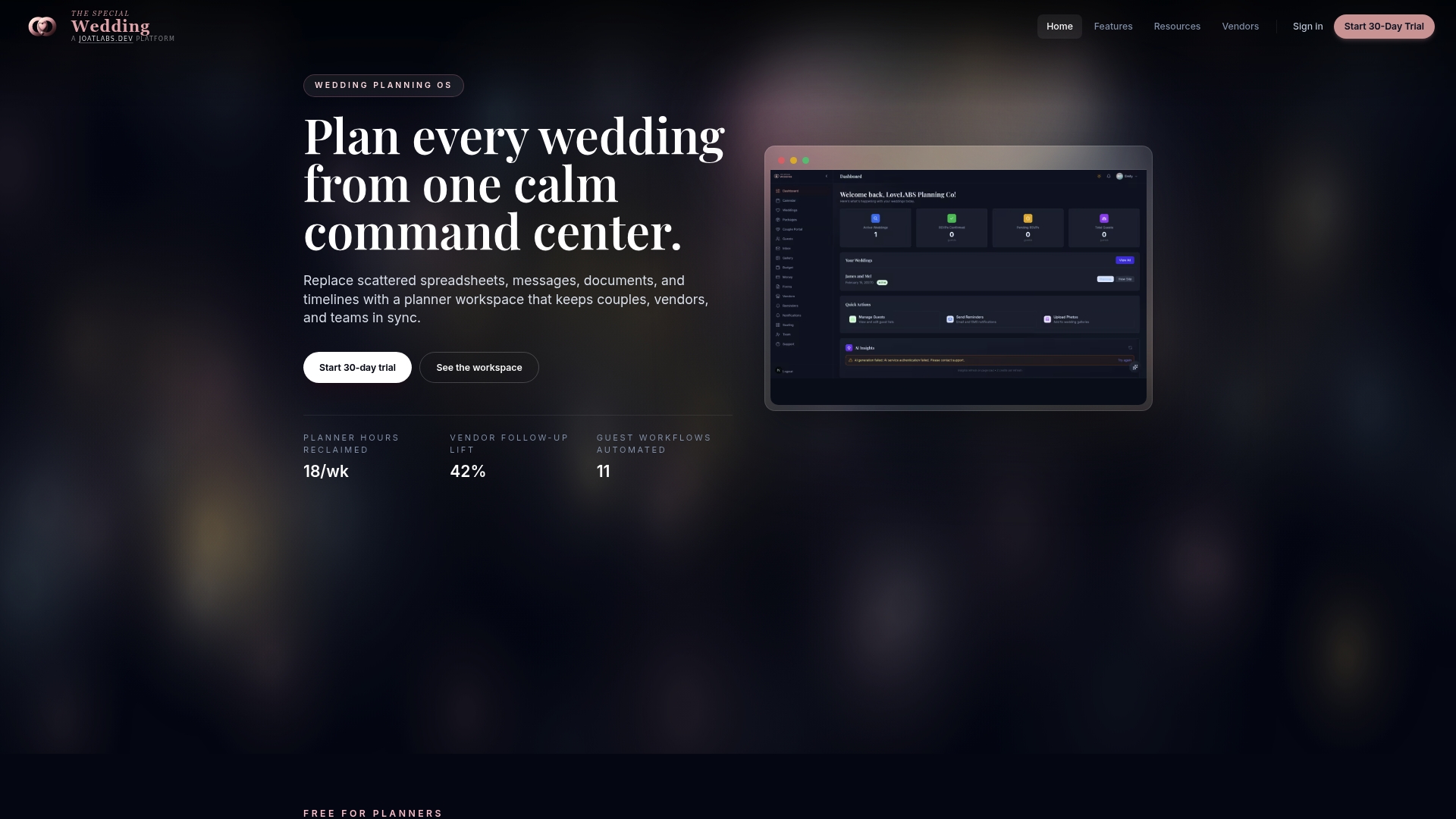
TheSpecialWedding.io brings all of it into one place. With all-in-one wedding planner software, you can issue milestone invoices tied directly to signed contracts, automate payment reminders, and track vendor payments alongside client billing in a single dashboard. The branded client portal gives your clients a clear view of what they owe and when, which speeds up payments and reduces back-and-forth. From vendor management integration to itemized billing templates, the platform is built for planners who want to spend less time on administration and more time on the work that actually matters.
Frequently asked questions
What is a typical retainer amount for a wedding planner invoice?
Most wedding planners collect a retainer between 25% and 50% of the total fee at booking to secure the date and cover initial expenses like vendor outreach and early deposits.
How do milestone payments benefit both planners and clients?
Milestone billing aligns payment timing with planning progress, which improves cash flow for planners and makes large fees more manageable and transparent for clients throughout a long engagement.
Should vendor costs be included with planner fees on invoices?
No. Separating vendor costs from planner fees prevents clients from perceiving markups where none exist and gives both parties a clear record of what was charged for services versus what was paid on the client’s behalf.
Why is it important to link invoices to signed contracts?
Linking invoices to contracts ensures that every payment milestone matches the terms the client already agreed to, which reduces billing disputes and simplifies record-keeping over engagements that can last 18 months.
How can automated payment reminders improve invoice management?
Automated reminders reduce the time you spend manually following up on overdue invoices, increase on-time payment rates, and keep cash flow steady across multiple active weddings without adding to your daily task list.
Recommended
Free wedding planner templates
Skip the blank page — these templates ship with the form fields you actually need.
Browse all 9 free templates →