Wedding Planning Progress Tracking: A Complete Guide
Wedding Planning Progress Tracking: A Complete Guide
Wedding planning progress tracking is the practice of methodically monitoring every task, payment, vendor, and guest detail through a centralized system so nothing gets missed and every deadline is met. Most couples face a planning window of 12–18 months and hundreds of moving parts. Without a structured tracking method, critical items like deposit deadlines and vendor confirmations fall through the cracks. A well-built tracking system turns that complexity into a manageable, phase-by-phase workflow that both couples and professional planners can follow with confidence.
What is wedding planning progress tracking?
Wedding planning progress tracking is a centralized command center that combines four core elements: a task timeline, a budget tracker, a vendor log, and a guest list. Each item carries a status label such as Not Started, In Progress, or Done, along with a due date and an assigned owner. Centralized checklists typically organize these elements into separate tabs or sections, making it easy to see what is complete and what needs attention at a glance.
The industry standard term for this practice is wedding project management, though most couples and planners use the more descriptive phrase “progress tracking” in everyday conversation. Both terms refer to the same core discipline: keeping every thread of the planning process visible, dated, and assigned.
Progress tracking does more than organize tasks. It creates an early warning system. When a vendor payment is overdue or a guest count is still unconfirmed three weeks out, a well-maintained tracker surfaces that problem immediately. Without it, those gaps only appear on the wedding day itself.

What are the core components of wedding planning progress tracking?
A reliable tracking system covers four distinct areas. Each one requires its own structure and data fields.
- Timeline tasks: Every planning action from venue booking to final vendor confirmation, with a due date, an assigned owner, and a status label.
- Budget tracker: Line items for every expense category, including estimated cost, actual cost, deposit paid, and balance due.
- Vendor log: Contact details, contract totals, payment milestones, and confirmation status for every vendor.
- Guest list: Names, contact information, RSVP status, meal preferences, and seating assignments.
The difference between a spreadsheet-based system and an integrated digital tool shows up most clearly in the vendor and budget tabs. A spreadsheet requires manual updates across multiple files. An integrated platform like Thespecialwedding connects vendor contracts, payment schedules, and task timelines in one workspace, so a change in one area reflects across the others automatically.
Pro Tip: Build your tracker before you book your first vendor. Starting with an empty system is far easier than retrofitting one after contracts are already signed and deposits are already paid.
Digital checklists with sharing features outperform paper-based systems for most couples because they allow real-time collaboration. When your partner marks a task complete or your planner updates a vendor status, you see it immediately. That shared visibility removes the need for constant check-in calls.
How should couples and planners implement effective tracking routines?
Consistent tracking routines are what separate a system that works from one that gets abandoned by month three. The most effective approach is a short, focused weekly review rather than a long planning session.
- Set a fixed weekly time. Pick a 15-minute window each week, same day and time, dedicated only to reviewing progress. Do not use this time to make new planning decisions.
- Review three things only. Check what was completed since last week, what is due in the next two weeks, and whether any item has changed status or been blocked.
- Assign one owner per task. Every task needs a single responsible person with a clear due date. Shared ownership creates ambiguity and delays.
- Set buffer deadlines. Add an internal deadline 1–2 weeks before the real due date for every critical task. This gives you recovery time if something slips.
- Share the tracker. Give your partner, planner, and key family members access to the same system. Transparency reduces miscommunication and duplicate effort.
Weekly reviews enable early detection of budget overruns or delayed tasks that monthly reviews consistently miss. That frequency matters most in the final three months, when the pace of decisions accelerates.
Pro Tip: Keep your weekly check-in to status scanning only. The moment it turns into a planning meeting, it loses its effectiveness and starts to feel like a burden.
What does a wedding planning timeline look like from start to finish?
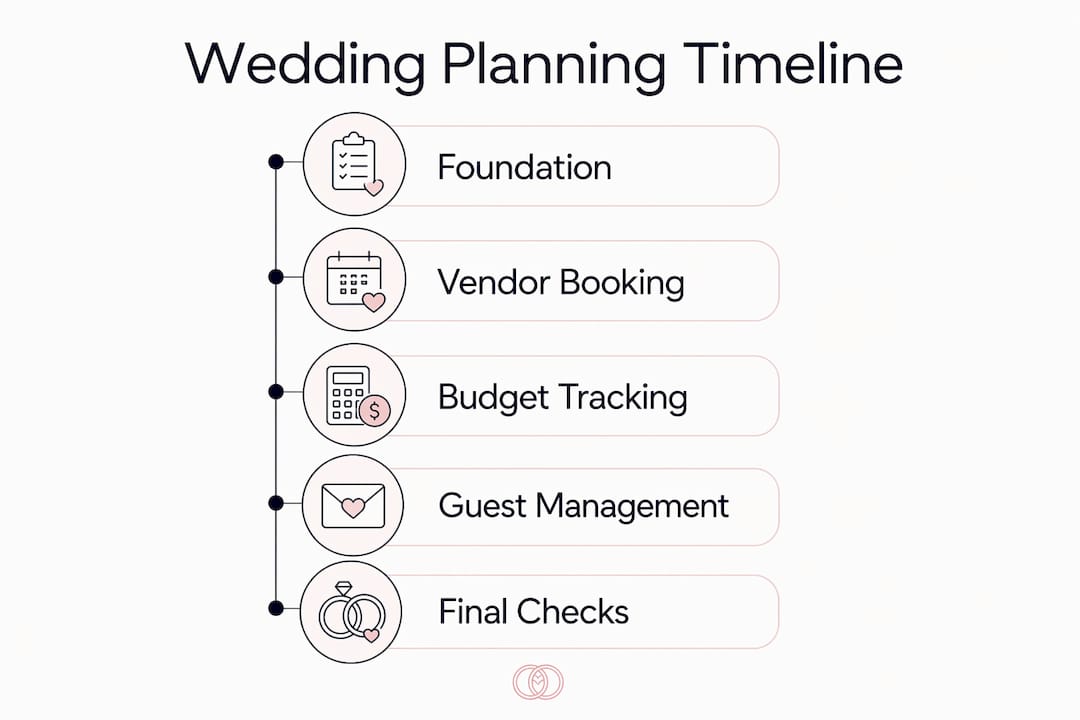
A typical wedding planning timeline spans 12–18 months and contains 300–400 individual tasks grouped into logical phases. Once the wedding date is set, those tasks distribute automatically across the timeline in a structured sequence.
| Phase | Timeframe | Key tasks |
|---|---|---|
| Foundation | 12+ months out | Venue booking, setting the budget, building the guest list |
| Vendor selection | 9 months out | Catering, photography, music, florist contracts |
| Detail planning | 6 months out | Dress fittings, menu selection, invitation design |
| Confirmation | 3 months out | Final guest count, seating plan, vendor confirmations |
| Final prep | 1 month out | Final payments, rehearsal dinner planning, day-of timeline |
| Wedding week | 7 days out | Vendor call confirmations, personal readiness, hand-off logistics |
Each phase builds on the previous one. Skipping the 9-month vendor selection phase, for example, creates a cascade of problems at the 6-month mark when preferred vendors are already booked.
The task grouping logic matters as much as the timeline itself. Tasks within each phase are ordered so that decisions requiring vendor input come before decisions that depend on those vendors. You confirm your caterer before you finalize your menu. You book your photographer before you schedule your engagement session. That sequencing is what makes a 300-task list feel manageable rather than paralyzing.
- Venue and catering decisions anchor every other vendor choice.
- Guest count drives seating, catering minimums, and invitation quantities.
- The day-of timeline cannot be finalized until all vendor arrival windows are confirmed.
- Managing your guest list in parallel with vendor bookings prevents late-stage surprises in headcount.
How does tracking budget and vendor payments integrate with overall progress monitoring?
Budget tracking is the most underestimated component of wedding progress monitoring. Most couples track tasks well but treat payments as an afterthought. That gap creates financial surprises in the final weeks.
Milestone payment tracking works best as a separate, filterable list sorted by due date. Each row should show the vendor name, total contract value, deposit paid, next payment amount, and next payment date. Filtering by the next two weeks gives you an instant view of what is due.
- Separate deposits, installments, and final balances into distinct line items.
- Flag any payment that is within 14 days of its due date as high priority.
- Cross-reference payment status with vendor confirmation status weekly.
- Use your payment tracking system to catch discrepancies between contracted amounts and invoiced amounts before they become disputes.
Pro Tip: Build a single “payments due this month” view at the start of each month. It takes five minutes to create and prevents the panic of discovering a $2,000 balance due in 48 hours.
Categories running over budget show up clearly in weekly reviews, giving you time to adjust before the overage compounds. A category that is 20% over budget at the 6-month mark is recoverable. The same overage discovered at the 2-week mark is not.
What are the best practices for last-minute progress tracking?
The final 14 days before the wedding require a different mode of operation. Planning decisions should be locked. The only work left is confirmation, coordination, and hand-off.
- Days 14–8: logistics focus. Confirm every vendor booking by phone, not just email. Verify arrival times, setup windows, and final headcounts. Send the finalized day-of timeline to all vendors.
- Days 7–1: personal readiness. Delegate logistics to your planner or a trusted point person. Your job in the final week is to show up rested and present, not to manage spreadsheets.
- Lock the day-of timeline. Distribute the final version to your planner, venue coordinator, photographer, and officiant at least five days before the wedding.
- Bundle final payments. Final two-week coordination works best when payments, confirmations, and timeline distribution happen as a coordinated bundle rather than scattered tasks.
- Use a hand-off checklist. Define exactly who is responsible for each decision on the wedding day. Ambiguity at this stage causes the most visible failures.
Pro Tip: Create a “last-mile logistics” checklist with no more than 20 items covering vendor calls, final payments, and timeline distribution. Pin it to the top of your tracker and work through it methodically in the final two weeks.
Key Takeaways
Effective wedding planning progress tracking requires a centralized system with four components, weekly 15-minute reviews, buffer deadlines, and a dedicated final-14-day confirmation protocol to prevent last-minute failures.
| Point | Details |
|---|---|
| Build a four-part command center | Track timeline tasks, budget, vendors, and guests in one centralized system with status labels and due dates. |
| Run weekly 15-minute reviews | Focus only on completed tasks, upcoming deadlines, and blocked items to catch problems early. |
| Assign one owner per task | Single ownership with buffer deadlines eliminates ambiguity and keeps accountability clear. |
| Treat payments as a separate tracker | Filter milestone payments by due date weekly to prevent financial surprises in the final weeks. |
| Lock decisions before the final 14 days | Use the last two weeks for confirmation and hand-off only, not new planning decisions. |
Why tracking discipline matters more than the tool you choose
Most couples spend more time choosing a planning app than building the habits that make any tool work. That is the wrong priority.
The couples and planners I have seen navigate complex weddings without major stress share one habit: they treat their weekly check-in as non-negotiable. Not a planning session. Not a vendor call. A 15-minute status scan. That discipline is what keeps a 400-task project from feeling like chaos.
The second habit is task ownership. When two people are responsible for something, nobody is responsible for it. Assigning one name to every task sounds bureaucratic until the florist calls with a question three days before the wedding and you know exactly who handles it.
Buffer deadlines are the habit most planners undervalue. Building a 1–2 week internal deadline before every real due date feels like extra work until the first time a vendor goes silent and you have two weeks to find a replacement instead of two days.
The tool matters less than you think. A well-maintained spreadsheet beats a neglected platform every time. That said, an integrated platform like Thespecialwedding removes the manual work of keeping multiple files in sync, which makes it easier to maintain the habits that actually drive results. The digital checklist approach works best when the system is shared, updated in real time, and reviewed on a fixed schedule.
The uncomfortable truth is that most wedding stress is not caused by difficult vendors or tight budgets. It is caused by poor visibility. You cannot manage what you cannot see.
— JOATLABS
How Thespecialwedding supports your planning process
Thespecialwedding is built for planners and couples who want one workspace instead of eight scattered files. The platform connects task timelines, vendor contracts, guest lists, and payment schedules in a single dashboard so every update is visible to everyone who needs it.
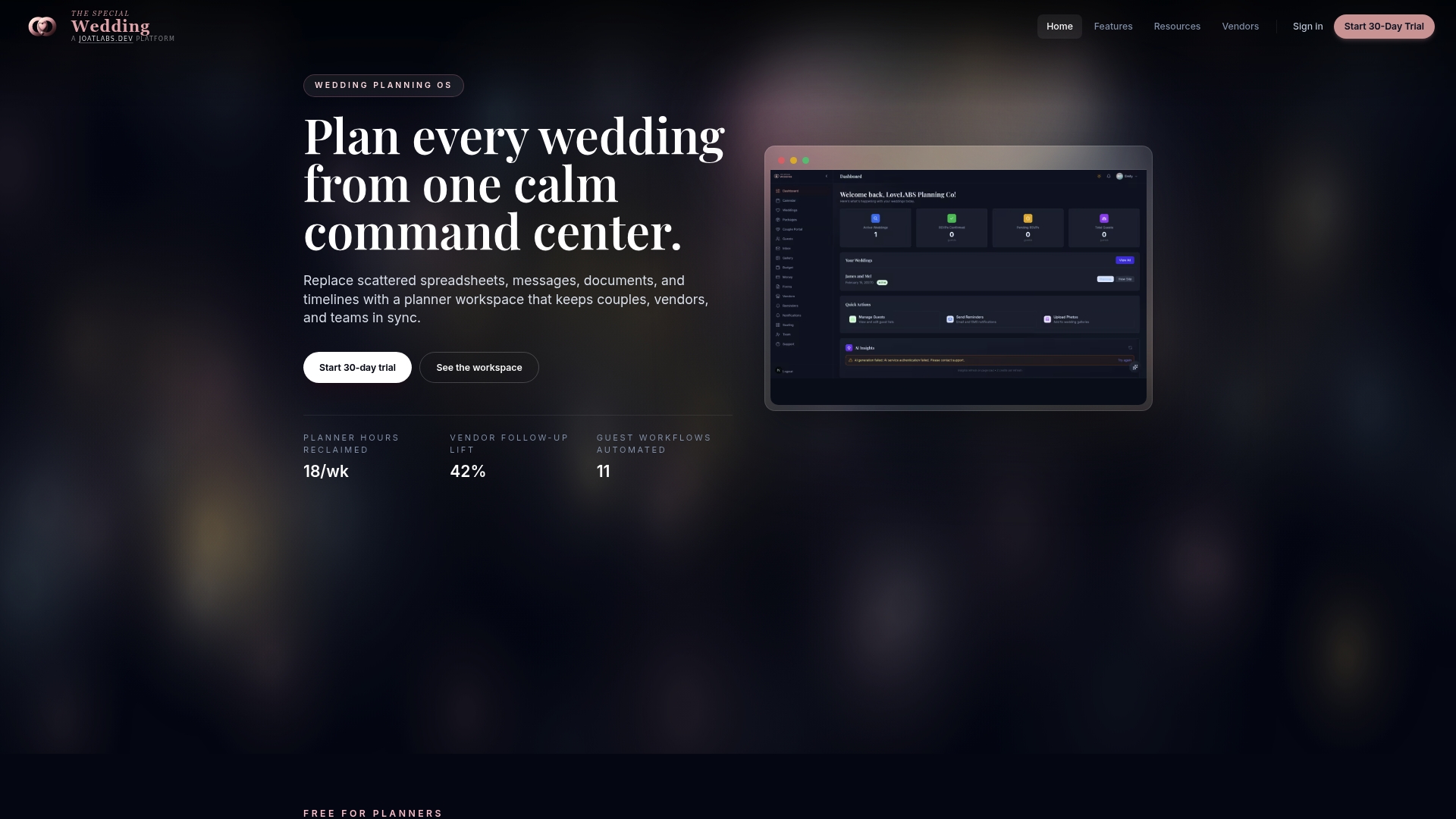
For couples planning in Oklahoma, the Thespecialwedding vendor directory lists verified local professionals including venues, decorators, DJs, and planners. If you need a professional planner to manage your tracking system for you, Events By Suad in Oklahoma City offers full-service wedding and event planning. For event rentals, Komplete Event Rentals in Tulsa provides equipment and setup support. The platform gives you the structure to track every detail and the vendor connections to execute on it.
FAQ
What is wedding planning progress tracking?
Wedding planning progress tracking is a centralized system that monitors task completion, budget, vendor payments, and guest RSVPs across a structured timeline. It uses status labels, due dates, and assigned owners to keep every planning detail visible and on schedule.
How many tasks does a typical wedding plan include?
A typical wedding plan contains 300–400 tasks distributed across phases from 12+ months out through the wedding week. Tasks are grouped logically so each phase builds on the decisions made in the previous one.
How often should couples review their wedding planning checklist?
A short weekly review of around 15 minutes is the most effective cadence. Weekly check-ins focus on completed tasks, items due in the next two weeks, and any blocked or changed items.
What is the most common mistake in wedding budget tracking?
The most common mistake is treating payments as part of the general task list rather than maintaining a separate, filterable payment tracker sorted by due date. Milestone payment tracking by deposit, installment, and final balance prevents last-minute financial surprises.
What should couples focus on in the final two weeks before the wedding?
The final 14 days should focus entirely on vendor confirmation, final payments, and day-of timeline distribution. Final-week coordination works best when all logistics are delegated through a clear hand-off checklist rather than managed ad hoc.
Recommended
- Wedding RSVP Tracking System: Your 2026 Planning Guide | The Special Wedding Blog
- Wedding Lead Management for Planners: 2026 Guide | The Special Wedding Blog
- What Is a Wedding Planning Task Board? Your Guide | The Special Wedding Blog
- Wedding planning time management: a pro guide for planners | The Special Wedding Blog
Free wedding planner templates
Skip the blank page — these templates ship with the form fields you actually need.
Browse all 9 free templates →