Fix Pipeline Fast: Wedding Sales Stages & Next Steps for Planners
Fix Pipeline Fast: Wedding Sales Stages & Next Steps for Planners
The wedding sales pipeline runs through six stages: awareness/discovery, inquiry, nurture/consideration, consultation, proposal/quote, and booking & onboarding. The highest-impact fix at every stage is the same one most teams skip: give each stage an explicit next step and automate the follow-up so no inquiry goes quiet. The playbook below covers the scripts, templates, KPIs, and audit checklist to make that happen.
TL;DR:
- Speed up your initial reply within one business hour and include a scheduling link to prevent inquiries from cooling off.
- Automate follow-up sequences at each stage, especially after sending proposals, to maintain momentum and reduce gaps in the sales process.
- Track key KPIs such as response time, consultation booking rate, proposal acceptance, and overall booking rate weekly or monthly to identify leaks.
- Use a unified platform that centralizes client intake, workflows, contracts, and payments to drastically reduce manual handoffs and delays.
- Tailor sales stages and scripts to different client tiers, with shorter processes for budget clients and more relationship-building for luxury clients.
Thespecialwedding Bring Your Wedding Pipeline Together
TheSpecialWedding helps planners replace scattered tools with one collaborative workspace for intake, workflows, timelines, and client communication.Explore TheSpecialWedding
Table of Contents
- What Are the Stages of a Wedding Sales Pipeline?
- The Stage-by-Stage Playbook: Scripts, Fields, and Follow-Up Timing
- Where Wedding Pipelines Leak (And How to Patch Them)
- Which KPIs Actually Predict Bookings?
- Automating the Pipeline Without Losing the Personal Touch
- A 30/60/90 Plan to Fix Your Pipeline
- Customizing Stages for Budget, Mid-Tier, and Luxury Clients
- Connecting Your Pipeline to Marketing: Social Media, Bridal Shows, and Referrals
- Upselling and Cross-Selling Without Feeling Pushy
- Handling Objections at Every Stage of the Sale
- Scripting and Training Your Sales Team for Consistency
- Why Most Pipeline Failures Are Workflow Failures
- Run Your Pipeline on One Platform Instead of Five
- Sources
What Are the Stages of a Wedding Sales Pipeline?
Each stage of the wedding sales process exists to move a couple one step closer to a signed contract, and each one has a single action that triggers the next move. Skip that trigger and the lead sits, cools off, and books with someone who replied faster.
- Awareness/discovery: The couple finds you through Instagram, a bridal show, or a referral. Trigger: they visit your site or ask a friend for your contact info.
- Inquiry: They fill out a form or send a message. Trigger: a fast, personal first reply with a scheduling option, not a form-letter brochure dump.
- Nurture/consideration: They are comparing you against two or three other vendors. Trigger: educational content and social proof that keeps you top of mind until they book a call.
- Consultation/sales call: You get them on the phone or in person. Trigger: a structured discovery conversation that ends with a scheduled proposal delivery date.
- Proposal/quote: You send pricing and packages. Trigger: a simple, decision-ready document with a clear deadline and a follow-up plan.
- Booking & onboarding: They sign and pay a deposit. Trigger: a digital contract, a payment link, and immediate access to your client portal.
These labels track closely with the standard wedding pro funnel of awareness, inquiry, nurture, consultation, and booking, and they map cleanly to how couples actually behave, not to abstract marketing jargon.
The Stage-by-Stage Playbook: Scripts, Fields, and Follow-Up Timing
Generic advice like “follow up more” doesn’t tell your team what to type or when to hit send. Here’s the operational detail for each stage.
1. Inquiry: capture the right fields, reply fast
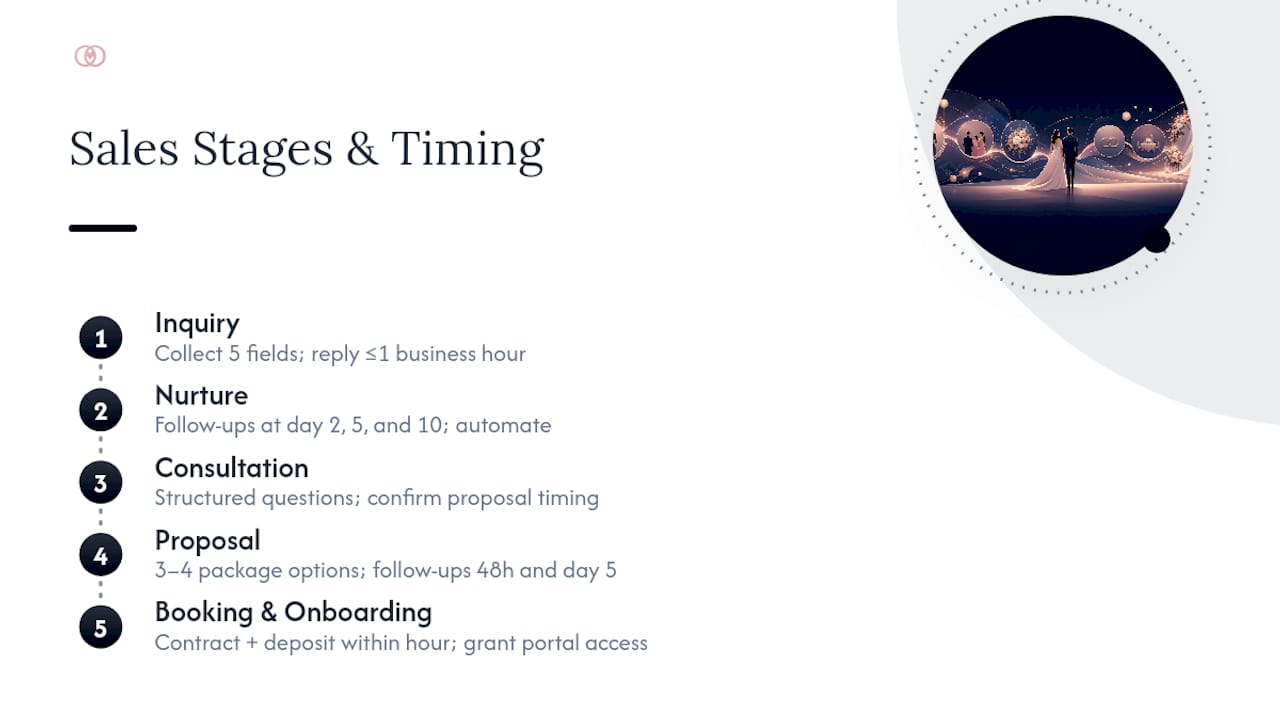
Your intake form should ask for wedding date, venue (or venue status), estimated guest count, budget range, and how they found you. Those five fields let you qualify a lead in seconds and route it to the right person or package tier. Skip the essay-style “tell us about your dream wedding” box. It slows couples down and gives you nothing you can act on.
Reply within one business hour if you can manage it. The first message should confirm you received their inquiry, ask one clarifying question if needed, and include a scheduling link for a consultation call. Speed matters more than polish here.
2. Nurture: stay visible without becoming noise
Not every inquiry books a consult on the first reply. Build a short sequence: a follow-up two days after the first reply, another at day five with a testimonial or portfolio piece, and a final check-in around day ten with a light pricing hint or availability note. Automated sequences at this stage measurably lift consult booking rates because couples stop falling out of the process during the “still deciding” window.
3. Consultation: run a structured conversation, not a pitch
Ask about their vision, their non-negotiables, their guest count, and who else is involved in the decision. Listen for red flags: unrealistic budgets for their guest count, unclear decision authority, or a date that conflicts with your capacity. Close every call by confirming when they’ll receive a proposal and how they should respond.
Keep pricing framing simple. A structured process focused on client needs rather than an overwhelming menu of add-ons builds trust faster and shortens the decision window.
4. Proposal: simple packages, tight follow-up
Limit initial package choices to roughly three or four line items. More options create hesitation, not confidence. Use a retainer or deposit to reserve the date, and leave detailed collection or add-on selections for later conversations, well after the contract is signed.
Plan two to three follow-up touches after sending the proposal: one at 48 hours, one at day five, and a final nudge before any stated deadline. Reduce friction by using e-signature tools and offering split payment options if your pricing allows it.
5. Booking & onboarding: make signing effortless
Once they say yes, the digital contract and deposit request should go out within the hour. Immediately grant client portal access, send a welcome packet, and outline what happens next: timeline calls, vendor introductions, design meetings. A wedding proposal workflow that automates this handoff prevents the awkward gap where a couple has paid but has no idea what comes next.
Pro Tip: Build your proposal follow-up messages before you need them. Writing a reminder email while you’re staring at a cold lead almost always produces a worse message than one written calmly in advance.
Where Wedding Pipelines Leak (And How to Patch Them)
If inquiries are steady but consultations are rare, or couples go quiet right after you send pricing, you have a leak, not a lead-generation problem. Chasing more traffic into a leaky pipeline just wastes more ad spend and more of your time.
Three symptoms point to specific fixes:
- Lots of inquiries, few consults: Your first reply is too slow or too generic, or your scheduling link is buried three paragraphs down.
- Silence after you send pricing: Your proposal is confusing, has too many options, or has no deadline pushing a decision.
- Long gaps after a great consult: You have no automated proposal follow-up sequence, so momentum from the call evaporates.
A five-minute audit can surface most of this: check your average first-reply time, walk through your own inquiry form as if you were a stressed couple, and review your last ten consultations for a pattern in who did and didn’t book. The WeddingPro tune-up framework covers exactly these checkpoints, and running it quarterly catches leaks before they become a slow season you can’t explain.
The fix priorities, in order: speed up your first reply, simplify your intake form, standardize your consult script, template your proposals, and automate your reminders. Teams that treat inquiries as a lead-generation problem often overlook that better follow-up workflows, not more traffic, are usually the real fix.
Which KPIs Actually Predict Bookings?
Seven metrics tell you almost everything about pipeline health, and you can track most of them in a spreadsheet before you ever touch a CRM.
- Total inquiries: Count by source (Instagram, referral, bridal show, website) so you know where to invest.
- Response time: Measure hours between inquiry and your first reply. Anything past four hours starts costing you bookings.
- Two-way conversation rate: The percentage of inquiries that reply to your first message. Low numbers point to a weak opening message.
- Consult booking rate: Inquiries that convert into a scheduled call. This is your nurture sequence’s report card.
- Consult-to-proposal rate: Calls that end with a proposal sent. A low rate here usually means your discovery questions aren’t qualifying well.
- Proposal acceptance rate: Proposals that convert to signed contracts. Watch this against your package complexity.
- Overall booking rate: Total inquiries divided by total bookings, your bottom-line health check.
Log these weekly if you’re a solo planner, monthly if you run a studio with several sales staff.
Automating the Pipeline Without Losing the Personal Touch
Automate the repetitive, time-sensitive tasks first: initial reply confirmations, consultation scheduling, proposal follow-up reminders, and deposit due-date nudges. These are the tasks most likely to slip when you’re juggling five active weddings, and they’re also the ones couples notice most when they’re missing.
Template the content that repeats with only small variations:
- An initial reply confirming receipt and offering a scheduling link.
- A consultation confirmation with what to expect and how to prepare.
- A proposal follow-up that restates the deadline without sounding pushy.
- A deposit reminder timed a few days before the due date.
Automating digital contracts, payment collection, and reminder sequences measurably speeds up signed contracts and deposits, largely because it removes the manual lag between “they said yes” and “the paperwork is actually moving.”
A unified platform can handle this by centralizing client intake, templated workflows, real-time dashboards, and client portals in one workspace instead of five disconnected tools. Calendar sync, payment processing, and contract tools can live inside the same system, which can cut the handoff time between booking and onboarding significantly.
Pro Tip: Don’t automate your consultation call itself. Automate everything around it, scheduling, reminders, confirmations, so the call stays the one truly human touchpoint in your pipeline.
A 30/60/90 Plan to Fix Your Pipeline
Fixing a leaky pipeline all at once overwhelms your team and rarely sticks. A phased rollout works better for small studios without dedicated sales staff.
- Days 1 to 30: Set a response-time service level agreement, one business hour, ideally. Add a scheduling link to every first-reply template. Standardize your consultation script so every team member asks the same core discovery questions.
- Days 31 to 60: Build automated nurture sequences for cold inquiries. Create templated proposals with your locked package structure. Move contracts to a digital e-signature system if you haven’t already.
- Days 61 to 90: Build a simple KPI dashboard tracking the seven core metrics. Train staff on the finalized scripts and templates. Test one variable at a time in your follow-up messages, subject lines first, then timing, then content.
This sequencing, starting with response time and scheduling before layering in automation and reporting, tends to work best for small teams who are managing the pipeline alongside actual wedding production work.
Customizing Stages for Budget, Mid-Tier, and Luxury Clients
A $5,000 elopement package and a $75,000 full-service luxury wedding don’t move through your pipeline at the same speed, and treating them identically wastes everyone’s time.
Budget-conscious clients typically need a shorter pipeline. They’ve often already narrowed their choices and want a fast quote, so your inquiry-to-proposal window should be tight, sometimes same-day, with pricing transparency baked into your website or initial reply rather than reserved for a consult call.
Mid-tier clients benefit from the full standard pipeline: a proper consultation, a considered proposal, and a nurture sequence that builds trust over one to two weeks. This is where most of your standard scripts and templates apply directly.
Luxury clients need a longer, more relationship-driven nurture stage, sometimes multiple consultations before a proposal ever goes out, plus a proposal that reads more like a custom presentation than a price sheet. Consider adding staged sales moments after booking, engagement session upgrades, design reveal meetings, that generate additional post-booking revenue rather than bloating your initial pitch with every possible add-on.
The mistake to avoid: using one script and one proposal template for all three tiers. It either scares off budget clients with an overbuilt sales process or makes luxury clients feel like they’re getting the same treatment as everyone else.
Connecting Your Pipeline to Marketing: Social Media, Bridal Shows, and Referrals
Your pipeline is only as good as what feeds it, and different marketing channels need different intake handling.
Instagram and social inquiries usually arrive as a direct message, not a form submission, so build a quick-response habit or an auto-reply that redirects to your actual intake form. Bridal show leads arrive in batches, dozens of business cards after one Saturday, which means you need a same-week bulk follow-up sequence ready before the show even happens, not scrambled together afterward. Referral leads convert at the highest rate of any channel because trust is already established, so fast-track them straight to a consultation offer instead of running them through a full nurture sequence.
Tag every inquiry by source inside your CRM or spreadsheet. That single habit tells you which marketing channel actually produces booked weddings versus which one just produces inquiries that never respond. A studio that spends heavily on bridal shows but sees a low two-way conversation rate from that source is often better off shifting budget toward referral incentives or targeted social content instead.
Weak homepage conversion can quietly choke your inquiry volume before marketing spend even matters. If your site’s conversion path is confusing, even a great ad campaign or a strong bridal show presence sends couples to a dead end.
Upselling and Cross-Selling Without Feeling Pushy
The proposal stage isn’t the only place to grow revenue, and treating it that way usually backfires by overwhelming couples with options before they’ve even said yes.
The best upsell moments happen after booking, not during the initial sale. Once a couple has signed and paid a deposit, they’re in trust-building mode, not decision-fatigue mode, which makes it the right time to introduce add-on services: an engagement session package, expanded floral upgrades, a second-day brunch coordination, or extended photography hours.
Cross-selling works best when it solves a problem the couple mentions themselves. If they bring up wanting more lighting during a venue walkthrough, that’s your opening to introduce a lighting or rental partner rather than pitching it cold. Vendor referrals through a directory can double as a soft cross-sell moment when you connect couples to trusted event decor and lighting specialists or rental providers already vetted for quality.

Keep your initial proposal lean, around three or four core packages, and save the expanded menu for a post-booking conversation. Couples who feel rushed into add-ons during the sales stage are far more likely to second-guess the whole booking.
Handling Objections at Every Stage of the Sale
Objections show up differently depending on where the couple is in your pipeline, and matching your response to the stage matters more than having one universal rebuttal.
At the inquiry stage, the objection is usually silent, they just don’t reply. The fix isn’t a persuasive script, it’s a faster first response and a lower-friction way to book a call. At the consultation stage, objections get vocal: “we’re not sure about our budget,” or “we’re still talking to other planners.” Address budget concerns by asking what’s driving the number rather than immediately discounting your rate, and address comparison-shopping by highlighting what your process specifically solves for them, not by disparaging competitors.
At the proposal stage, the classic objection is “we need to think about it.” That’s often a signal your packages are too complex or your deadline is too soft. A simple, decision-ready structured proposal with clear options reduces this stall significantly. At booking, hesitation usually centers on the deposit amount or contract terms, resolve this by walking through the contract live on a call rather than leaving them to read dense legal language alone.
The common thread: every objection is really a request for clarity or reassurance. Train your team to hear “I need to think about it” as “I don’t have enough information to decide yet,” and respond accordingly.
Scripting and Training Your Sales Team for Consistency
A pipeline only performs as well as the person running the consultation call, which means scripting isn’t about sounding robotic, it’s about making sure every team member covers the same ground.
Build a written discovery script with the core questions every consult must include: budget range, guest count, vision priorities, and decision-making authority (are both partners on the call, or is a parent involved?). New hires should shadow at least three live consultations before running one solo, and every team member should review a handful of recorded or role-played calls each quarter to catch drift in tone or pacing.
Pair scripts with clear decision criteria: what counts as a qualified lead worth a full consult versus one that should be redirected to a simpler package or a different planner on the team. This prevents your most experienced closer from spending an hour on a lead that was never going to convert.
Track individual conversion rates by stage if you have more than one salesperson. A team member with a strong consult booking rate but a weak proposal acceptance rate needs coaching on proposal delivery, not on their opening pitch, and that distinction only shows up when you measure each stage separately rather than just tracking overall bookings.
Why Most Pipeline Failures Are Workflow Failures
Most wedding businesses don’t have a marketing problem. They have a workflow problem dressed up as a marketing problem. A marketing funnel measures attention; a sales pipeline has to measure action; confusing the two is why so many CRMs end up full of vague statuses like “considering” that don’t tell anyone what to do next.
Platform-driven workflows fix this by forcing every status to carry a next step, an automated reminder, a scheduled task, a triggered email, so leads stop dying quietly in a stalled column. That’s the practical difference between a pipeline that looks organized and one that actually converts.
Run the audit checklist above this week. Most of what’s costing you bookings takes minutes to spot and days, not months, to fix.
— JOATLABS
Run Your Pipeline on One Platform Instead of Five
Most of the fixes in this playbook, faster replies, templated proposals, automated reminders, digital contracts, still require someone to manually stitch together email, a scheduling app, a contract tool, and a spreadsheet CRM. There are platforms that serve as alternatives to that patchwork for planners who want the entire pipeline, from first inquiry to signed contract, running inside one workspace instead of multiple browser tabs.
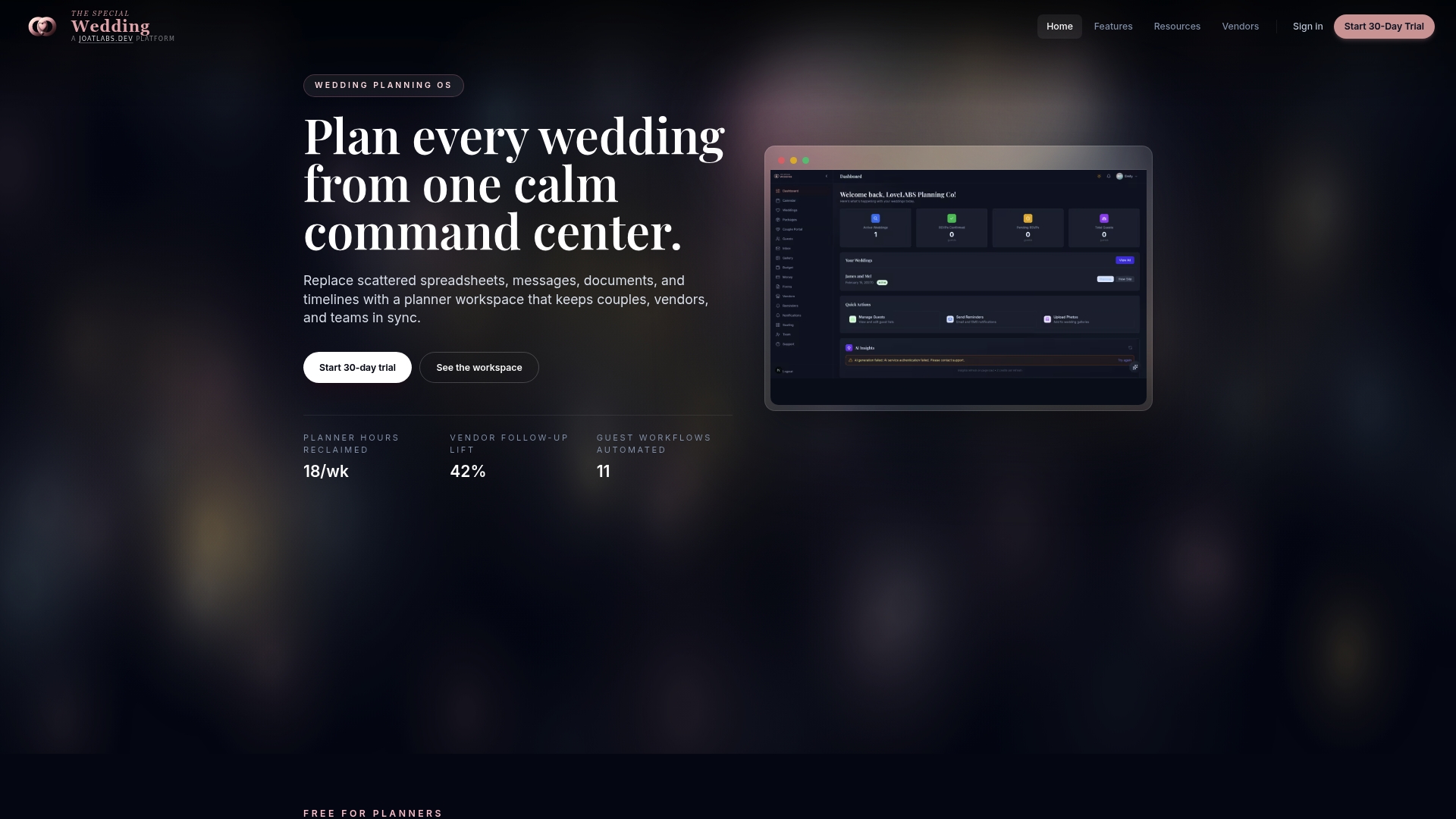
Such platforms centralize client intake forms, templated follow-up workflows, real-time pipeline dashboards, and client portals so teams can see exactly where every couple sits and what needs to happen next. Calendar sync and contract and payment tools living in the same system can reduce the gap between “they said yes” and “the deposit is collected,” avoiding an awkward multi-day scramble. Faster consult booking, fewer leads lost to slow replies, and smoother onboarding are the direct payoff of removing that manual handoff.
If you’re managing multiple weddings and still tracking inquiries in a spreadsheet, start with the wedding planner software and CRM built for exactly this pipeline, and see how templated workflows and automated follow-up hold up against your current process.
Sources
A few resources worth bookmarking as you put this playbook into practice:
- Shannon Tarrant — Wedding business lead problem
- KJ & Co. — Sales funnel every wedding planner pro needs
- PPA — A wedding sales process that prepares clients to buy
- WeddingPro — Why aren’t they booking? A 5-minute sales pipeline tune-up
Recommended
Free wedding planner templates
Skip the blank page — these templates ship with the form fields you actually need.
Browse all 9 free templates →