Wedding Transportation Coordination: A Complete Planning Guide
Wedding Transportation Coordination: A Complete Planning Guide
Wedding transportation coordination is the process of planning, scheduling, and managing all vehicles that move your wedding party and guests between locations on your wedding day. Done well, it keeps everyone on time, reduces stress, and prevents the kind of logistical chaos that derails even the most carefully planned events. This guide covers what wedding transportation coordination actually involves, how to build a timeline, which vehicle types fit different needs, and how to manage communication on the day itself.
What is wedding transportation coordination?
Wedding transportation coordination is the organized management of every vehicle, route, schedule, and communication needed to move people safely and on time throughout your wedding day. The industry term for this process is “event transportation logistics,” though most planners and couples simply call it wedding transport coordination. Both terms describe the same discipline: treating your wedding’s movement of people as a planned operation, not an afterthought.
The core components include:
- Master schedule: A document listing every pickup and drop-off time, location, and vehicle assignment for the entire day
- Vehicle selection: Matching the right vehicle type and capacity to each group, from the bridal party to out-of-town guests
- Route planning: Mapping each transit leg with buffer times built in to account for group boarding and traffic
- Driver communication: Sharing contact details, parking instructions, and timing expectations with every driver before the wedding day
- Guest communication: Informing guests of shuttle schedules, pickup points, and drop-off locations through your wedding website and direct messages
Each component depends on the others. A perfect schedule fails if guests don’t know where to board. A great route plan fails if the driver has no contact for the point person. Coordination means all five elements work together.
Pro Tip: Build your master transportation schedule inside your overall wedding day runsheet. A single document that covers all vendors and vehicles prevents the version-control problems that come from managing separate files.
How to plan and timeline wedding transportation effectively
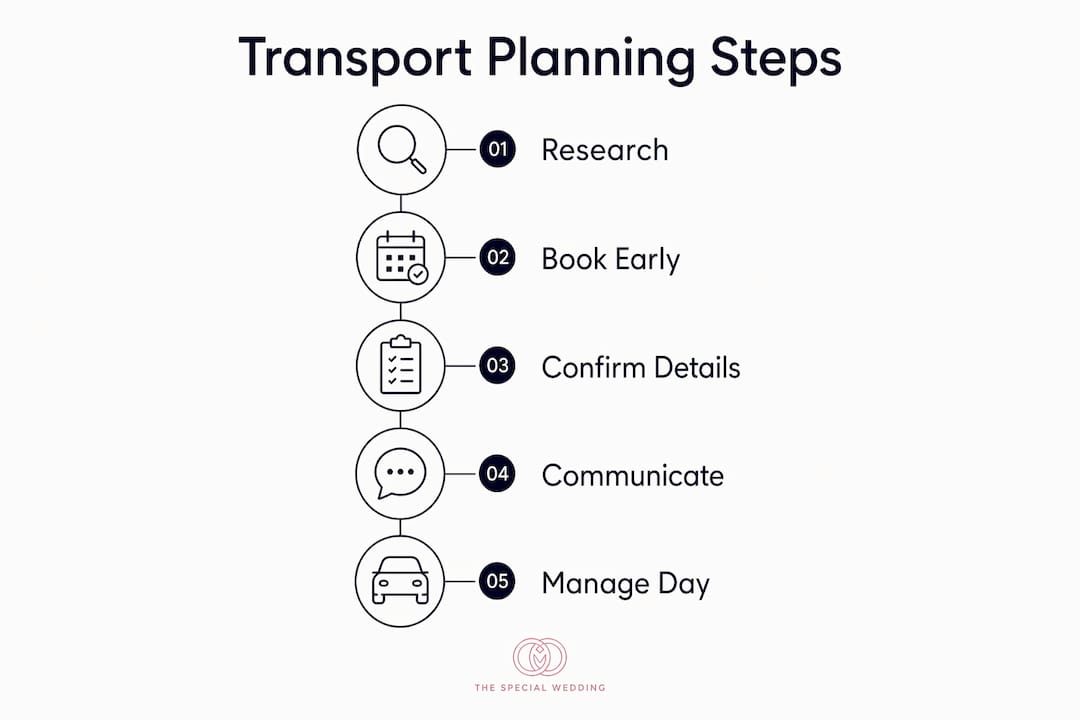
Timing is the most common failure point in wedding transport planning. Couples often treat transportation as a last-minute booking, then discover their preferred vehicles are already reserved.
Follow this sequence:
- 8–12 months out: Start researching transportation vendors. Identify how many vehicles you need, what types, and for which legs of the day. Book early for peak seasons since popular dates fill fast.
- 6–8 months out: Sign contracts and pay deposits. Contracts should specify exact vehicle models, passenger capacity, and cancellation terms. Vague contracts lead to surprises on the day.
- 3–4 months out: Finalize your passenger lists, routes, and driver contact details. Share preliminary schedules with your wedding planner or coordinator so transport aligns with vendor arrival times.
- 1–2 weeks out: Send confirmed pickup times and locations to all guests using shuttle services. Update your wedding website with this information.
- 1 week before: Share a complete master logistics document with drivers, your point person, and your planner. This document should include company names, driver contacts, parking instructions, and every pickup and drop-off detail.
Pro Tip: Insist that your transportation contract names the specific vehicle model and its licensed passenger capacity. A contract that says “limo-style vehicle” gives the company room to send something smaller or older than you expected.
The 3-to-4-month window is when most couples lose control of their transport plan. Passenger lists change, venues update their loading zone policies, and photographers request adjusted arrival times. Treat this window as your coordination checkpoint, not just a confirmation call.
What types of wedding transportation services should couples consider?
The right vehicle depends on group size, distance, and the tone you want to set. Here is a breakdown of the most common options:
| Vehicle type | Best for | Typical capacity | Estimated cost |
|---|---|---|---|
| Stretch limousine | Couple or small bridal party | 6–10 passengers | $400–$800 |
| SUV limousine | Larger bridal party | 10–14 passengers | $600–$1,200 |
| Minibus | Wedding party plus family | 15–24 passengers | $600–$1,000 |
| Charter or party bus | Large guest groups | 25–55 passengers | $800–$2,000 |
Cost ranges vary based on rental duration, typically priced for 4–6 hours. A 20-passenger minibus for a 5-hour window sits in a different budget category than a stretch limo for two hours.
A few practical points on vehicle selection:
- Guest shuttles are the highest-value addition for remote venues or venues with limited parking. Large shuttles seating 25–55 passengers reduce on-site parking congestion and eliminate the risk of guests arriving late or getting lost.
- Destination weddings treat transportation as a budget priority, not an optional extra. Guests traveling from hotels to a venue they don’t know need reliable, scheduled transport.
- Tipping is standard. Budget 15–20% of the vehicle cost per driver, and confirm whether gratuity is already included in your contract.
Providing shuttles for guests is widely recognized as one of the most appreciated courtesies a couple can offer, particularly at venues with limited parking or in areas where guests are unfamiliar with local roads.
How to handle communication and logistics on the wedding day
Day-of coordination is where plans either hold together or fall apart. The single most important decision you make is who runs the transportation on the day itself.
- Designate a point person who is not the couple or immediate family. This person manages all driver communication, confirms arrivals, handles boarding, and solves problems in real time. A fully empowered point person with driver contacts and decision-making authority keeps the couple out of logistics entirely.
- Share the master logistics document widely. Every driver, your planner, the venue coordinator, and your point person should have this document at least one week before the wedding.
- Use your wedding website and text messages for guest communication. Clear shuttle schedule information posted on your wedding website and sent as day-of reminders significantly increases shuttle usage and reduces missed rides.
- Build buffer time into every transit segment. A 20-minute drive realistically becomes a 45-minute transportation window when you account for group boarding and minor delays. Add 15–20 minutes to each leg as a standard practice.
- Stagger vendor arrivals. Transportation planning must align with photographer schedules, caterer deliveries, and venue loading zone policies to prevent simultaneous congestion at entrances.
Pro Tip: Give your transportation point person a printed copy of the master logistics document, not just a digital version. Phones die, apps crash, and venues often have poor cell coverage.
The wedding event runsheet is the best place to embed your transportation schedule. When transport times live inside the same document as ceremony cues and vendor arrivals, your point person can see how a delay in one area affects everything else.
Key takeaways
Effective wedding transportation coordination requires a master schedule, the right vehicles, clear guest communication, and a dedicated point person who is not the couple.
| Point | Details |
|---|---|
| Start booking early | Begin researching and reserving vehicles 8–12 months before the wedding, especially for peak dates. |
| Use detailed contracts | Specify exact vehicle models and passenger capacity to avoid substitutions on the day. |
| Assign a point person | Designate someone outside the immediate family to manage all driver and guest communication. |
| Build in buffer time | Add 15–20 minutes to every transit segment to absorb boarding delays and traffic. |
| Communicate with guests | Post shuttle schedules on your wedding website and send day-of reminders to reduce missed rides. |
Transportation is the part most couples underestimate
My honest observation after years of watching wedding days unfold is that transportation failures are almost always the result of planning it last. Couples spend months choosing florals and music, then book a limo two weeks out and assume it will work itself out.
The couples who have the smoothest days treat transport as a logistics operation from the start. They integrate it with their vendor scheduling workflow early, not as an afterthought. They know that a photographer waiting at the ceremony venue while the bridal party is stuck in traffic creates a cascade of delays that no amount of buffer time can fully absorb.
The point person role is also consistently undervalued. Couples often assign it to a well-meaning friend who has no authority to make decisions. The best point people I have seen operate like a logistics manager: they have every driver’s cell number, they know the backup plan if a vehicle is late, and they are not distracted by the emotion of the day. Giving that person real authority, not just a title, is what separates a smooth day from a stressful one.
Transportation also sets the emotional tone earlier than most couples realize. Guests who arrive on a comfortable, on-time shuttle are relaxed and ready to celebrate. Guests who drove in circles looking for parking arrive frustrated. That first impression matters more than the centerpieces.
— JOATLABS
Find trusted transportation vendors through Thespecialwedding
Planning your wedding transport means finding reliable vendors you can actually trust with your timeline.
Thespecialwedding’s vendor directory connects you with vetted local transportation and event service providers, so you spend less time searching and more time planning. Whether you need a shuttle company for 50 guests or a luxury vehicle for the bridal party, the directory gives you direct access to providers in your area. Browse listings, compare services, and contact vendors without the back-and-forth of cold outreach. Your wedding day logistics deserve professionals who know how to show up on time.
FAQ
What is wedding transportation coordination?
Wedding transportation coordination is the planning and management of all vehicles, schedules, and communications needed to move your wedding party and guests between locations on your wedding day. It includes booking vehicles, building a master schedule, and assigning a point person to manage day-of logistics.
When should you book wedding transportation?
Start booking 8–12 months before your wedding date, with contracts signed and deposits paid by 6–8 months out. Popular vehicles and peak-season dates fill quickly, so early booking protects your options.
How much does wedding transportation cost?
Costs range from $400 for a stretch limousine to $2,000 for a large guest charter bus, depending on vehicle type and rental duration. Always confirm whether gratuity is included in the quoted price.
Do you need a transportation point person?
Yes. Assigning a dedicated point person who is not the couple or immediate family is critical. This person handles all driver communication, manages guest boarding, and resolves delays in real time so the couple stays focused on the day.
How do you communicate shuttle schedules to guests?
Post shuttle times and pickup locations on your wedding website and send a text reminder on the morning of the wedding. Clear guest communication reduces missed rides and cuts down on parking congestion at the venue.
Recommended
- Wedding Event Seating Coordination Tips That Work | The Special Wedding Blog
- Wedding coordinator’s role in vendor scheduling | The Special Wedding Blog
- Wedding Reception Flow Planning: Your Complete Guide | The Special Wedding Blog
- Wedding Planning Progress Tracking: A Complete Guide | The Special Wedding Blog
Free wedding planner templates
Skip the blank page — these templates ship with the form fields you actually need.
Browse all 9 free templates →