Wedding Workflow Automation for Pros: A Practical Guide
Wedding Workflow Automation for Pros: A Practical Guide
Yes — automate your high-volume, repeatable admin now. The single best first step is picking one workflow, either inquiry intake or consult booking, and running it end-to-end through a platform like Thespecialwedding before touching anything else. Teams that do this cut first-response time from 6–24 hours to under 5 minutes, which directly affects how many leads convert to consultations. Start there, measure the result, then expand.
Pro Tip: Before building anything, write down the exact steps you take manually for your top two admin tasks. That map becomes your automation blueprint.
Key Takeaways
Wedding workflow automation delivers the fastest ROI when you start with one high-volume, low-variability task, build in human approval gates, and measure response time and conversion before expanding.
| Point | Details |
|---|---|
| Start with one workflow | Inquiry intake or consult booking delivers the fastest, most measurable ROI. |
| Human gates are required | Keep human review on all client-facing sequences for the first two weeks after launch. |
| Test before going live | Run at least five historical leads through each automation to catch edge cases early. |
| Audit every season | Review all active workflows quarterly to catch outdated templates and broken integrations. |
| Thespecialwedding.io | Provides a ready-built platform with templates, onboarding, and connected workflows for planners and agencies. |
Table of Contents
- Why wedding workflow automation pays for itself fast
- Which wedding tasks should you automate first?
- How to build a wedding automation in seven steps
- Which systems should you connect in your tech stack?
- Should you hire a VA or build an automation?
- How Thespecialwedding.io runs these workflows for you
- Ready-to-copy templates you can use today
- What automation actually gets wrong (and how to fix it)
- Thespecialwedding.io gives you a faster path to live workflows
- Sources
Why wedding workflow automation pays for itself fast
Every hour you spend copying inquiry details into a spreadsheet, chasing a contract signature, or manually sending a payment reminder is an hour you are not spending on a new client or a better event. The business case for automation is straightforward: faster response, fewer errors, and the capacity to take on more bookings without adding headcount.
Agencies that consolidate onto a unified platform report measurable gains in capacity planning and event-level margin visibility. When your inquiry form, CRM, calendar, and contracts all talk to each other, you stop losing leads to slow follow-up and stop making timeline errors because someone forgot to update a shared document.
The client experience improves too. Consistent, on-time communication, whether that is a confirmation email, a payment reminder, or a vendor brief, signals professionalism. Couples notice when things run smoothly, and they refer other couples because of it.
- Faster lead conversion: Automated first responses keep warm leads from going cold overnight.
- Fewer timeline errors: A single source of truth for vendor instructions reduces day-of surprises.
- Higher proposal throughput: Template-driven proposals go out in minutes, not hours.
- Scalable capacity: Recovering admin hours means you can coordinate more events per season without burning out.
Which wedding tasks should you automate first?
Not every task is worth automating. The best candidates are high-volume, low-variability, and time-sensitive. Here is a prioritized list by impact:
High priority (automate immediately):
- Inquiry capture and qualification (web form → fit score → auto-reply)
- Consult booking and reminders (calendar link + confirmation + 24-hour reminder)
- Contract delivery and e-signature follow-up
- Staged payment invoicing and receipts
Medium priority (automate after the above are stable):
- Proposal drafting from a template library
- Automated timeline generation and vendor brief distribution
- Client FAQ responses via a portal or chatbot
- Post-wedding review requests
Lower priority (automate when volume justifies it):
- Gallery delivery notifications and print upsell sequences
- Vendor payment tracking and follow-up
- Budget summary reports
For photographers specifically: AI-driven culling and editing tools like Aftershoot automate the most time-consuming post-production tasks. Culling, basic editing, and gallery delivery are highly repeatable, and the time savings are measurable per shoot. Practitioners who have documented their photography workflow automations consistently cite gallery delivery sequences as the single highest-ROI automation they run.
A useful trigger-to-output example: an inquiry form submission fires a webhook, scores the lead against your criteria, sends a personalized auto-reply, and drops a calendar booking link, all before you open your laptop in the morning.

Pro Tip: Build your first automation around a task you do at least three times per week. Frequency is what makes automation pay off quickly.
How to build a wedding automation in seven steps
A reliable automation does not happen by connecting two apps and hoping for the best. Follow this sequence:
- Map the process. Write every manual step, who does it, how long it takes, and what triggers the next step. No step should be assumed.
- Define success KPIs. Pick two or three metrics before you build: response time, contract turnaround, or consult-to-book rate. You need a baseline to know whether the automation is working.
- Choose trigger points. Identify the specific event that starts each automated sequence, a form submission, a payment received, a date threshold, or a status change in your CRM.
- Create templates and decision rules. Draft every email, document, and notification the automation will send. Write the if/then rules that handle variations (e.g., if budget is under $X, route to a different proposal template).
- Wire integrations. Connect your tools using native integrations first, then middleware like Zapier or Make for gaps, and direct API calls only when the others cannot handle the logic.
- Run staged tests with historical examples. Feed real past inquiries through the automation before going live. Check every output against what you would have sent manually. This is where most errors surface.
- Deploy, monitor, and set rollback rules. Go live with a human approval queue for the first two weeks. Define the conditions under which you will pause the automation and revert to manual, then review weekly.
Human approval gates are not optional for client-facing sequences. A practitioner discussion on automation pitfalls makes the point clearly: the automations that cause the most damage are the ones that skip a human review on sensitive client communications. Build the gate in from day one.
Pro Tip: Test with at least five historical leads before going live. Include one edge case, such as an inquiry with a missing phone number or an unusual venue type, to confirm your decision rules handle exceptions gracefully.
Which systems should you connect in your tech stack?
The core system types every wedding pro needs to integrate are:
- Website forms (Typeform, Gravity Forms, or a native intake form)
- CRM and client portal (where all client data and communication history lives)
- Calendar (Google Calendar or Outlook for booking and reminders)
- Payment processor (Stripe or QuickBooks for invoicing and receipts)
- Galleries (Pic-Time or SmugMug for delivery and print upsell)
- Contracts and e-sign (DocuSign, HelloSign, or a native contract tool)
- Cloud storage (Google Drive or Dropbox for documents and assets)
- Email marketing (for nurture sequences and post-wedding follow-up)
Integration approaches vary by complexity. Native integrations, where two tools connect directly without a third party, are the most reliable and should be your first choice. When a native connection does not exist, middleware tools like Zapier or Make handle most common patterns without code. Webhooks are the right choice when you need real-time data transfer between systems that support them. Direct API calls are reserved for custom logic that no off-the-shelf connector can handle.
A practical flow example: an inquiry arrives via your website form, a webhook fires to your CRM, the lead is scored against your criteria, a calendar booking link is sent automatically, and the confirmed booking triggers a contract draft, all within minutes of the original submission. Understanding which system types exist helps you choose the right integration pattern for each connection.
Pro Tip: Start with the fewest possible integrations. Two connected systems that work reliably beat five connected systems with one broken link.
Should you hire a VA or build an automation?
The honest answer is: it depends on the task. Use this framework to decide.
| Task type | Recommended approach |
|---|---|
| High-volume, low-variability (payment reminders, confirmations) | Automate |
| Low-volume, high-judgment (vendor negotiation, difficult client calls) | Delegate to VA or handle personally |
| Moderate variability, time-sensitive (proposal customization) | Hybrid: template automation + human review |
| Sensitive client-facing moments (complaint handling, rescheduling) | Human only |
Automation has a lower ongoing cost than a VA for tasks it can handle reliably, but the build cost and maintenance time are real. A simple Zapier workflow might take two to four hours to set up and test. A more complex multi-step sequence with conditional logic can take a full day or more. A VA can handle exceptions and judgment calls that automation cannot, and for a solo planner managing fewer than ten events per year, a part-time VA may deliver better ROI than a complex tech stack.
The risk of over-automation is real. When every client touchpoint is automated, the relationship can feel transactional. Solo planners especially benefit from keeping high-emotion moments, such as the first consult and the final timeline review, personal while automating the administrative scaffolding around them.
Run a two-week pilot before committing to either path. Automate one task and track the error rate and client feedback.
How Thespecialwedding.io runs these workflows for you
Thespecialwedding is built specifically for professional planners and agencies who need these workflows production-ready, not assembled from scratch. The platform covers the full inquiry-to-delivery chain in one workspace.
Core features tied to the workflows above:
- Client intake forms with qualification logic
- Template library for proposals, contracts, and timelines
- Automation rules for triggers, reminders, and status updates
- Calendar sync for booking and vendor scheduling
- Contract delivery and e-signature tracking
- Payment workflows with staged invoicing
- Gallery management and delivery
- Team roles and approval queues
- Real-time dashboards and reporting for capacity planning
A full inquiry-to-booking flow on the platform works like this: a couple submits an intake form, the platform scores the inquiry and sends an automatic reply with a consult booking link, the confirmed booking triggers a contract draft and a payment schedule, and the signed contract kicks off a timeline build with vendor brief distribution. Every step is logged, every vendor gets the right brief, and you see the status of all active events on one dashboard.
The onboarding timeline is designed to get you to a live automation within four weeks: Week 1 is discovery and stack mapping, Week 2 is connecting your existing tools and importing historical client data, Week 3 is building and testing your first two workflows, and Week 4 is go-live with monitoring. Planners who follow this path recover meaningful admin hours per week and report faster consult-to-book conversion.

Pro Tip: Import at least ten past client records during onboarding. Real historical data surfaces edge cases in your templates before they reach a live client.
Ready-to-copy templates you can use today
These templates are designed to drop directly into your automation platform or email tool. Adjust the bracketed fields to match your brand voice.
1. Inquiry qualification auto-reply (send immediately on form submission)
Subject: We received your inquiry, [First Name]
Hi [First Name], thank you for reaching out. We have received your inquiry for [Wedding Date] at [Venue]. We will review your details and follow up within one business day. In the meantime, here is a link to our availability calendar: [Link]. We look forward to connecting.
2. Consult confirmation + 24-hour reminder sequence
- Confirmation (immediate): “Your consultation is confirmed for [Date] at [Time]. Here is the call link: [Link]. Please complete this short questionnaire before we meet: [Link].”
- Reminder (24 hours before): “Just a reminder: your consultation is tomorrow at [Time]. We are looking forward to it. [Call Link]”
3. Proposal follow-up cadence
- Day 0: Send proposal with a personalized note.
- Day 3: “Hi [First Name], I wanted to check in on the proposal I sent. Do you have any questions I can answer?”
- Day 7: “I have a few dates still open for [Season]. Let me know if you would like to hold one while you decide.”
4. Gallery delivery with print upsell (for photographers)
Subject: Your gallery is ready, [First Name]
Hi [First Name], your gallery is live at [Gallery Link]. You have [X] days of full access. When you are ready to order prints, use this link for [10%] off your first order: [Print Link]. Let me know if you have any questions.
Trigger-to-timing reference:
| Trigger | Send timing | Expected action |
|---|---|---|
| Inquiry form submitted | Immediate | Auto-reply + booking link |
| Consult booked | Immediate + 24 hours before | Confirmation + reminder |
| Proposal sent | Day 3, Day 7 | Follow-up check-ins |
| Contract signed | Immediate | Payment schedule + welcome email |
| Gallery delivered | Immediate + Day 7 | Delivery notice + print upsell |
Testing checklist before going live:
- Run each template with sample data and confirm all variables populate correctly.
- Test one edge case per template (missing field, unusual date format).
- Confirm reply-to addresses and sender names are correct.
- Set your KPI baseline (current response time, current consult-to-book rate).
- Document your rollback plan: which step reverts to manual if the automation fails.
What automation actually gets wrong (and how to fix it)
Most wedding pros who struggle with automation make the same two mistakes. They automate too much too fast, and they never revisit what they built.
The first mistake is treating automation as a set-and-forget system. A workflow you built for last season’s inquiry volume may not handle a surge in spring bookings, a new venue type, or a change in your pricing structure. Automations need a quarterly review, at minimum, to catch templates with outdated pricing, broken integrations, or decision rules that no longer match your business.
The second mistake is removing human judgment from moments that require it. Couples planning a wedding are making one of the largest emotional and financial decisions of their lives. An automated email that arrives at the wrong moment, or with the wrong tone, can undo weeks of relationship building. Keep the automation on the administrative scaffolding and keep yourself in the relationship.
One practical fix: schedule a 30-minute automation audit at the start of each new season. Check every active workflow against your current pricing, vendor list, and service offerings. Update templates before they go stale, not after a client notices something is wrong.
Thespecialwedding.io gives you a faster path to live workflows
Stop building your automation stack from scratch across eight disconnected tools. Thespecialwedding.io gives professional planners and agencies a single workspace where client intake, contracts, payments, timelines, and vendor communications are already connected and ready to run.
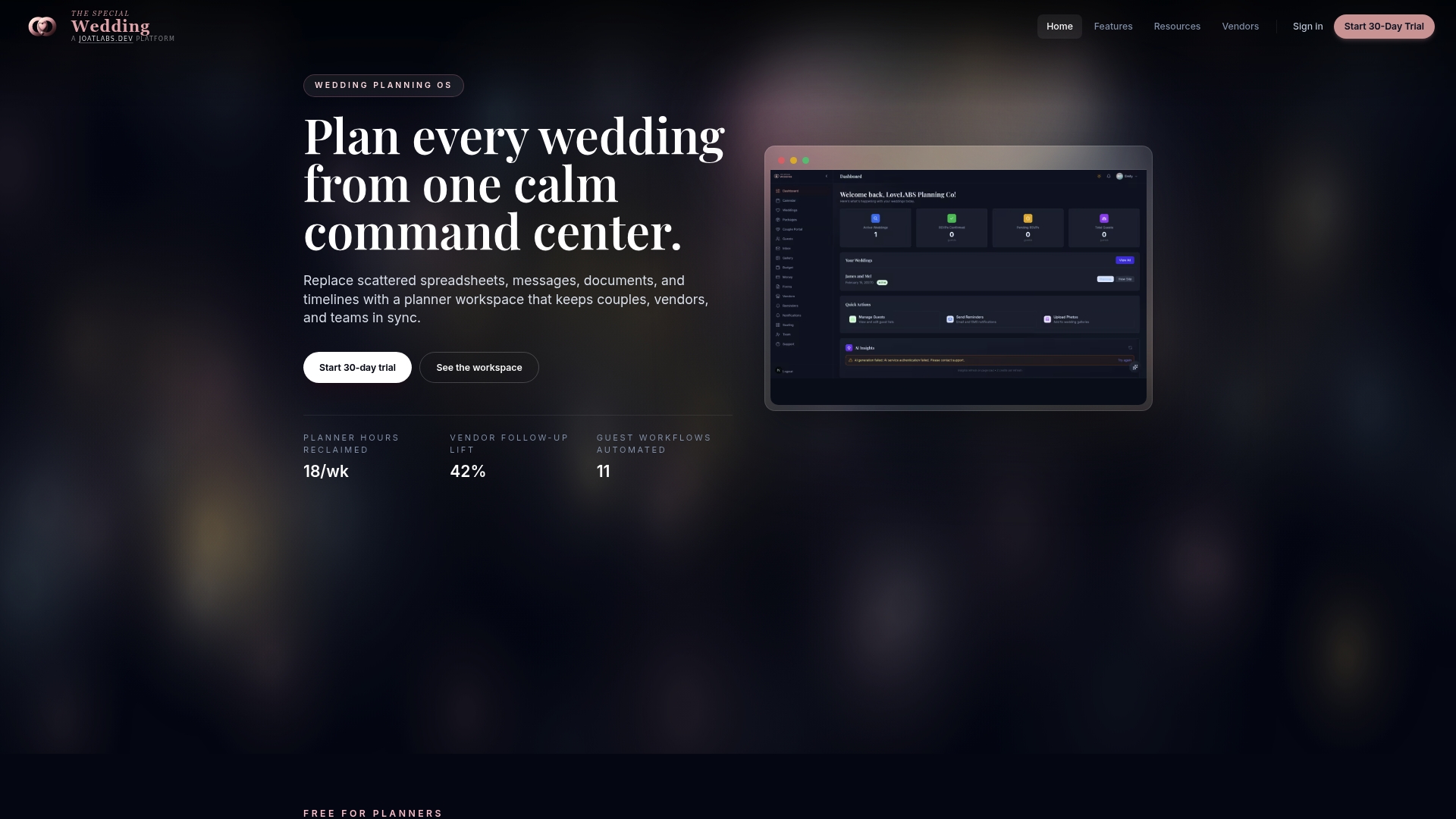
The platform’s template library covers the most common wedding workflow sequences, so your first automation can be live in days, not weeks. The four-week onboarding path walks you through connecting your existing tools, importing your client history, and testing your first workflows before they touch a real lead. For agencies managing multiple events simultaneously, the multi-event workspace and team role controls mean every coordinator works from the same data without stepping on each other.
Start your 30-day free trial at Thespecialwedding and run your first automated inquiry workflow this week.
Sources
Recommended
- Automated Wedding Day Timeline: What Couples Need to Know | The Special Wedding Blog
- Wedding planning time management: a pro guide for planners | The Special Wedding Blog
- Wedding planner workspace explained: boost multi-event ops | The Special Wedding Blog
- Solo Wedding Planner Organization Tips That Work | The Special Wedding Blog
Free wedding planner templates
Skip the blank page — these templates ship with the form fields you actually need.
Browse all 9 free templates →