Types of Wedding Event Management Systems in 2026
Types of Wedding Event Management Systems in 2026

Wedding event management systems are specialized software platforms that handle scheduling, vendor coordination, payments, guest management, and communication for professional planners. The industry has moved well beyond spreadsheets and email threads. Today, platforms like Plutio, Curate, Everly, Planivia, and HoneyBook each represent a distinct category of tool, built around different operational priorities. Choosing the right type means understanding what each system is actually designed to do, whether that is milestone-based payment tracking, AI-powered vendor outreach, or guest-facing RSVP management.
1. Types of wedding event management systems: an overview
The phrase “wedding event management system” covers a broad range of software. The recognized industry term is event management software (EMS), and within that category, wedding-specific platforms have emerged as a distinct subset. These systems fall into five primary types: all-in-one project platforms, venue-specific CRMs, AI-powered planning tools, guest management systems, and budgeting and operational coordination tools. Most professional planners use at least two of these types simultaneously, and many rely on mixed tool stacks that include platforms like HoneyBook, Aisle Planner, Trello, QuickBooks, and Canva. That fragmentation is exactly the problem these systems are designed to solve.

2. All-in-one wedding planner platforms
All-in-one platforms treat each wedding as a single project record, connecting proposals, contracts, timelines, vendor tracking, and payments inside one workspace. This architecture matters because changes propagate automatically across the project: update a vendor contact, and the timeline reflects it; mark a payment received, and the client portal updates instantly.
Plutio is the clearest example of this model in action. Its payment milestone structure follows a predictable schedule:
- Retainer collected at contract signing
- Second payment due at the six-month mark
- Third payment due three months before the wedding
- Final balance cleared 30 days before the event
Each milestone triggers an automated reminder, which reduces manual chasing and eliminates the back-and-forth that consumes planner time. The practical impact is significant: planners managing six or more weddings simultaneously can track payment status across all clients from a single dashboard without opening individual email threads.
The limitation of all-in-one platforms is setup complexity. Migrating from a scattered tool stack into a unified system requires time and discipline. The payoff, however, is that duplicate data entry disappears almost entirely once the system is configured correctly.
Pro Tip: Before committing to an all-in-one platform, map your current tool stack and identify where data gets re-entered manually. Those friction points are exactly what the platform should eliminate first.
3. Venue-specific CRMs with event-linked messaging
Venue-focused CRM systems solve a problem that general project tools do not: communication confusion across multiple simultaneous bookings. When a venue hosts 40 events per year, a message about florals for a June wedding must never appear in the thread for a September corporate event. Curate addresses this directly by linking all messaging to event records, so every communication, document, and vendor note is scoped to a specific booking.
The feature set in venue-specific systems typically includes:
| Feature | Operational benefit |
|---|---|
| Proposal builder with e-sign | Closes bookings faster without external tools |
| Event-linked client messaging | Prevents cross-event communication errors |
| BEO (Banquet Event Order) generation | Standardizes F&B and setup instructions for staff |
| Availability calendar | Prevents double-booking across event types |
| Vendor coordination portal | Centralizes florist, caterer, and AV communication |
This type of system is most valuable for venue teams, caterers, and florists who manage multiple events simultaneously and need event-scoped document workflows to avoid the common failure mode of cross-event operational ambiguity. A florist receiving a setup brief for the wrong event is not a minor inconvenience. It is a reputational risk.
4. AI-powered wedding planning systems
AI-driven wedding planning tools automate the most repetitive administrative tasks in the planning cycle: vendor outreach, timeline generation, and milestone reminders. Everly is the leading example in this category, and its performance data is striking. The platform reports 85% vendor response rates using AI-drafted inquiry emails, compared to roughly 30% for manual outreach. That gap represents hours of follow-up time recovered per wedding.
Here is how AI-powered systems typically structure their core workflow:
- Intake and brief creation. The planner inputs budget, location, guest count, and style preferences. The AI uses these structured inputs to generate a planning brief.
- Automated vendor outreach. The system drafts personalized inquiry emails for each vendor category and sends them on the planner’s behalf.
- Unified inbox management. All vendor quotes and responses are collected in one place, eliminating the need to track replies across multiple email accounts.
- Timeline generation. The AI builds a 12 to 18 month planning timeline with milestone reminders distributed automatically to both the planner and the client.
The key insight here is that AI shines in repetitive administrative tasks, freeing planners to focus on creative decisions like design direction and client experience. AI does not replace judgment. It removes the administrative load that prevents planners from exercising it.
Pro Tip: Use AI-generated vendor inquiry emails as a starting point, not a final draft. Add one specific detail about the couple’s vision before sending. Personalization at that level consistently improves response quality, not just response rate.
5. Guest-facing tools integrated in wedding management systems
Guest management is a distinct functional category within wedding planning software, and the best platforms in this space go well beyond a simple RSVP form. Planivia integrates personalized guest timelines, wedding websites, RSVP tracking, visual seating charts, and real-time budget syncing into a single interface. The seating chart feature includes drag-and-drop placement and conflict detection, which flags issues like dietary restrictions or family dynamics before they become day-of problems.
The operational value of syncing guest management with budgeting is underappreciated. When a guest count changes, the budget should update automatically. When a dietary restriction is added, it should appear on the BEO without a separate data entry step. Planivia’s auto-distributed checklists spanning 12 to 18 months with automated alerts demonstrate how timeline integration reduces last-minute chasing and operational confusion.
For planners who want to extend guest engagement beyond the platform itself, tools like QR code photo sharing and QR-based seating plans integrate well with guest-facing systems, giving guests a frictionless way to find their seats and share event photos without requiring a dedicated app download.
| Platform capability | Without integration | With integration |
|---|---|---|
| Guest count change | Manual budget update required | Budget updates automatically |
| Dietary restriction added | Separate BEO update needed | Synced to F&B records instantly |
| Seating conflict detected | Discovered day-of | Flagged during planning phase |
Managing guest lists without extra staff becomes realistic when these systems are configured correctly from the start.
6. Budgeting and operational coordination tools
Budgeting tools represent a specialized subset of wedding management systems, and AI has made them significantly more useful. Pearl Planner, developed by David’s Bridal, uses AI to generate real-time cost charts based on regional pricing data, helping planners allocate funds dynamically rather than working from static estimates. The system integrates budgeting directly into the planning workflow, so cost projections update as vendor quotes come in.
Operational coordination tools like Agenday take a different approach. Rather than focusing on the client-facing planning experience, Agenday provides a centralized dashboard that serves as a single source of truth for event schedules, F&B orders, dietary tracking, and team collaboration. Real-time updates mean that a change made by one team member is immediately visible to everyone else, which eliminates the version-control problems that plague shared spreadsheets.
| Tool | Primary function | Best for |
|---|---|---|
| Pearl Planner | AI budget allocation with regional data | Planners managing budget-sensitive clients |
| Agenday | Operational dashboards and F&B coordination | Venue teams and multi-staff operations |
| Planivia | Budget synced to guest and seating data | Solo planners managing full event scope |
Pro Tip: When evaluating budgeting tools, test whether the system updates projections automatically when a vendor quote changes. Static budget templates are only marginally better than a spreadsheet. Dynamic, quote-linked budgeting is the actual differentiator.
Key takeaways
The most effective wedding event management system is one that models each wedding as a single project record, connecting vendors, payments, timelines, and guest data without requiring manual re-entry across tools.
| Point | Details |
|---|---|
| All-in-one platforms | Milestone-triggered payments and unified project records eliminate duplicate data entry. |
| Venue-specific CRMs | Event-linked messaging prevents cross-booking communication errors for multi-event operators. |
| AI-powered tools | Automated vendor outreach achieves up to 85% response rates versus 30% for manual methods. |
| Guest management systems | Syncing RSVP, seating, and budgeting data reduces day-of errors and manual corrections. |
| Budgeting tools | AI-driven regional cost data and dynamic quote integration outperform static budget templates. |
Why system type matters more than feature count
The most common mistake planners make when evaluating wedding management systems is comparing feature lists instead of operational models. A platform with 40 features built around a venue-booking workflow will frustrate a solo planner who needs a client-facing project record. The architecture of the system, how it structures data and links records, determines whether it fits your operation.
My strongest recommendation is to prioritize systems that treat each wedding as a single project record. When vendor contacts, payment schedules, timelines, and client communications all live inside one record, operational consistency becomes automatic rather than effortful. You stop reconciling data across tools and start spending that time on the work that actually requires your judgment.
AI features deserve a measured assessment. The 85% vendor response rate that Everly reports is a real and meaningful number, but it depends on structured inputs. Garbage in, garbage out applies here as much as anywhere. Feed the AI a vague brief and you get generic outreach. Feed it a precise brief with budget, location, and style details, and the output is genuinely useful.
For multi-event operations, event-linked messaging is not optional. It is the feature that separates a tool built for one wedding at a time from a system built for a real planning business. Curate’s approach of scoping all communication to event records is the right model. Any system that lets messages float free of their event context will eventually cause a costly mix-up.
Finally, do not underestimate the value of a planning dashboard that gives you a real-time view across all active weddings. The ability to see payment status, outstanding vendor confirmations, and upcoming milestones in one place is what separates planners who scale from those who stay stuck at capacity.
— JOATLABS
Build your vendor network alongside your planning system
Choosing the right wedding management system handles the operational side of your business. The vendor side requires a different kind of infrastructure: a network of trusted caterers, florists, venues, and event specialists you can rely on across multiple weddings.
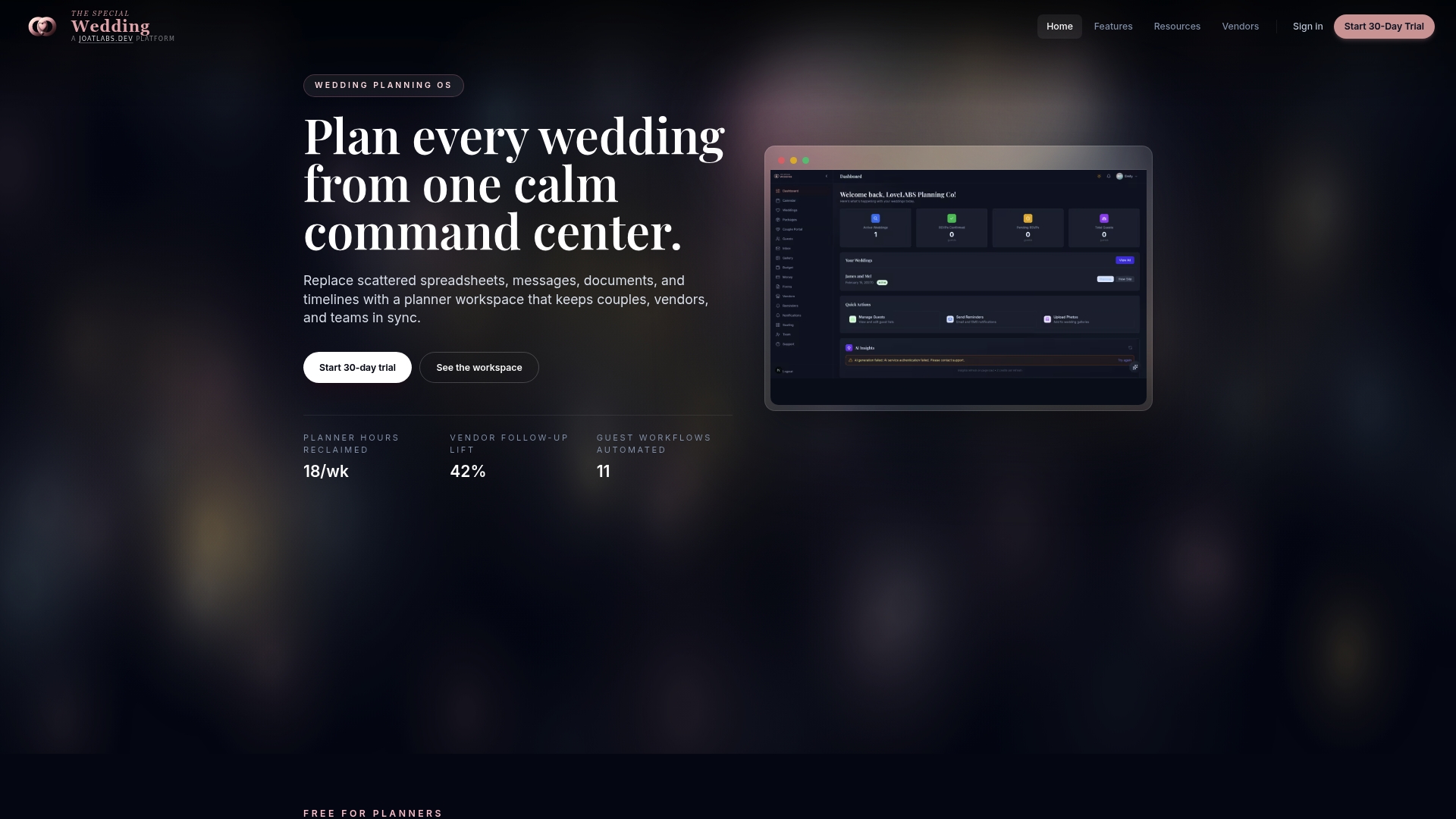
Thespecialwedding makes that side of the equation easier. The vendor directory connects professional planners with vetted local vendors across every category, from full-service caterers like Capers and Company in Edmond, OK, to florists and venue specialists in your region. When your management system handles the workflow and your vendor network handles the execution, you have the foundation for a planning operation that scales without breaking. Explore the directory and start building the vendor relationships your clients expect.
FAQ
What are the main types of wedding event management systems?
The five main types are all-in-one project platforms, venue-specific CRMs, AI-powered planning tools, guest management systems, and budgeting and operational coordination tools. Each type is built around a different operational priority, so the right choice depends on your business model and client volume.
How do I choose between wedding management systems?
Prioritize the system’s data architecture over its feature count. A platform that models each wedding as a single project record, linking vendors, payments, timelines, and guest data, will outperform a feature-heavy tool with disconnected modules.
What is event-linked messaging in a venue CRM?
Event-linked messaging scopes all client and vendor communications to a specific event record, preventing messages from one booking from appearing in another. Curate’s venue CRM uses this model to eliminate cross-event communication errors for teams managing multiple simultaneous bookings.
Can AI wedding planning tools replace a human planner?
AI tools automate repetitive tasks like vendor outreach and timeline generation, but they do not replace creative judgment or client relationship management. Everly’s AI achieves strong vendor response rates by drafting personalized inquiry emails, but the planner still directs strategy and makes final decisions.
Do wedding management systems integrate with guest tools?
Yes. Platforms like Planivia sync RSVP tracking, seating charts, and budgeting data in real time, so a change in guest count automatically updates cost projections and F&B records without requiring separate manual updates.
Recommended
- What Is a Wedding Guest Management System? | The Special Wedding Blog
- Wedding RSVP Tracking System: Your 2026 Planning Guide | The Special Wedding Blog
- Wedding Planning Dashboard Benefits for Pros in 2026 | The Special Wedding Blog
- Wedding planner workspace explained: boost multi-event ops | The Special Wedding Blog
Free wedding planner templates
Skip the blank page — these templates ship with the form fields you actually need.
Browse all 9 free templates →