Wedding Lead Management for Planners: 2026 Guide
Wedding Lead Management for Planners: 2026 Guide

Most wedding planners assume lead management means keeping a tidy inbox and following up when they remember. That assumption quietly kills bookings. What is wedding lead management for planners, really? It is a systematic process that moves couples through defined stages from first inquiry to signed contract, with documented next steps at every point. Done right, it is the single biggest lever you have for growing your business predictably. This guide covers the full definition, best practices, the right tools, and how to measure what actually matters.
Table of Contents
- Key takeaways
- What is wedding lead management for planners
- Best practices for nurturing wedding leads
- Using technology: wedding planner CRM tools
- Measuring and optimizing lead performance
- Common pitfalls and how to avoid them
- My honest take on wedding lead management
- How Thespecialwedding helps you manage leads better
- FAQ
Key takeaways
| Point | Details |
|---|---|
| Lead management is a process, not a tool | Buying software alone does not fix conversion; defined workflows and qualification criteria do. |
| Speed changes everything | Responding within five minutes can increase lead qualification by up to 21 times compared to delayed replies. |
| Pipeline stages must match your sales cycle | Wedding CRM stages should mirror real booking decisions, not generic sales templates. |
| Quality beats volume | Tracking conversion rates at each stage reveals far more than counting total inquiries received. |
| Next actions prevent lost leads | Every lead in your pipeline needs a scheduled next step, or it will die during a busy planning season. |
What is wedding lead management for planners
Wedding lead management is the structured practice of capturing, qualifying, nurturing, and converting couples from initial inquiry through to a signed contract and deposit. It is not a single action. It is a repeatable pipeline with defined stages that every inquiry moves through.
According to Salesforce’s lead management framework, the stages look like this:
- Inquiry capture: The couple submits a contact form, sends a message on social media, or calls your studio.
- Contact and qualification: You verify the couple’s date, budget, and vision to determine if they are a fit for your services.
- Discovery call: A real conversation where you ask deeper questions and begin building the relationship.
- Proposal: You send a personalized package outlining services, pricing, and the experience you provide.
- Contract and deposit: The couple signs and pays, converting from a lead to a client.
- Planning and event: The work begins. This stage belongs to client management, not lead management.
That last distinction matters more than most planners realize. Lead management and client management are two separate disciplines. Lead management is optimized for booking conversion. Client management covers everything after the contract is signed. Conflating them creates a process where neither gets done well.
The other critical principle is the difference between lead volume and lead quality. Chasing every inquiry wastes time and dilutes your focus. Effective lead management measures conversion rates at each stage, not just the number of inquiries received. A planner who converts 40% of 30 qualified leads outperforms one converting 10% of 100 unqualified ones every time.
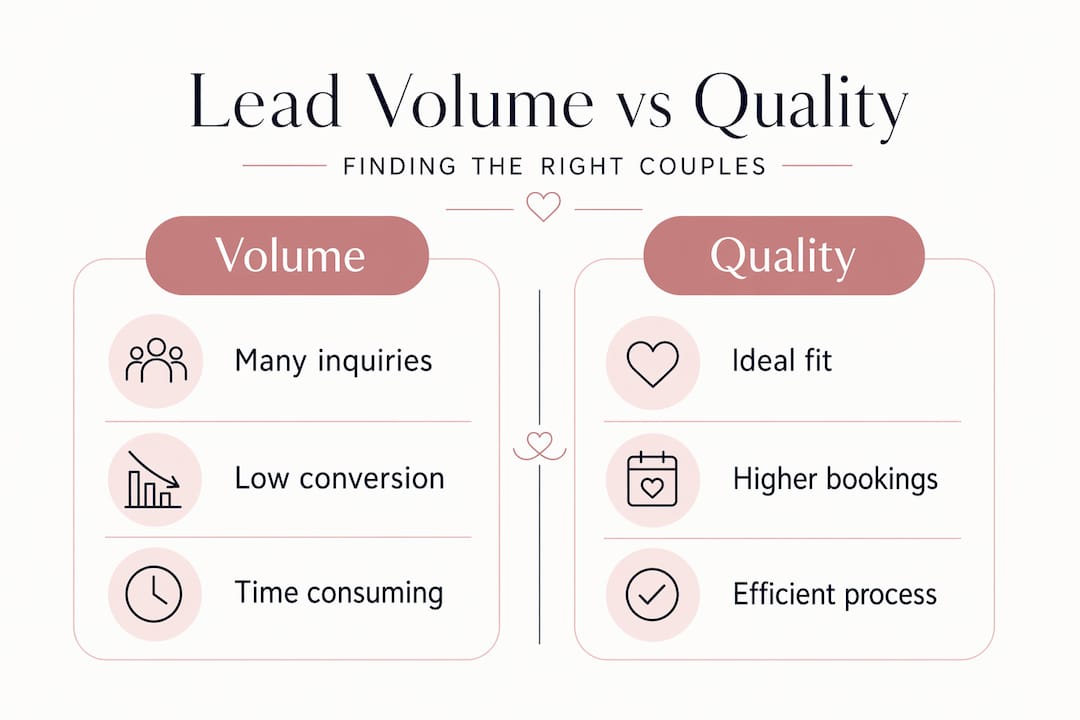
| Metric | Lead volume focus | Lead quality focus |
|---|---|---|
| Primary measure | Total inquiries per month | Conversion rate per pipeline stage |
| Follow-up strategy | Respond to everyone equally | Prioritize qualified, high-fit couples |
| Result | High effort, low predictability | Lower effort, higher booking reliability |
Best practices for nurturing wedding leads
The most common reason planners lose leads is not price. It is slow, inconsistent follow-up. Responding within five minutes increases the likelihood of making contact by roughly 100 times compared to waiting an hour. That number is not a typo. Couples researching wedding planners are contacting multiple businesses at once. The first planner to respond thoughtfully and quickly earns a significant advantage.
Here is a practical multi-touch follow-up cadence you can build into any system:
- Day 1: Send an automated acknowledgment within minutes of the inquiry, followed by a personal reply within the hour. The automated message buys you time while confirming the couple’s message was received.
- Day 3: Send a value touchpoint. This could be a link to your portfolio, a blog post relevant to their wedding style, or a short video introducing your process.
- Days 5 to 7: Check in with a brief, low-pressure message. Ask if they have questions or if their date is still available.
- Day 10 to 14: Offer a soft close. Let them know you have limited availability for their season and ask if they would like to schedule a call before you open that date to other inquiries.
- Day 21: Final follow-up. Keep it warm and direct. If there is no response after this, move the lead to a cold nurture sequence rather than abandoning it entirely.
This type of structured follow-up cadence stops once the couple books or explicitly declines. The automation handles timing; your personal messages handle tone.
Pro Tip: Document your follow-up policy in writing and share it with your team. The majority of booking conversions are won or lost in follow-up, and team-wide consistency is what makes that process reliable, not individual memory.
Most leads are not ready to book immediately. Nurturing keeps your brand present and trustworthy until couples reach the point where they are ready to commit. Think of a cold lead sequence as a slow drip of value, not pestering. A monthly check-in email featuring real weddings you have planned or a seasonal availability update costs almost nothing and keeps you top of mind.

Using technology: wedding planner CRM tools
The right wedding planner CRM tools do one primary job: centralize every inquiry source into a single pipeline so that no lead falls through the cracks. Couples reach you through your website, Instagram DMs, wedding directories, vendor referrals, and word of mouth. Without a centralized system, you are managing leads across scattered emails, text threads, and sticky notes.
Here is what a wedding-specific CRM should do for your lead pipeline:
- Capture inquiries automatically from multiple sources into one dashboard view
- Track pipeline stage so you always know where each couple stands
- Trigger follow-up reminders based on stage age or inactivity
- Log vendor referrals so you can measure which relationships generate the most bookings
- Manage proposals and contracts within the same system to reduce back-and-forth
- Send payment and deposit reminders once a lead converts to a client
Generic CRM tools built for sales teams can technically do some of this. But wedding-centric CRM stages that reflect actual booking milestones, seasonal capacity, and vendor coordination are materially different from a B2B sales pipeline. If your CRM does not understand the concept of a wedding date as a hard deadline driving urgency, you are forcing a round peg into a square hole.
The other use case planners often overlook is referral tracking. Strong vendor relationships are one of the most reliable lead sources in this industry. Your CRM should track which photographers, florists, and venues are sending you inquiries so you can invest in those relationships strategically. If you are not measuring referral sources, you are guessing at your marketing ROI.
For planners managing multiple events simultaneously, wedding planning dashboard tools provide pipeline visibility across every active lead and current client in one view, which makes triage and prioritization significantly faster.
Measuring and optimizing lead performance
You cannot improve what you do not track. The core metrics for any lead management strategy for planners are straightforward, but most planners never measure them consistently.
Pro Tip: Set aside 30 minutes every Monday to review your pipeline. Check how many leads moved stages, how many are stalled, and whether any follow-up deadlines were missed. This weekly habit catches problems before they cost you bookings.
Focus on these key performance indicators:
- Inquiry to discovery call rate: What percentage of inquiries result in a scheduled call?
- Discovery call to proposal rate: How many calls convert to a sent proposal?
- Proposal to contract rate: This is your closing ratio. If it is below 30%, your proposals or pricing communication likely need work.
- Average lead age by stage: How long does a lead sit in each stage before moving forward or going cold?
- Lead source to booking: Which channels produce leads that actually convert, not just inquiries?
Closed-loop measurement connects the original lead source to the final booking outcome. This tells you whether your investment in a particular wedding directory, advertising platform, or referral relationship is actually generating revenue. Without it, you are making marketing decisions based on activity rather than results.
When you identify a stage where leads stall consistently, that is a bottleneck worth diagnosing. If couples frequently ghost after the discovery call, your proposal timing or presentation may need revision. If leads go cold after the proposal stage, price transparency or follow-up timing could be the issue. The data tells you where to look. You supply the fix.
Common pitfalls and how to avoid them
Even planners who understand lead management in theory make predictable operational mistakes. Recognizing them early saves you from losing bookings you should have won.
- Delayed first response: Waiting more than an hour to acknowledge an inquiry is one of the most common and costly mistakes. Set up an automated instant reply for every contact form you have.
- Single-touch follow-up: Sending one message and waiting is not follow-up. It is hope. Build the multi-stage cadence described above into your workflow.
- No documented next step: Every lead in your pipeline should have a clear, scheduled next action. If a lead has “follow up soon” written next to it, it is already at risk.
- Over-relying on personalization at scale: Personal touches matter, but trying to craft every message from scratch when you have 30 active leads is unsustainable. Use templates with personalization tokens for the parts that vary.
- Treating cold leads as dead leads: A couple who inquired three months ago and went quiet may simply not be ready yet. A cold nurture sequence costs you almost nothing and occasionally converts.
Pro Tip: For solo planner operations, the biggest risk is letting lead management collapse during peak planning season. Build your follow-up cadence into your calendar as non-negotiable blocks, not tasks you get to when time allows.
Managing the couple’s decision window is the real skill here. Couples typically make venue and planner decisions within a two to four week window after inquiry. Your job is to stay visible, valuable, and responsive throughout that entire window without being aggressive.
My honest take on wedding lead management
I have seen planners with beautiful portfolios and genuinely strong service lose business to planners who are simply better at following up. That is uncomfortable to admit because it means raw talent is not enough. The discipline of managing a pipeline consistently, especially during the months when you are buried in active events, is what separates planners who grow predictably from those who ride the feast and famine cycle.
What I have learned is that most planners underestimate how much lead management is an operational discipline, not a technology problem. Buying a CRM without defining your stages, qualification criteria, and follow-up policy is like buying a filing cabinet and leaving everything on the floor next to it.
The single change I would push every planner to make first is this: write down your follow-up policy. Not in your head. On paper or in a shared doc. Who responds, when, what they say, and what happens if there is no reply. Once it is written down, it becomes a system. Systems scale. Memory does not.
Speed matters too, but not at the cost of quality. A fast, generic response loses to a slightly slower, personalized one. The goal is fast enough to stay competitive and specific enough to feel human.
— JOATLABS
How Thespecialwedding helps you manage leads better
If you are ready to stop patching together spreadsheets and email threads, Thespecialwedding is built specifically for how wedding planners actually work. The platform centralizes every inquiry source into a single pipeline, triggers follow-up reminders automatically, and tracks lead sources so you always know which relationships are generating bookings.
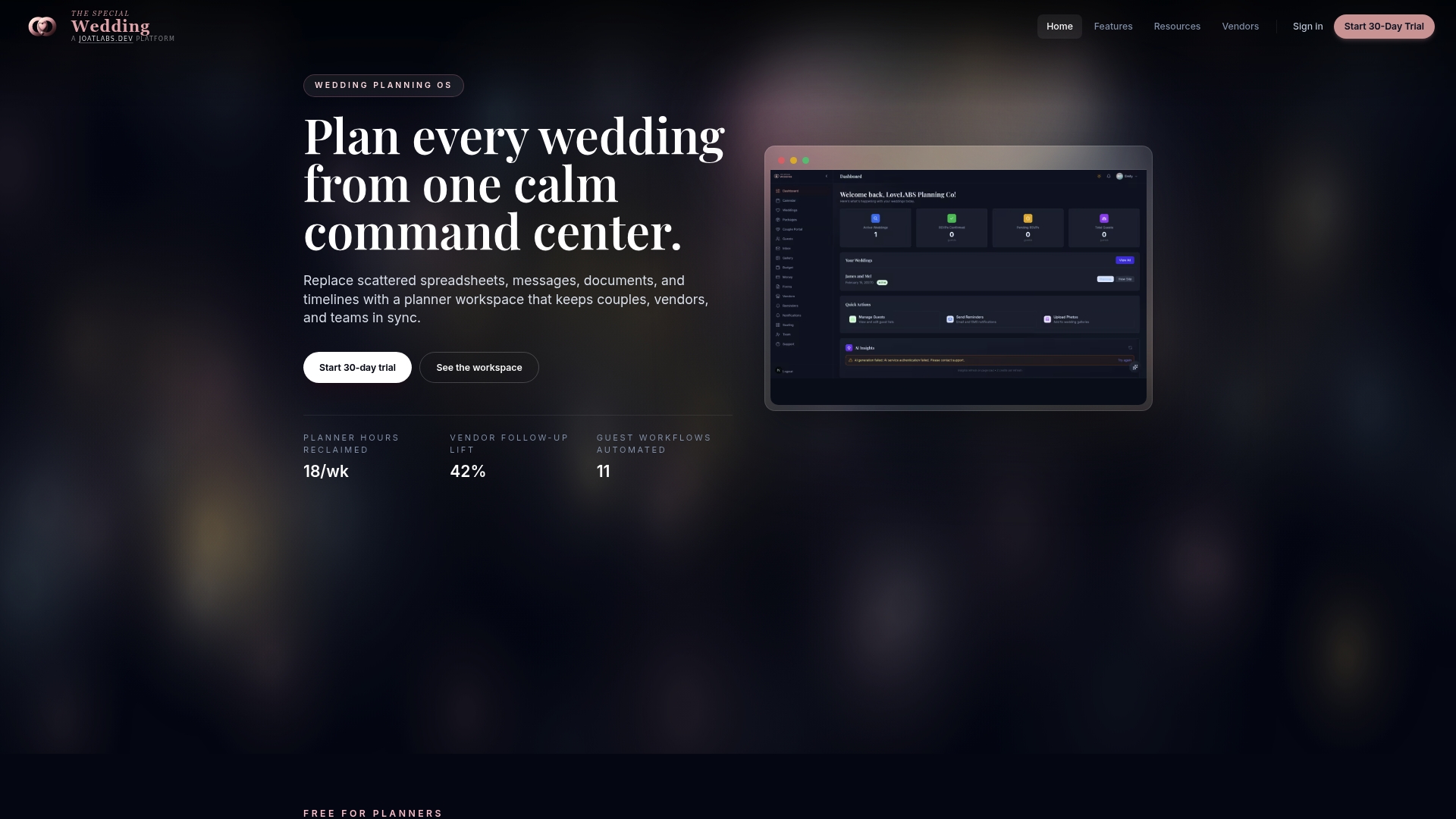
Beyond the lead pipeline, Thespecialwedding handles the full transition from lead to client, covering contracts, payment schedules, vendor coordination, and event timelines in one workspace. You can explore the vendor directory to build referral partnerships directly within the platform. For planners ready to see what a fully integrated system looks like in practice, the Events By Suad listing is a strong example of a professional planning service leveraging the platform’s full capability. Visit Thespecialwedding to see how it fits your workflow.
FAQ
What is wedding lead management for planners?
Wedding lead management is the process of tracking couples through defined stages from inquiry to signed contract, with documented follow-up actions at each step. It is an operational discipline focused on converting inquiries into bookings reliably.
How many follow-up touchpoints should a wedding planner use?
A proven cadence covers at least five touchpoints over three weeks, including an instant acknowledgment, value message, check-in, soft close, and final follow-up. After that, move the lead to a cold nurture sequence rather than dropping contact entirely.
What features should a wedding planner CRM have?
A wedding planner CRM should centralize inquiries from multiple sources, track pipeline stages with wedding-specific milestones, automate follow-up reminders, log vendor referrals, and manage proposals and deposit tracking in one place.
How do you measure lead management success as a planner?
Track conversion rates at each pipeline stage, specifically inquiry to call, call to proposal, and proposal to contract. Connect each booking back to its original lead source to understand which marketing and referral channels produce real revenue.
What is the difference between lead management and client management?
Lead management covers the process from inquiry to signed contract. Client management covers everything after booking, including planning phases, vendor coordination, and event execution. Effective planners treat these as distinct workflows with separate tools and processes.
Recommended
- Wedding planning time management: a pro guide for planners | The Special Wedding Blog
- Solo Wedding Planner Organization Tips That Work | The Special Wedding Blog
- Wedding planner workspace explained: boost multi-event ops | The Special Wedding Blog
- Wedding RSVP Tracking System: Your 2026 Planning Guide | The Special Wedding Blog
Free wedding planner templates
Skip the blank page — these templates ship with the form fields you actually need.
Browse all 9 free templates →