Wedding Planner Service Package Management Guide
Wedding Planner Service Package Management Guide

Managing multiple clients, each expecting something different, is where the cracks appear. Wedding planner service package management is the operational discipline of defining, organizing, and executing bundled service offerings so that every client receives exactly what was promised, nothing more and nothing less. Yet many planners treat package management as a simple checklist rather than the structured system it actually needs to be. This guide breaks down the full picture: what packages include, how to run them operationally, how to price and contract them clearly, and the practical habits that separate planners who scale from planners who scramble.
Table of Contents
- Key takeaways
- What is wedding planner service package management
- Operational systems that make packages work
- Pricing, contracts, and financial transparency
- Comparing package models and their management challenges
- Practical habits for better package management
- My perspective on getting package management right
- Tools that support your package management workflow
- FAQ
Key takeaways
| Point | Details |
|---|---|
| Packages need clear scope definitions | Defining what is included versus reimbursable prevents disputes and misaligned expectations with clients. |
| Operations require a documented system | A run of show, vendor packet, and central hub reduce day-of confusion for every package type. |
| Contracts must separate fees from costs | Planner fees and pass-through vendor costs should always appear as distinct line items in every contract. |
| Package type shapes your staffing needs | Full-service, partial, and day-of packages each carry unique staffing and deliverable responsibilities. |
| Technology reduces management overhead | Centralized planning platforms keep timelines, communications, and vendor data in one place across all active events. |
What is wedding planner service package management
At its core, service package management is the process of organizing bundled service offerings to deliver the promised scope with the right staffing, clear inclusions, and defined exclusions for every client engagement. The industry term most planners use internally is “wedding management,” but the broader practice includes everything from how you structure your pricing tiers to how you execute a vendor packet the week before a wedding.
Most confusion happens because the word “package” gets used loosely. A client might hear “full-service planning” and assume you will handle every vendor call, every invoice, and every last-minute errand. Without a documented scope, that assumption becomes your problem.
Wedding planning service packages generally fall into three categories:
- Full-service planning: Covers vendor sourcing, budget management, design direction, timeline creation, and day-of execution from engagement to reception.
- Partial planning: The client handles some elements independently, while you take ownership of specific deliverables such as vendor coordination or design.
- Day-of coordination: You step in during the final weeks, confirm all vendor logistics, and manage the wedding day itself.
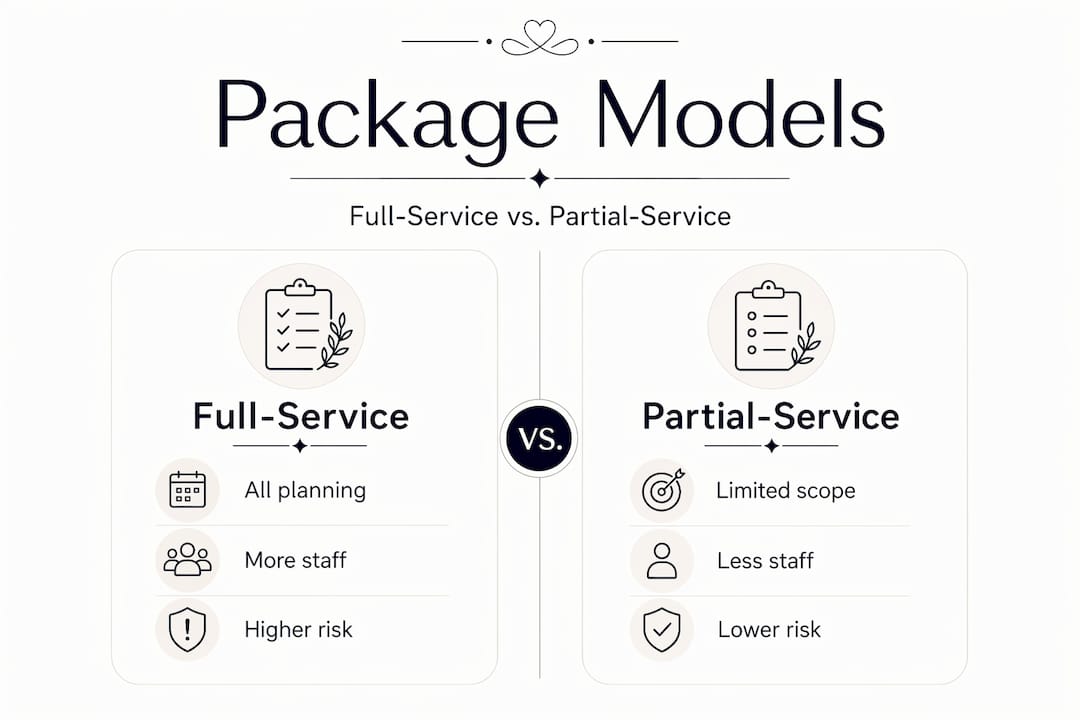
Each package type has a different staffing requirement, a different set of deliverables, and a different risk profile. Managing these packages well means knowing exactly what each one includes and communicating that clearly before a contract is signed. The distinction between included services and reimbursable or out-of-scope work is where most client disputes begin. Your contract is not just a legal document. It is your scope of work, and it protects both parties.
Operational systems that make packages work
Knowing what a package includes is only half the job. The harder part is building the execution layer that actually delivers it. Wedding management as an execution system is often mistaken for “more planning,” but it is something distinct. It is the operational infrastructure that removes vendor confusion and guest questions on the day itself.
The most effective system for any package type follows a structured documentation approach:
- Central planning hub: A single shared workspace where all timelines, vendor contacts, contracts, and client decisions live. Every update happens here, not in a text thread.
- Vendor packet: A concise document sent to each vendor containing the run of show, venue layout, contact list, and any special instructions specific to them.
- Guest one-pager: A brief reference sheet for ushers, family members, or anyone fielding guest questions during the event.
- Cue-based run of show: A cue-based show guide that triggers each transition, announcement, and vendor action by time and signal rather than assumption.
Roles and responsibilities must also be assigned in writing. For a full-service package, your team may include a lead planner, an assistant, and a day-of coordinator. For a day-of package, you might be working solo. Either way, every vendor and team member should know who owns each decision before the event begins.
Final vendor confirmations should happen no later than two weeks out. That window gives you time to resolve any conflicts before they become crises. Your vendor scheduling process should include a confirmation call, a written summary of their deliverables, and a clear point of contact for day-of questions.
Pro Tip: Build your vendor packet template once and update it per event. A reusable structure saves hours across a full season of weddings.
Pricing, contracts, and financial transparency
The financial side of package management is where many planners lose both money and trust. Planner fees are entirely separate from vendor costs, and every contract should reflect that separation clearly.
Here is a practical comparison of what typically falls inside and outside your planner fee:
| Category | Included in planner fee | Reimbursable or pass-through |
|---|---|---|
| Planning labor | Yes | No |
| Vendor sourcing and communication | Yes | No |
| Vendor payments (florist, caterer, etc.) | No | Yes |
| Transportation and parking | No | Yes |
| Design materials and decor | No | Yes |
| Overtime labor beyond agreed hours | No | Yes (billed separately) |
When you conflate your fee with vendor budgets in a client conversation, you create the expectation that everything is covered. Separating these line items is not just good accounting. It is the clearest way to manage client expectations throughout the engagement.
Vendor payment schedules typically require retainers upfront with final balances due before the event. Your contract should inform clients of these timelines explicitly. If a florist’s balance is due 30 days before the wedding, your client needs to know that in month one, not month eleven.
For your own fee structure, common wedding planner pricing options include flat-rate packages, percentage-of-budget pricing, and hourly rates for partial or consultation-based work. Each model has trade-offs, but flat-rate packages tied to a clearly defined scope give both you and your client the most predictability.
Pro Tip: Add a “scope expansion” clause to every contract. If a client requests work outside the agreed package, that clause gives you a documented process to price and approve additional services without conflict.
Comparing package models and their management challenges
Popular package types each carry distinct operational demands. Understanding those differences is the foundation of sound capacity planning.
| Package type | Core deliverables | Staffing needs | Key management challenge |
|---|---|---|---|
| Full-service planning | Vendor sourcing, budget management, design, timeline, day-of execution | Lead planner plus assistant | Scope creep as clients add requests over a 12-month engagement |
| Partial planning | Defined deliverables agreed in advance (e.g., vendor coordination only) | Lead planner, sometimes solo | Unclear handoff points when clients manage some vendors independently |
| Day-of coordination | Final confirmations, vendor packets, run of show, day-of management | Solo or one assistant | Late-stage discoveries of vendor conflicts or missing contracts |
Full-service planning is a comprehensive project management role that spans from engagement through reception, covering vendor contracts, budgeting, and design cohesion. It carries the highest revenue potential but also the heaviest operational load.

Day-of coordination sounds simple until you realize it requires inheriting months of planning decisions made without your involvement. The biggest risk is walking into a situation where vendor contracts have gaps, timelines are vague, or key decisions have not been confirmed. Building a thorough intake checklist for day-of clients is non-negotiable.
A few principles for aligning package choice with client needs:
- Match package scope to client availability. Couples with demanding careers often need more management from you, not less.
- Be direct about what partial planning does not cover. The client managing their own caterer is also the client calling you about the caterer on the wedding day.
- Price day-of packages to reflect the real workload. Two to three weeks of active coordination work is not the same as one eight-hour shift.
Practical habits for better package management
The planners who handle the most events without burning out are not necessarily the most talented. They are the most organized. Here is what that looks like in practice:
- Use a centralized planning platform. Wedding planning software that bundles timelines, vendor management, budgets, and communication into one workspace dramatically reduces the time you spend hunting for information across emails and spreadsheets.
- Set client approval milestones in the contract. Clear communication milestones and approval gates established early prevent scope creep and last-minute surprises.
- Document every decision in writing. Verbal approvals do not exist. If a client agrees to a venue change or a vendor substitution over the phone, follow up with a written summary immediately.
- Plan staffing at the package level. Know your assistant needs before you book the wedding, not the week before.
- Audit your packages annually. Scope, pricing, and workload shift over time. Reviewing your packages each year keeps them aligned with your current business capacity and market rates.
Treating each package as a service contract with defined planning artifacts, approval gates, and clear vendor communication ownership prevents the failures that come from unclear responsibilities.
Pro Tip: For solo planners, organization systems built for one require even more rigor than team-based operations. There is no one to catch what falls through the cracks.
My perspective on getting package management right
I have seen planners with genuinely excellent taste and client relationships run into the same operational wall repeatedly. The problem is almost never creativity or skill. It is a missing system underneath the beautiful work.
What I have learned is that the contract conversation is actually the most important service you offer. When you walk a client through exactly what is included, what they will handle, and what falls outside the scope, you are not just setting legal terms. You are building the operational foundation for a client relationship that will span anywhere from six months to two years.
The mistake I see most often is treating the package as a marketing tool rather than an operational blueprint. Planners design their packages to sound appealing and then figure out how to execute them afterward. That sequence gets you into trouble. Build the execution model first, then wrap the marketing language around it.
Technology plays a real role here, but not in the way most people expect. The value is not in the automation itself. It is in having a single source of truth that you and your client can both reference. When the timeline is in one place, the vendor confirmations are in one place, and the approved decisions are documented, you spend less time managing anxiety and more time managing the actual event.
Package management done right is a client relationship tool. The clearer your systems, the more confident your clients feel. That confidence generates referrals, not just completed weddings.
— JOATLABS
Tools that support your package management workflow
If you are still managing active client packages across email threads, spreadsheets, and separate messaging apps, the system is working against you.
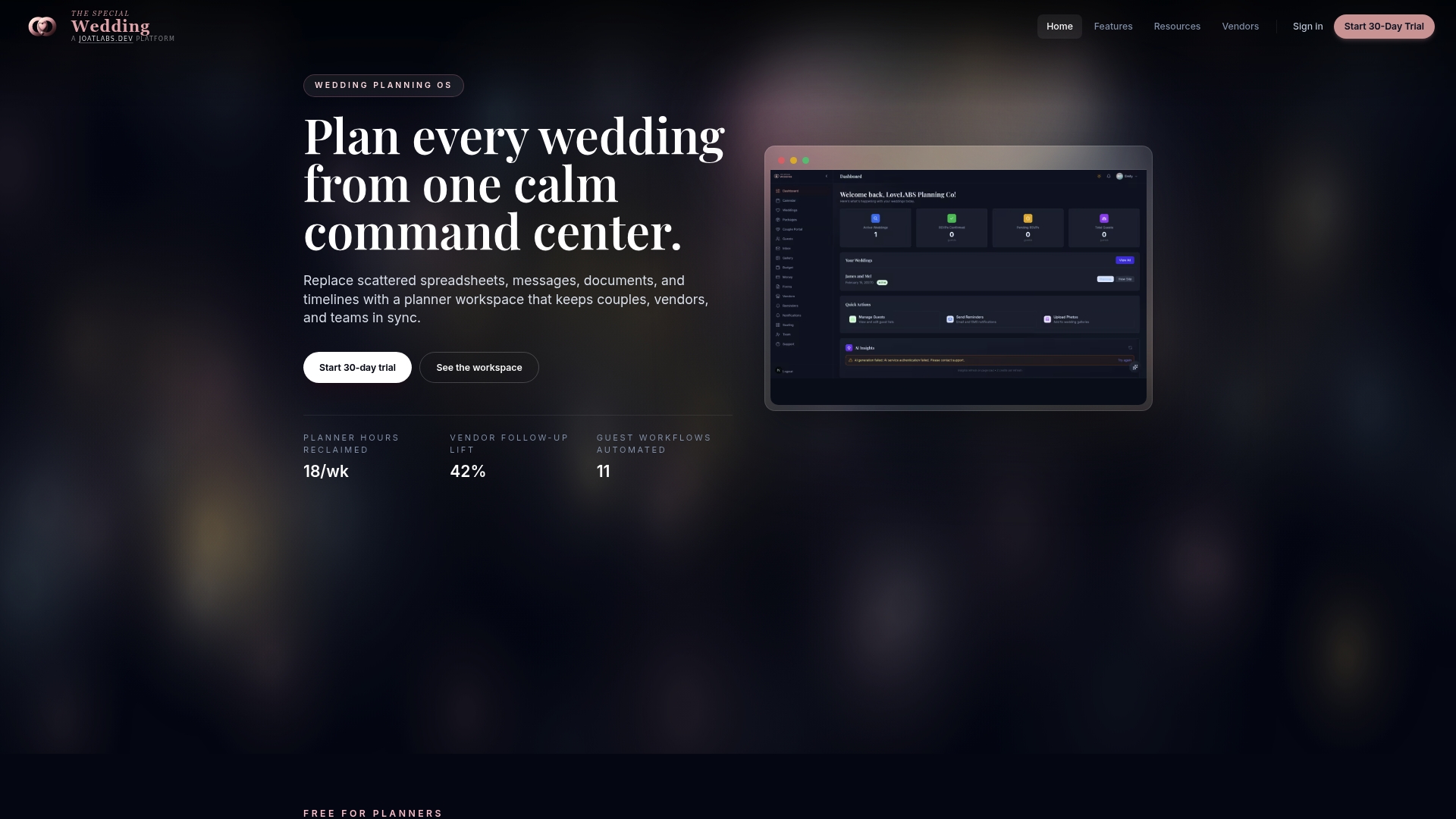
Thespecialwedding is built specifically for professional planners who need to manage multiple events without losing track of any detail. The platform centralizes client intake, vendor communication, timelines, seating, and guest management in one workspace, replacing the scattered tool stack that creates errors and delays. Whether you are a solo planner or running a multi-planner studio, the platform scales to how you actually work.
You can also explore the vendor directory on Thespecialwedding to source and connect with wedding professionals who fit your package offerings. For a closer look at how managed packages work in practice, the Events By Suad profile is a strong example of a planner operating with structured service offerings. And if invoice management is a gap in your current workflow, invoice management practices for planners is worth a read.
FAQ
What is wedding planner service package management?
Wedding planner service package management is the process of organizing, defining, and executing bundled service offerings to deliver the agreed scope with correct staffing, clear inclusions, and documented exclusions. It covers everything from contract terms to day-of execution systems.
What does a wedding planner do within a full-service package?
A full-service wedding planner handles vendor sourcing, budget management, design coordination, timeline creation, and complete day-of execution from engagement through reception, acting as the primary project manager for the entire event.
How do I choose a wedding planner package model for my business?
Match your package model to your capacity and client needs. Full-service suits clients who want complete handoff; partial planning works when clients manage some vendors themselves; day-of coordination fits couples who planned independently but need expert execution on the day.
What should wedding planner pricing options include in a contract?
Every contract should separate your planner fee from pass-through vendor costs, specify payment timelines, define reimbursable expenses, and include a clause for scope expansion if clients request work outside the agreed package.
What are the main benefits of wedding planner services structured around clear packages?
Clear packages set accurate expectations, reduce scope disputes, allow planners to price their labor correctly, and give clients a transparent understanding of what they are receiving. They also make it easier to staff and schedule efficiently across multiple active events.
Recommended
- Wedding planning time management: a pro guide for planners | The Special Wedding Blog
- Wedding planner invoice management examples for pros | The Special Wedding Blog
- Solo Wedding Planner Organization Tips That Work | The Special Wedding Blog
- Wedding coordinator’s role in vendor scheduling | The Special Wedding Blog
Free wedding planner templates
Skip the blank page — these templates ship with the form fields you actually need.
Browse all 9 free templates →