Build Your Wedding Day-of Coordination Timeline
Build Your Wedding Day-of Coordination Timeline

A wedding day-of coordination timeline is a minute-by-minute operations plan that synchronizes every vendor, activity, and transition from the first vendor arrival through the grand exit. Without one, even the most carefully planned wedding unravels fast. A photographer who arrives late, a caterer who needs 30 extra minutes for setup, or a florist who didn’t know the ceremony moved indoors — these are not bad luck. They are scheduling failures. When you build a wedding day-of coordination timeline correctly, you eliminate most of those failures before the day begins. This guide walks you through every component, timing decision, and vendor collaboration step you need.
What goes into a wedding day-of coordination timeline?
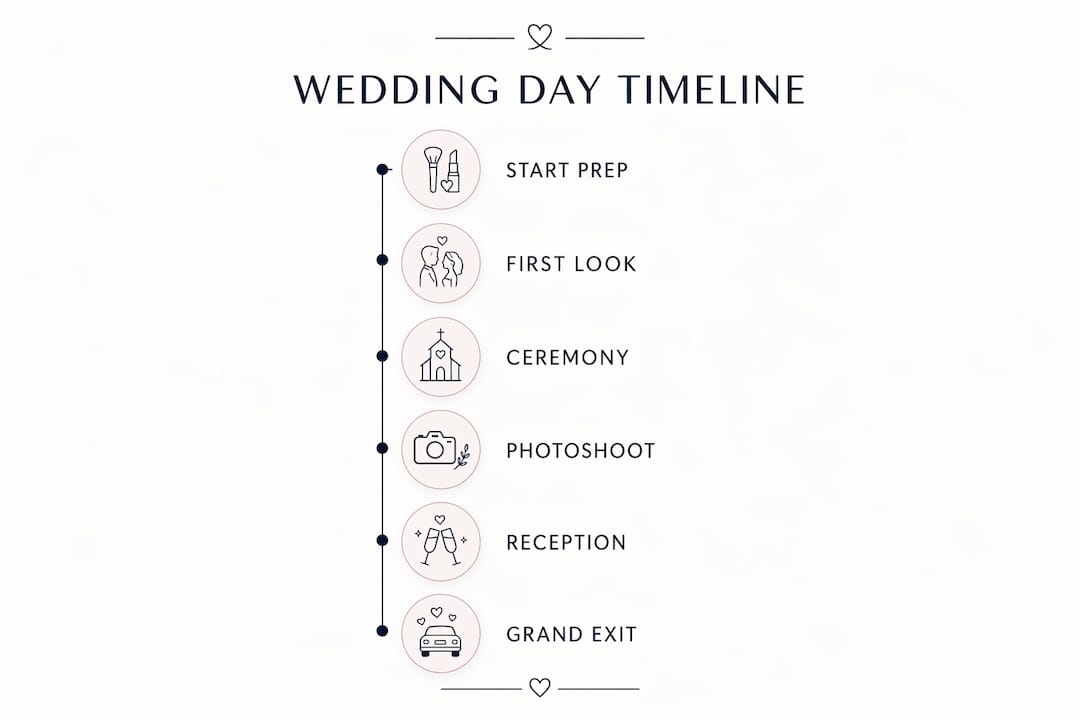
A complete wedding day coordination schedule covers 10 to 14 hours from the first vendor load-in to final cleanup. That span surprises most couples. Here is what belongs in every section of that window.
Vendor and setup logistics:
- Vendor arrival and load-in times for florists, rental companies, and lighting crews
- Venue setup windows for tables, decor, and audio-visual equipment
- Catering setup and kitchen prep start times
Getting ready block:
- Hair and makeup start time, typically 5–6 hours before the ceremony for larger wedding parties
- Dressing time for the couple and wedding party
- First look window if you have one scheduled
Photography windows:
- First look session
- Bridal party portraits
- Family formals (these take longer than most couples expect — budget 30–45 minutes minimum)
- Couple portraits during cocktail hour
Ceremony and reception sequence:
- Ceremony start and end times
- Cocktail hour start and end
- Grand entrance into the reception
- Dinner service start
- Toasts and speeches (confirm order and number with your MC)
- First dance, parent dances
- Cake cutting
- Open dancing
- Grand exit and cleanup window
Pro Tip: Add a 10–15 minute buffer between every major transition. Guests take longer to move than you think, and vendors always need a few extra minutes to reset.
How do you determine the right timing and sequence?
Setting realistic timing is the part most couples get wrong. The process works best when you build outward from one fixed point.
- Lock your ceremony start time first. The ceremony start time is the only unmovable event in the entire day. Every other event is planned to protect it.
- Work backwards for the getting-ready block. If your ceremony starts at 5 PM, hair and makeup typically begins around 10 AM. Confirm the exact start with your stylist based on party size.
- Consult your photographer on portrait timing. Photographer and coordinator input is critical here. Golden hour, venue lighting, and travel between locations all affect how much time you actually need.
- Build forward from the ceremony end. Cocktail hour, dinner service, and reception events flow in sequence. Ask your caterer how long plated service takes versus buffet. A plated dinner for 150 guests typically runs 60–75 minutes.
- Add buffer time at every seam. Weather delays, traffic, and family photo logistics are predictable unpredictables. Build them in rather than hoping they won’t happen.
- Sequence reception events around your priorities. If you want long open dancing, move toasts to before dinner. If you want a relaxed dinner, push the cake cutting later.
- Confirm vendor-specific timing needs. Your DJ needs time to set up and sound-check. Your caterer needs a firm dinner start time to coordinate kitchen output. Ask each vendor directly what they need.
Pro Tip: For a 5 PM ceremony, a sample anchor sequence looks like this: hair starts at 10 AM, first look at 2 PM, ceremony at 5 PM, cocktail hour at 5:30 PM, reception dinner at 7 PM, grand exit at 10 PM.
The total span from that first hair appointment to the grand exit is exactly 12 hours. That sits squarely within the 10 to 14 hour total window that most full-service weddings require.

How should you collaborate with vendors on the timeline?
Vendor and coordinator involvement in timeline creation prevents last-minute surprises and accounts for real logistics that couples simply cannot anticipate alone. Here is how to run that collaboration well.
- Involve your photographer and coordinator first. These two vendors have the most complex timing needs and the most experience spotting scheduling conflicts before they happen.
- Ask every vendor for their timing requirements in writing. How long does your florist need for setup? When does your caterer need access to the kitchen? What time does your band need for soundcheck? Get specific answers, not estimates.
- Use a shared, editable document. A live, shared timeline document lets vendors update details in real time and reduces the coordinator’s workload on the day itself. Google Docs or a dedicated planning platform both work. The key is that everyone sees the same version.
- Start building the timeline 4–8 weeks out. Begin finalizing vendor logistics 4–8 weeks before the wedding. Use that window to collect all vendor timing needs and draft your first complete schedule.
- Send the finalized timeline 7–10 days before the wedding. Confirm and distribute the final schedule about one week out. This gives vendors time to flag any last-minute conflicts without leaving you scrambling the day before.
- Create tailored versions for different recipients. Your photographer needs different detail than your caterer. Your wedding party needs to know when to be dressed and where to stand, not vendor load-in times. Customize what you share.
- Designate your coordinator as the single point of contact on the day. Vendors should direct all timing questions and adjustments to the coordinator, not to you. You should be getting married, not managing logistics. Learn more about coordinator responsibilities and how they protect your schedule.
What tools and templates help you build the timeline?
The right tools make the difference between a timeline that lives in a Google Doc and one that actually gets used on the day. Here is a comparison of the main options.
| Tool Type | Best For | Key Limitation |
|---|---|---|
| Printable PDF template | Quick reference on the day | Cannot be updated in real time |
| Spreadsheet (Google Sheets) | Customizable, shareable with vendors | Requires manual formatting and version control |
| Dedicated planning platform | Full vendor coordination and automation | Requires setup time upfront |
| Word processor document | Simple, familiar format | Easy to lose version history |
Beyond the format, your wedding day schedule guide should include these supporting elements:
- A day-of coordination checklist covering vendor contact numbers, payment due dates, and delivery confirmations
- A separate vendor contact sheet with cell numbers, not just email addresses
- A backup plan note for weather-dependent events like outdoor ceremonies
Start with a template, then customize it. Generic wedding day timeline templates give you the structure. Your job is to fill in the real times, real vendor names, and real venue-specific details. A template for a 2 PM ceremony looks very different from one built around a 5 PM start. For timeline management tips tailored to your specific wedding size and format, Thespecialwedding offers resources built specifically for this process.
What are the most common timeline mistakes to avoid?
Common pitfalls include skipping buffer time, ignoring vendor input, and failing to protect the ceremony start time. Each of these is avoidable with the right habits.
- Underestimating photo windows. Family formals with 10 groupings take 45 minutes minimum. Couples routinely budget 20. Your photographer will tell you exactly how long they need. Listen to them.
- Skipping buffer time entirely. A timeline with zero gaps is a timeline that falls apart by noon. Build in 10–15 minutes between every major block.
- Ignoring vendor input. The timeline must function as a synchronization tool among independent vendors, not a suggestion sheet. If your caterer says they need 90 minutes for setup, that is not a preference. It is a hard constraint.
- Treating the ceremony start time as flexible. It is not. Guests are seated, officiant is ready, and your venue contract likely has a hard start. Everything upstream of the ceremony must absorb any delays, not the ceremony itself.
- Not communicating changes in real time. If hair runs 20 minutes long, your coordinator needs to know immediately so they can shift the portrait schedule, not discover the problem at the altar.
“The best wedding timelines are built with enough structure to keep everyone on track and enough breathing room to handle the unexpected without panic.” — Revel Coordination
On the reception side, keep events flowing by cueing your MC and DJ at least 10 minutes before each transition. A relaxed but timely reception feels effortless to guests. That feeling is the result of a well-built coordination schedule, not luck. For guidance on vendor scheduling coordination, Thespecialwedding covers the coordinator’s specific role in keeping that flow intact.
Key takeaways
A well-built wedding day coordination schedule is the single most effective tool for preventing vendor conflicts, protecting your ceremony start time, and keeping your entire event on track.
| Point | Details |
|---|---|
| Start building 4–8 weeks out | Begin collecting vendor timing needs and drafting your schedule well before the wedding. |
| Ceremony time is the anchor | Every other event is planned around protecting the ceremony start time. |
| Buffer time is non-negotiable | Add 10–15 minutes between every major transition to absorb real-world delays. |
| Share tailored versions with vendors | Customize what each vendor receives so they only see what is relevant to their role. |
| Use a shared, live document | A cloud-based timeline lets vendors update in real time and reduces day-of confusion. |
The timeline is a tool, not a script
Most couples approach the wedding day timeline as a rigid script. That mindset creates more stress, not less. After working through hundreds of wedding coordination schedules, the pattern is clear: the couples who have the smoothest days are the ones who built a detailed timeline and then trusted their coordinator to manage it.
The timeline’s job is to align expectations before the day begins. Once the day starts, your coordinator becomes the conductor. They absorb the small delays, communicate with vendors, and make real-time calls so you never have to. That only works if the timeline was built collaboratively in the first place.
The single biggest mistake I see is couples who build the timeline alone and then hand it to vendors the week of the wedding. By that point, there is no time to fix conflicts. Vendor input needs to happen during the drafting phase, not after. Your photographer knows that the light at your venue is gone by 6:30 PM. Your caterer knows that plated service for 200 guests takes 80 minutes, not 60. That knowledge belongs in your timeline from the start.
Buffer time is the other thing couples consistently underestimate. It feels wasteful on paper. On the day, it is the difference between a relaxed cocktail hour and a frantic one. Build it in everywhere. You will not regret a single minute of it.
Finally, focus on event flow rather than exact minutes. If dinner runs 10 minutes long because guests are enjoying themselves, that is a good problem. The goal is not a perfectly executed schedule. The goal is a day that feels right. A solid timeline makes that possible.
— JOATLABS
Plan your wedding day with the right vendors
Building a great coordination schedule is only half the equation. The vendors you book determine whether that schedule actually holds.
Thespecialwedding features a curated vendor directory covering catering, photography, transportation, rentals, and event decor across the Oklahoma City area. Whether you need a caterer in Edmond who can confirm exact setup windows or transportation in Oklahoma City that fits your timeline to the minute, the platform connects you with professionals who understand coordination schedules. You can also explore the full vendor directory to find florists, lighting specialists, and planning services that work within your specific timeline and budget.
FAQ
What is a wedding day-of coordination timeline?
A wedding day-of coordination timeline is a detailed, hour-by-hour schedule covering all vendor arrivals, preparation blocks, ceremony timing, and reception events. It functions as the operational plan that keeps every vendor and activity synchronized throughout the day.
How long should a wedding day timeline be?
A complete wedding day timeline covers 10 to 14 hours, from the first vendor load-in through the grand exit and cleanup. The exact length depends on your ceremony start time and reception end time.
When should i finalize my wedding day timeline?
Finalize your timeline about a month before the wedding and send the confirmed version to all vendors 7–10 days before the event. This window allows time for last-minute adjustments without creating day-of surprises.
How do i build buffer time into my wedding schedule?
Add 10–15 minutes between every major transition, including after the ceremony, before portraits, and between dinner and dancing. Failing to build in buffers is one of the most common causes of delays on the wedding day.
Who should receive a copy of the wedding day timeline?
Every vendor, your wedding party, and immediate family members should receive a copy. Customize each version so recipients only see the details relevant to their role. Your coordinator should hold the master copy and manage all real-time adjustments.
Recommended
- Wedding coordinator’s role in vendor scheduling | The Special Wedding Blog
- The Role of Event Coordinator in Wedding Planning | The Special Wedding Blog
- How to Share Wedding Event Timeline with Vendors | The Special Wedding Blog
- Wedding Event Seating Coordination Tips That Work | The Special Wedding Blog
Free wedding planner templates
Skip the blank page — these templates ship with the form fields you actually need.
Browse all 9 free templates →