The Role of Event Coordinator in Wedding Planning
The Role of Event Coordinator in Wedding Planning

Most couples assume a wedding coordinator shows up the morning of the ceremony with a clipboard and a walkie-talkie. That picture misses about 80% of what actually happens. The real role of event coordinator in wedding planning starts weeks before the big day and covers everything from contract reviews to vendor communication to rehearsal logistics. Understanding what a coordinator actually does, when they get involved, and how they differ from a wedding planner will change how you approach hiring one and how much value you get from the relationship.
Table of Contents
- Key takeaways
- The role of event coordinator in wedding planning explained
- Core responsibilities from pre-wedding to reception
- How coordinators manage timing, communication, and logistics
- Benefits of hiring a wedding event coordinator
- My honest take on what coordinators actually do
- Find the right coordinator and vendors for your wedding
- FAQ
Key takeaways
| Point | Details |
|---|---|
| Coordinators start early | Most wedding event coordinators get involved 4 to 8 weeks before the wedding, not just on the day itself. |
| Different roles, different scope | Wedding planners design and plan; coordinators execute; venue coordinators only manage the venue. |
| One point of contact | A coordinator takes over all vendor communication in the final weeks, keeping you out of logistical back-and-forth. |
| Documented systems matter | Run-of-show documents and vendor packets are what separate a smooth wedding day from a chaotic one. |
| Couples stay present | With a coordinator handling logistics, you actually get to enjoy your wedding rather than manage it. |
The role of event coordinator in wedding planning explained
The industry uses several overlapping titles, and the confusion between them is real. A wedding planner typically works with you from the start, often 12 to 18 months out, helping select vendors, set a budget, and shape the overall vision. A wedding event coordinator (also called a month-of or day-of coordinator) enters later, focuses entirely on execution, and turns the plans you have made into a working operational system. A venue coordinator is employed by the venue and protects the venue’s interests, not yours.
Knowing the difference matters because these roles are not interchangeable. If you have done your own planning, you do not need a full-service planner. But you almost certainly need a coordinator.
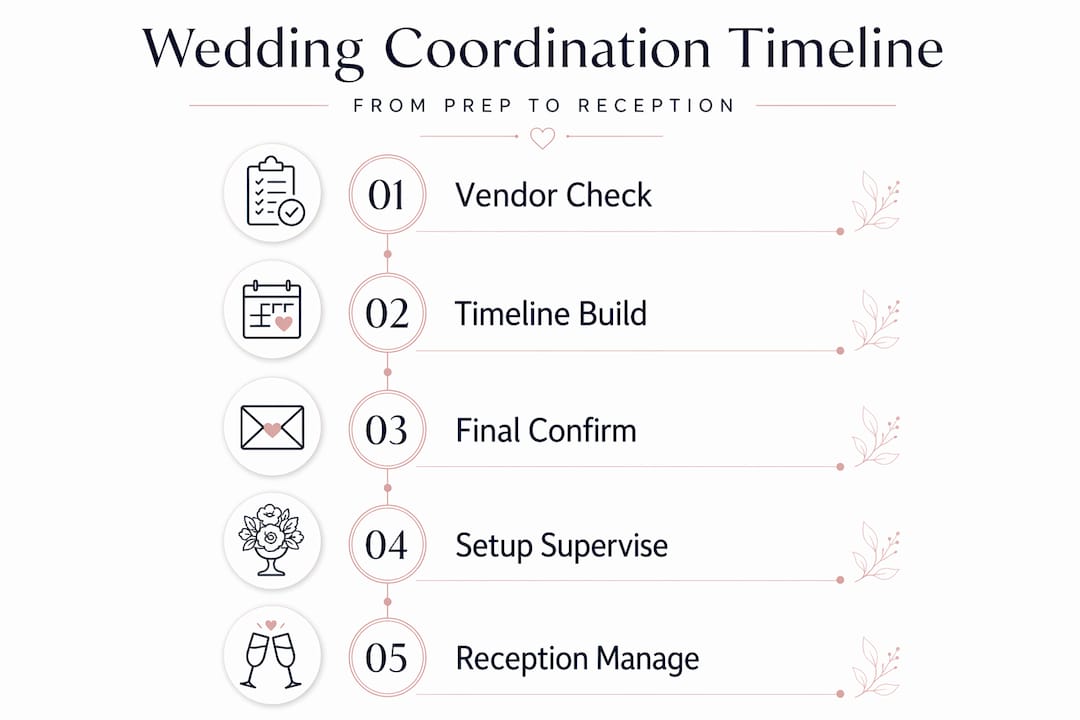
Here is where the typical wedding event coordinator workflow begins taking shape, broken into the types of involvement you should expect:
- Full-service planner: Involved from vision to farewell. Handles vendor sourcing, contract negotiations, design direction, and full logistical oversight.
- Wedding coordinator (month-of or day-of): Steps in 4 to 8 weeks before the wedding. Reviews contracts, creates timelines, takes over vendor communication, and runs the event day.
- Venue coordinator: Manages catering staff, the physical space, and venue-specific logistics. Does not manage your outside vendors or personal timeline.
- Freelance wedding coordinator: Often operates independently with a defined workflow covering client intake, timeline building, and day-of execution across multiple weddings.
Coordinators typically begin their work 4 to 8 weeks before the wedding, which is when the operational complexity peaks. Vendor confirmations, timeline gaps, and logistical conflicts all surface in this window. A good coordinator finds those problems before they become your emergency.
Core responsibilities from pre-wedding to reception
The scope of what a coordinator manages is broader than most couples expect. Here is a clear, step-by-step picture of the work involved:
- Collect all vendor contracts and contact information. The coordinator gathers every signed contract, identifies the lead contact at each vendor, and builds a master contact sheet. Nothing falls through the cracks because everything is in one place.
- Review contracts for timing expectations and responsibilities. This is where issues often surface. A coordinator reads the fine print to understand what each vendor has committed to, what is not covered, and where the couple may have overlooked a detail.
- Draft and refine the master timeline. The timeline and run-of-show documents become the operational spine of the wedding day. The coordinator maps out every cue, from hair and makeup to the final send-off.
- Take over vendor communication. Coordinators meet couples 4 to 6 weeks before the wedding and then become the single point of contact for all vendors, handling confirmations, changes, and last-minute requests directly.
- Manage the rehearsal. The coordinator runs the ceremony rehearsal, cues the wedding party through the processional order, and answers every question so that the actual ceremony is not the first time anyone knows where to stand.
- Oversee vendor arrivals and setup on the wedding day. The coordinator is on-site before guests arrive, directing vendors to the right locations, confirming setup matches the agreed plan, and solving problems before anyone else notices them.
- Run the ceremony and reception timeline. They cue the music, direct the processional, signal speakers, and keep the reception moving from cocktail hour through the last dance.
- Handle unexpected issues discreetly. When the florist is late, a boutonniere is missing, or a vendor has a question, the coordinator handles it. You never hear about most problems because a good coordinator resolves them before they reach you.
Pro Tip: Ask potential coordinators specifically how they handle vendor communication in the final two weeks. Their answer will tell you whether they are truly operational professionals or someone who shows up on the day with a printed schedule.
How coordinators manage timing, communication, and logistics
The most underrated part of a coordinator’s job is the system they build before the wedding day arrives. Improvisation on a wedding day is a sign of poor preparation. Great execution is the product of documented, distributed, agreed-upon plans.
Here is how the communication and timing workflow breaks down in practice:
Successful wedding coordination depends on a single source of truth, one document or hub that contains every relevant piece of information. Vendors should never have to call the couple to ask where to park or what time setup begins. That question goes to the coordinator, and the answer is already in the packet.
The run-of-show document takes this further by assigning named responsibilities for every event cue. Someone is designated as the “show caller” for key moments: when doors open, when the processional starts, when the couple enters the reception. Cue-based operational documents eliminate the gray areas that cause hesitation and confusion during live events.
| Without a coordinator | With a coordinator |
|---|---|
| Couple fields vendor questions on the wedding morning | Coordinator handles all vendor contact as single point of contact |
| Timeline exists as a rough estimate | Cue-based run of show with assigned responsibilities for each moment |
| Problems surface publicly and cause stress | Issues resolved behind the scenes before guests notice |
| Family members drafted to manage logistics | Coordinator owns operational execution from setup to send-off |
| Vendor conflicts discovered the day of | Contract review 4 to 8 weeks out identifies conflicts in advance |
Pro Tip: When reviewing a coordinator’s materials, ask to see a sample run-of-show document. If it only lists times and activities without named responsibilities, it is a schedule, not an operational plan.
The coordinator also becomes the main vendor point person in the final month, managing arrival times, setup sequences, payment logistics, and any last-minute substitutions. This protects you from the kind of back-and-forth that makes the weeks before a wedding feel exhausting.

Benefits of hiring a wedding event coordinator
The practical case for hiring a coordinator goes beyond “you will be less stressed,” though that part is very real. Here is what changes when a qualified coordinator is part of your team:
- You stop being the logistics manager. Coordinators alleviate stress by managing minute details like table arrangements, vendor emails, and real-time problem-solving so you are never pulled into operational decisions on your wedding day.
- Your family actually enjoys the event. Without a coordinator, the duty of managing logistics often falls to a parent, sibling, or maid of honor. A coordinator frees your entire inner circle to celebrate with you.
- Vendor management is professional. Coordinators know how to talk to vendors, what questions to ask, and how to hold them accountable to their contracts. Most couples do not have that experience, and vendors know it.
- Problems get solved before you know they exist. The coordinator’s job on the wedding day is to own the operational outcome, running the timeline, directing vendors, and handling unexpected issues discreetly so the couple stays present.
- The timeline actually runs. Receptions without coordinators routinely run 20 to 40 minutes behind. A coordinator with a tight cue sheet and the authority to redirect vendors and guests keeps events on schedule.
- You get to be a guest at your own wedding. Hiring a coordinator allows couples to turn off wedding planning mode and fully enjoy the day without mentally tracking timing and vendor details themselves.
The cost of a wedding coordinator varies by market and scope, but it consistently ranks as one of the most impactful uses of a wedding budget. The photographer captures the moments. The coordinator creates the conditions for those moments to happen.
My honest take on what coordinators actually do
I’ve worked alongside enough wedding professionals to say this plainly: the couples who skip the coordinator are almost always the ones who spend part of their wedding day managing logistics. Not because they wanted to. Because someone had to.
What I’ve found most surprising is how much of a coordinator’s value is invisible. You do not see the three vendor emails they sent at 7 a.m. You do not know about the florist who showed up 20 minutes late or the catering captain who needed a new timeline version an hour before guests arrived. You just experience a wedding that felt effortless. That feeling is manufactured, deliberately, by a professional who prepared for every contingency.
The couples who get the most from a coordinator are the ones who hire them with enough lead time to actually do the job. Many couples wrongly assume a day-of coordinator only appears on the day itself, but effective coordinators need 4 to 8 weeks of runway to reconcile contracts, build timelines, and identify gaps. Hiring someone two weeks out is setting them up to improvise, which is exactly what you are paying them not to do.
When you interview coordinators, ask about their vendor coordination approach and specifically how they handle communication in the final two weeks. Ask to see a sample timeline. The answers will tell you whether you are talking to someone who shows up with a checklist or someone who has already thought through your day more carefully than you have.
— JOATLABS
Find the right coordinator and vendors for your wedding

Knowing what a wedding coordinator does is one thing. Finding one who actually delivers is another. Thespecialwedding makes that search easier by connecting couples with vetted professionals in one place. The vendor directory features coordinators alongside the vendors they work most closely with, including rental companies like O-City Rentals, decorators like 405 Event Rental, and venues like V2 Events at Vast. Browsing by category lets you see the full team your coordinator will be working with, which makes evaluation much more straightforward. You also get an event staffing perspective from resources like this NY and NJ wedding staffing guide that shows how coordinators and vendors collaborate in practice.
FAQ
What is the difference between a wedding planner and a coordinator?
A wedding planner works with you from early in the planning process, handling vendor sourcing, budget management, and design direction. A wedding event coordinator steps in during the final weeks to execute the plan you have already built.
When does a wedding coordinator start working on your wedding?
Wedding coordinators typically begin 4 to 6 weeks before the wedding, collecting vendor contracts, building timelines, and taking over vendor communication during that preparatory period.
Do you need a coordinator if the venue has one?
Yes. A venue coordinator manages the venue’s staff and space, not your outside vendors or personal timeline. They work for the venue, not for you, so their priorities differ significantly from yours.
What does a wedding coordinator do on the wedding day?
They direct vendor arrivals, run the ceremony and reception timeline, cue music and speakers, handle unexpected issues discreetly, and serve as the single point of contact for all vendors so the couple can stay fully present.
How do you hire a wedding coordinator?
Start by asking for sample timelines and run-of-show documents during interviews. Confirm they plan to take over vendor communication at least four weeks out, and check references from couples whose weddings they have coordinated recently.
Recommended
- Wedding coordinator’s role in vendor scheduling | The Special Wedding Blog
- The Role of Wedding Planner Email Templates | The Special Wedding Blog
- Wedding Event Seating Coordination Tips That Work | The Special Wedding Blog
- Wedding planner workspace explained: boost multi-event ops | The Special Wedding Blog
Free wedding planner templates
Skip the blank page — these templates ship with the form fields you actually need.
Browse all 9 free templates →