Wedding Agency Team Management: A 2026 Guide
Wedding Agency Team Management: A 2026 Guide

Wedding agency team management is the structured coordination of roles, communication, and workflows within a planning agency to deliver consistent, high-quality events at scale. The industry term for this practice is event operations management, though most agency owners simply call it the system that keeps everything from falling apart. Without it, even talented planners lose time to duplicated work, missed vendor follow-ups, and unclear accountability. Platforms like Thespecialwedding, tools like HoneyBook, and systems like Aisle Planner each address parts of this problem. The agencies that grow without burning out are the ones that treat team management as a core business function, not an afterthought.
What is wedding agency team management?
Wedding agency team management is the deliberate organization of people, processes, and technology to coordinate event delivery across multiple clients and staff members. It covers everything from defining who owns each task to deciding which software unifies your communications, timelines, and billing. Agencies running 15 or more events per year cannot rely on informal coordination. The complexity multiplies too fast.
The practice sits at the intersection of human resources, project management, and client services. A well-managed agency team produces a standardized client experience regardless of which planner is assigned to a wedding. That consistency is what builds reputation and referrals. Agencies using centralized AI-driven systems reduce administrative burden by 5–10 hours weekly. That time compounds into real capacity for growth.
What are the core roles in a wedding planning team?
Clear wedding planning team roles are the foundation of effective collaboration. When every person knows their scope, micromanagement drops and execution speed increases.
The five roles that appear consistently in well-structured agencies are:
- Wedding Planner (Lead): Owns the client relationship, manages the overall event vision, and makes final decisions on design and logistics.
- Lead Coordinator: Executes the planner’s vision on the ground, manages the event day timeline, and serves as the primary point of contact for vendors during setup.
- Vendor Manager: Handles all vendor outreach, contract review, and follow-up communications to keep external partners on schedule.
- Budget Specialist: Tracks expenditures against the client’s budget, flags overruns early, and prepares financial summaries for client reviews.
- On-site Team Captain: Relieves the lead planner from managing minor day-of issues, delegating wedding day roles so the lead can focus on the client experience.
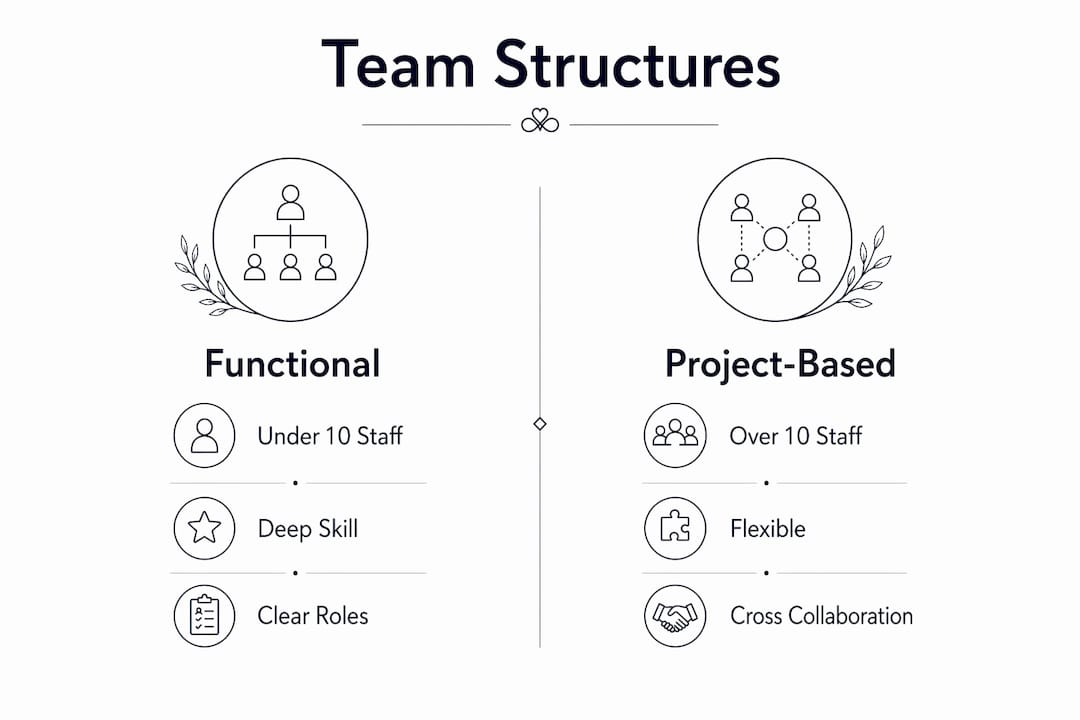
Agencies choose between two organizational structures. A functional structure groups staff by skill (all coordinators report to one manager), which works well for agencies under 10 staff. A divisional structure assigns small teams to specific event types or client tiers, which scales better once you manage 20 or more concurrent events. The right choice depends on your volume, not your preference.
| Structure | Best For | Key Benefit | Main Risk |
|---|---|---|---|
| Functional | Agencies under 10 staff | Deep skill specialization | Bottlenecks at the manager level |
| Divisional | Agencies with 20+ events | Faster client response | Duplicated resources across divisions |

Role clarity also reduces the most common friction point in growing agencies: two people doing the same task while a third task goes undone. Document who owns each deliverable before you hire, not after.
How do centralized systems improve team collaboration?
The choice between point solutions and a unified operating system is the most consequential technology decision a growing agency makes. Point solutions like HoneyBook, Aisle Planner, and Planning Pod each solve specific problems well. The issue is that teams with 4+ planners require centralized systems to avoid operational risks. Disjointed tools create data silos, and data silos create errors at the worst possible moments.
A centralized AI operating system automatically syncs communications, timelines, budgets, and vendor coordination in one workspace. Every team member sees the same data in real time. A coordinator updating a vendor arrival time in the system reflects immediately on the lead planner’s dashboard. That visibility eliminates the “I didn’t know that changed” conversation that derails event-day execution.
The financial impact is documented. Centralized management systems cut monthly financial report compilation from 5 days to 1.5 days and boost operational efficiency by up to 250%. For an agency managing multiple locations or a high volume of events, that is not a marginal improvement. It is a structural change in how the business operates.
Pro Tip: If your team spends more than 30 minutes per week reconciling information between two different tools, that is a signal to evaluate a unified platform. The hidden cost is not the subscription fee. It is the coordination time you are paying for in staff hours.
The wedding planning dashboard benefits of centralized visibility go beyond efficiency. They give agency managers a real-time view of every active event, every pending vendor payment, and every client communication. That visibility is what allows you to manage a team of six without being in every conversation.
How do you build processes that scale without burnout?
Sustainable growth in a wedding agency requires documented standard operating procedures before you add staff. This is the most common mistake growing agencies make. Hiring before documenting SOPs creates a situation where every new hire requires constant supervision, turning what should be a capacity increase into a management burden.
SOPs do not need to be long. They need to be specific. A vendor inquiry procedure that takes 20 minutes to document will save 2 hours of back-and-forth every time a new coordinator handles it. Emergency wedding-day protocols written down once prevent panicked calls to the lead planner during the ceremony.
The practices that protect team culture during peak season include:
- Public recognition: Acknowledge wins in team meetings or a shared channel. Non-billable recognition improves staff retention and reduces turnover during high-pressure periods.
- Structured feedback loops: Monthly one-on-ones where staff can flag process problems before they become client problems.
- Clear communication norms: Define which issues go to Slack, which go to email, and which require a call. Ambiguity here creates after-hours stress.
- Protected recovery time: Schedule buffer days after high-volume weekends. Burnout in wedding agencies is almost always a scheduling failure, not a motivation failure.
System maturity is more important than headcount when addressing agency bottlenecks. An agency with five planners and no documented processes will underperform an agency with three planners and a well-built operating system. Hire into a system, not instead of one.
Pro Tip: Before onboarding your next hire, run a 30-day SOP sprint. Document every recurring task your current team performs. You will find at least three processes that only one person knows how to do. That is your single-point-of-failure list.
What is wedding agency billing management?
Wedding agency billing management is the coordinated handling of contracts, payment tracking, and vendor financial communications across the agency team. It is not a solo function. In a properly structured agency, billing responsibilities are distributed across roles to prevent errors and delays.
The five core components of an effective billing workflow are:
- Contract oversight: The Budget Specialist or a designated admin reviews all client and vendor contracts for payment terms, deposit schedules, and cancellation clauses before signing.
- Payment tracking: A shared system logs every invoice issued, every deposit received, and every outstanding balance. Manual spreadsheets fail here because they are not updated in real time.
- Vendor payment coordination: The Vendor Manager confirms payment release dates with vendors and flags any disputes to the Budget Specialist before they escalate.
- Client billing communications: The Lead Planner or a dedicated client services role handles all payment reminders and balance-due notifications to maintain the client relationship.
- Financial reporting: Monthly summaries of revenue, outstanding receivables, and vendor costs are compiled from the centralized system. Integrated systems facilitate shorter billing cycles and enhance financial report accuracy.
The metrics that matter most for billing health are: invoice-to-payment cycle time, percentage of payments received on schedule, and vendor payment accuracy rate. Agencies that track these three numbers monthly catch cash flow problems before they affect operations. The multi-event workspace approach to billing keeps all financial data tied to the specific event, so nothing falls through the cracks when you are running five weddings in a single month.
Key takeaways
Effective wedding agency team management requires role clarity, documented processes, and centralized technology working together as a single operating system.
| Point | Details |
|---|---|
| Define roles before hiring | Document each position’s scope and reporting line to prevent overlap and micromanagement. |
| Choose the right system for team size | Teams with 4+ planners need a centralized platform, not a collection of point solutions. |
| Document SOPs before scaling | Write procedures for every recurring task before adding staff to avoid supervision overload. |
| Distribute billing responsibilities | Assign contract, payment, and reporting functions to specific roles for accuracy and accountability. |
| Invest in team culture | Public recognition and structured feedback reduce turnover during peak wedding season. |
The part nobody talks about when your agency starts to grow
I have watched agencies double their staff and somehow get slower. More people, more confusion, more dropped tasks. The reason is almost always the same: the owner hired to solve a problem that only a system could fix.
The transition from solo planner to team leader is not a staffing challenge. It is a documentation challenge. When you are the only one who knows how to handle a vendor dispute or build a run-of-show, you have not built a team. You have built a dependency. Every new hire inherits that dependency and adds their own.
What actually works is building the system first, then hiring into it. That means writing down the process before you need someone else to follow it. It means choosing a platform that gives every team member the same view of every event, not just the parts relevant to their role. And it means treating team culture as a business asset, not a soft benefit. The agencies that retain good coordinators through three consecutive peak seasons are not paying the most. They are managing the best.
The uncomfortable truth is that most agency owners are better planners than they are managers. That gap is closeable. But it closes through systems and deliberate practice, not through hiring someone and hoping they figure it out.
— JOATLABS
Build a stronger agency team with Thespecialwedding
Managing a growing wedding agency team gets significantly easier when your tools match your ambition. Thespecialwedding is built specifically for agencies that are done jumping between spreadsheets, email threads, and disconnected apps.
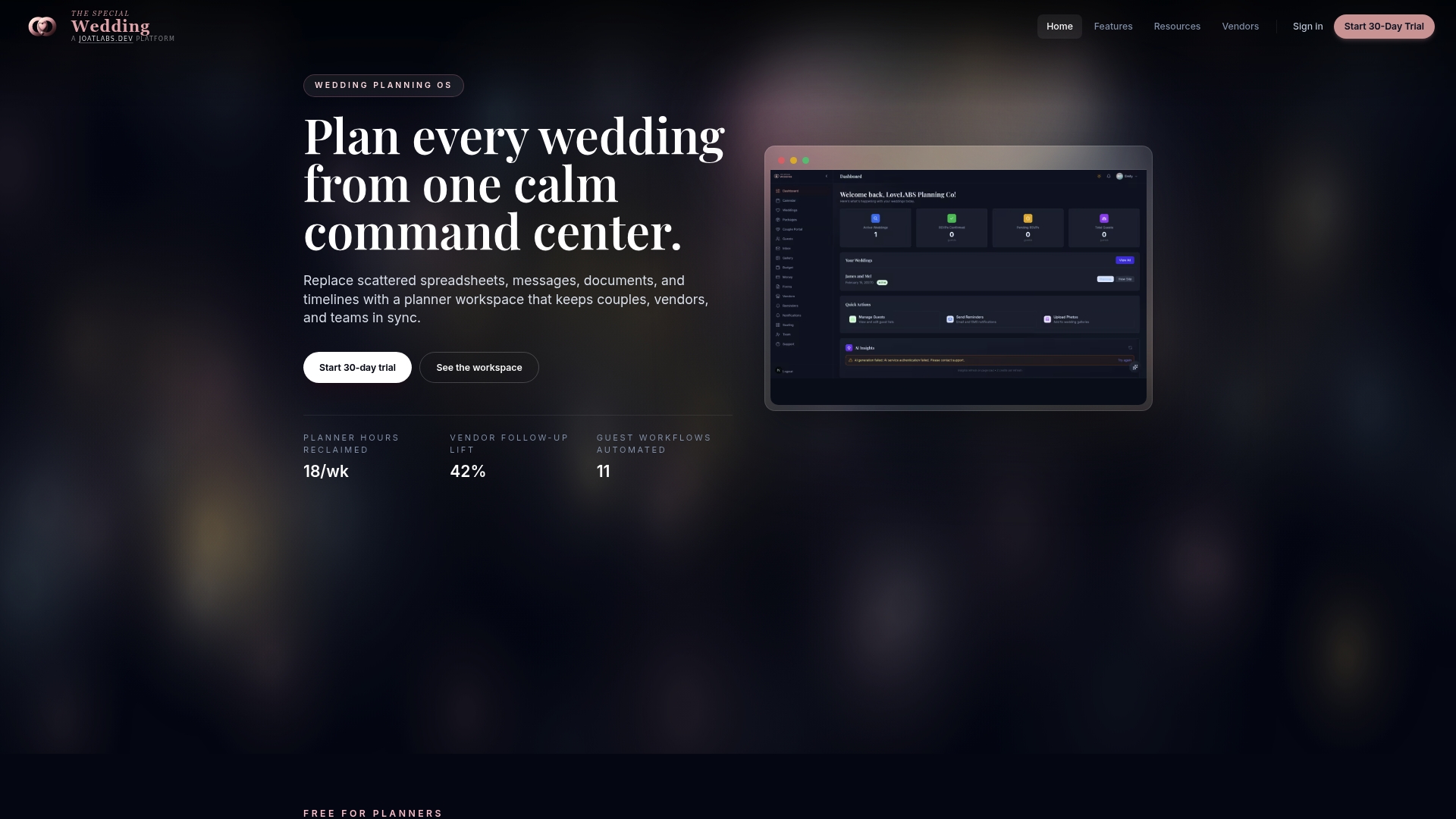
The platform gives your entire team a shared workspace for client intake, vendor coordination, event timelines, and billing, all in one place. You can explore trusted vendors in Oklahoma City to support your event sourcing, or connect with specialists like Events By Suad for local planning expertise. If you are ready to replace scattered tools with a system your whole team can actually use, Thespecialwedding’s planner platform is where to start.
FAQ
What is wedding agency team management?
Wedding agency team management is the organized coordination of staff roles, communication workflows, and operational processes within a wedding planning agency to deliver consistent event outcomes. It combines role clarity, documented procedures, and centralized technology to reduce errors and support growth.
How many planners before you need a centralized system?
Teams with four or more planners require a centralized management platform to avoid data silos and quality inconsistencies. Point solutions like HoneyBook or Aisle Planner work well for smaller operations but introduce coordination risks at scale.
What are the key wedding planning team roles?
The five core roles are Lead Planner, Lead Coordinator, Vendor Manager, Budget Specialist, and On-site Team Captain. Each role has a defined scope that prevents overlap and allows the agency to run multiple events simultaneously without micromanagement.
How does billing management work in a wedding agency?
Wedding agency billing management distributes contract oversight, payment tracking, vendor communications, and financial reporting across specific team roles. Integrated systems reduce monthly report preparation from several days to under two days and improve payment accuracy across the agency.
What is the biggest mistake growing wedding agencies make?
The most common mistake is hiring staff before documenting standard operating procedures. New hires without clear processes require constant supervision, which increases management overhead instead of reducing it.
Recommended
- Wedding Lead Management for Planners: 2026 Guide | The Special Wedding Blog
- Wedding planning time management: a pro guide for planners | The Special Wedding Blog
- Solo Wedding Planner Organization Tips That Work | The Special Wedding Blog
- Types of Wedding Event Management Systems in 2026 | The Special Wedding Blog
Free wedding planner templates
Skip the blank page — these templates ship with the form fields you actually need.
Browse all 9 free templates →